Precision Profiling: A Strategic Framework for Optimizing Biomarker Panels Across MAFLD Phenotypes
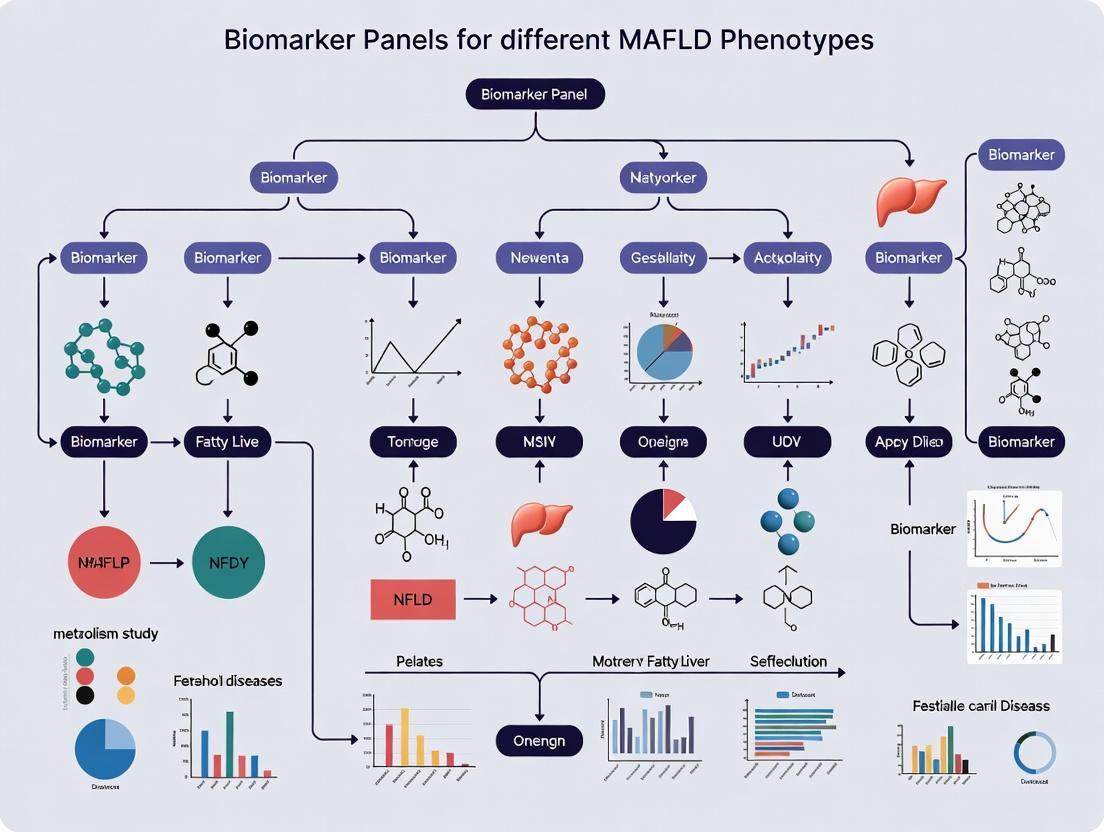
Metabolic dysfunction-associated fatty liver disease (MAFLD) encompasses a heterogeneous spectrum from simple steatosis to metabolic steatohepatitis (MASH) and fibrosis, demanding precise diagnostic and prognostic tools.
Precision Profiling: A Strategic Framework for Optimizing Biomarker Panels Across MAFLD Phenotypes
Abstract
Metabolic dysfunction-associated fatty liver disease (MAFLD) encompasses a heterogeneous spectrum from simple steatosis to metabolic steatohepatitis (MASH) and fibrosis, demanding precise diagnostic and prognostic tools. This article provides a comprehensive framework for researchers and drug developers on optimizing biomarker panels tailored to distinct MAFLD phenotypes. We explore the foundational pathophysiological drivers behind phenotype-specific biomarker discovery, detail advanced methodological approaches for panel assembly and validation, address common challenges in optimization, and critically evaluate emerging panels against gold-standard histology. The synthesis offers a strategic roadmap for developing clinically actionable, non-invasive tools to improve patient stratification, therapeutic monitoring, and clinical trial enrichment in the MAFLD landscape.
Decoding MAFLD Heterogeneity: The Pathophysiological Basis for Phenotype-Specific Biomarker Discovery
Troubleshooting Guides & FAQs
Q1: Our qPCR data for PNPLA3 expression in patient liver biopsies shows high variability between technical replicates. What are the most likely causes and solutions?
A: High variability often stems from RNA integrity or reverse transcription inconsistency.
- Primary Cause: Degraded RNA from suboptimal biopsy preservation.
- Troubleshooting Protocol:
- Check RNA Integrity Number (RIN): Use a bioanalyzer. Proceed only if RIN > 7.
- Standardize Reverse Transcription: Use a high-efficiency kit (e.g., SuperScript IV) with a fixed input of 1 µg RNA.
- Include Controls: Use a synthetic RNA spike-in (e.g., ercc) to monitor RT efficiency.
- Re-optimize qPCR: Perform a fresh primer efficiency curve (accept 90-110%) and use a probe-based assay.
Q2: During multiplex immunofluorescence for macrophage markers (CD68, CD163) in fibrotic MASH samples, we encounter high autofluorescence, obscuring signal. How to mitigate?
A: Liver fibrosis increases autofluorescence, primarily from lipofuscin and collagen.
- Solution Workflow:
- Quenching: Treat slides with 0.1% Sudan Black B in 70% ethanol for 20 min post-antibody staining.
- Spectrum Unmixing: Use a spectral imaging system. Acquire a pure autofluorescence signal from an unstained section and subtract it computationally.
- Alternative Dyes: Choose fluorophores in the far-red spectrum (e.g., CF640R, Alexa Fluor 750) where autofluorescence is lower.
Q3: Our LC-MS-based serum metabolomics data fails to distinguish simple steatosis from early MASH. How can we improve phenotyping accuracy?
A: This indicates inadequate coverage of key pathogenic pathways or normalization issues.
- Optimization Checklist:
- Pre-analytical Variables: Standardize patient fasting (>8h) and sample processing (serum separation within 30 min, snap freeze).
- Broad Coverage: Use a combined HILIC (hydrophilic) and C18 (hydrophobic) chromatography method.
- Internal Standards: Spike in a diverse suite of isotope-labeled standards prior to extraction.
- Data Normalization: Use probabilistic quotient normalization (PQN) followed by log-transformation.
Q4: When isolating primary hepatic stellate cells (HSCs) from MAFLD model mice for in vitro fibrogenesis studies, yield is low. What are critical steps for success?
A: Low HSC yield is common. Focus on digestion and gradient centrifugation.
- Detailed Protocol Adjustment:
- Perfusion: Perform a two-step ex vivo liver perfusion with EGTA solution followed by a collagenase IV/protease mix.
- Density Gradient: Use a discontinuous gradient of OptiPrep (e.g., 11.5% and 17%). Centrifuge at 1,400 x g for 25 min with slow acceleration and no brake.
- Collection: HSCs band at the interface. Wash twice in cold buffer.
- Viability/Purity: Check by autofluorescence (Vitamin A droplets) and α-SMA staining after 48-72h in culture.
Table 1: Representative Biomarker Levels Across the MAFLD Phenotype Spectrum
| Phenotype | Histological Hallmark | Serum Biomarker (Example) | Typical Range/Change vs. Healthy | Assay Platform |
|---|---|---|---|---|
| Simple Steatosis | Macrovesicular steatosis (≥5%) | ALT | 1.5-2.5x ULN | Clinical Chemistry |
| CK-18 M30 (Apoptosis) | ~250 U/L | ELISA | ||
| MASH (Non-fibrotic) | Steatosis + Lobular Inflammation + Ballooning | CK-18 M30/M65 | >350 U/L | ELISA |
| PNPLA3 rs738409 (G allele) | Odds Ratio: ~2.8 | Genotyping (qPCR) | ||
| Fibrotic MASH (F2-F4) | MASH + Progressive Fibrosis | PRO-C3 (Type III collagen formation) | >15 ng/mL | ELISA |
| ELF Score (HA, TIMP-1, PIIINP) | >9.8 | Immunoassay | ||
| Advanced Fibrosis/Cirrhosis (F4) | Bridging Fibrosis / Cirrhosis | Enhanced Liver Fibrosis (ELF) Score | >11.3 | Immunoassay |
| VWF-Ag | >250% | CLIA |
Essential Experimental Protocols
Protocol 1: Liver Histology Scoring for MAFLD Phenotyping (Based on NASH CRN System)
- Tissue Fixation: Fix liver biopsy in 10% neutral buffered formalin for 24-48h.
- Processing & Staining: Paraffin-embed, section at 4µm. Stain with H&E, Masson's Trichrome, and Picrosirius Red.
- Scoring: A blinded pathologist scores:
- Steatosis Grade (0-3): % of hepatocytes involved.
- Lobular Inflammation (0-3): Foci per 200x field.
- Hepatocyte Ballooning (0-2).
- Fibrosis Stage (0-4): 0=None, 1=Perisinusoidal, 3=Bridging, 4=Cirrhosis.
- Phenotype Assignment:
- Simple Steatosis: Steatosis ≥5%, no ballooning, no significant inflammation.
- MASH: Steatosis + Inflammation + Ballooning.
- Fibrotic MASH: MASH + Fibrosis Stage ≥1.
Protocol 2: Serum PRO-C3 ELISA for Fibrogenesis Measurement
- Sample Prep: Thaw serum samples on ice. Centrifuge at 10,000 x g for 10 min at 4°C.
- Assay: Use a validated competitive ELISA kit (e.g., Nordic Bioscience).
- Procedure: Follow manufacturer's instructions. Incubate 100 µL of 1:2 diluted serum with biotinylated antibody and peptide-conjugated plates overnight at 4°C.
- Detection: Add streptavidin-HRP, develop with TMB. Stop with 0.2 M H₂SO₄. Read absorbance at 450 nm (ref 650 nm).
- Calculation: Calculate PRO-C3 concentration from a 4-parameter logistic standard curve.
Visualizations
Diagram: MAFLD Phenotype Progression Pathway
Diagram: Multi-Omics Biomarker Panel Integration
The Scientist's Toolkit: Research Reagent Solutions
Table 2: Essential Reagents for MAFLD Phenotype Research
| Reagent / Material | Primary Function | Example / Application Note |
|---|---|---|
| Collagenase IV | Liver digestion for primary cell isolation (hepatocytes, HSCs). | Use with protease for murine HSC isolation. Activity lot-testing is critical. |
| OptiPrep Density Gradient Medium | Isolation of specific liver cell populations via density centrifugation. | Used for purifying hepatic stellate cells (HSCs) from non-parenchymal cell fraction. |
| PRO-C3 ELISA Kit | Quantifies type III collagen formation, a direct marker of active fibrogenesis. | Key for stratifying fibrotic MASH. Nordic Bioscience assay is well-validated. |
| M30/M65 Apoptosis ELISA Kits | Distinguish caspase-cleaved (M30) and total (M65) keratin-18 fragments. | M30/M65 ratio helps differentiate simple steatosis from MASH. |
| Picrosirius Red Stain Kit | Specific histological staining for collagen fibrils (fibrosis). | Visualizes under polarized light for enhanced birefringence. |
| Sudan Black B | Chemical quenching of tissue autofluorescence in immunofluorescence. | Vital for imaging in fibrotic/cirrhotic liver sections. |
| RNAlater Stabilization Solution | Preserves RNA integrity in tissue biopsies prior to extraction. | Crucial for ensuring accurate transcriptomic data from patient samples. |
| Stable Isotope-Labeled Internal Standards | Normalization and quantification in mass spectrometry-based metabolomics. | e.g., for bile acids, amino acids, lipids. Spike in early for absolute quantitation. |
Technical Support Center & Troubleshooting Guides
Q1: During RNA sequencing of liver tissue from different MAFLD phenotypes, we observe high variability in inflammatory gene signatures (e.g., TNF-α, IL-1β, IL-6) between technical replicates. What are the primary sources of this variability and how can we mitigate them?
A: High variability in inflammatory gene expression often stems from:
- Sample Homogeneity: Inflammatory foci are unevenly distributed. Solution: Ensure macro-dissection of consistent anatomical regions (e.g., left lobe) and consider laser capture microdissection (LCM) of specific zones.
- RNA Integrity: Inflammatory samples often have higher RNase activity. Solution: Use RNA stabilizers immediately upon collection and verify RIN > 7.0 via Bioanalyzer.
- cDNA Synthesis Bias: High GC-rich regions in promoter areas of inflammatory genes. Solution: Use a cDNA synthesis kit with high-fidelity, thermostable reverse transcriptase and include GC-rich buffers.
- Experimental Protocol: Standardized LCM and RNA extraction protocol provided below.
Q2: When quantifying hepatic ballooning in H&E-stained sections for phenotype stratification, inter-observer discordance is high. Are there robust digital pathology or AI-assisted quantification methods?
A: Yes. Traditional histology scoring (e.g., SAF score) is subjective. Implement the following:
- Whole-Slide Imaging (WSI): Scan slides at 20x magnification.
- AI-Assisted Tool: Use pre-trained convolutional neural networks (CNNs) like Hepatic Ballooning Net (HB-Net) or train your own using platforms like QuPath or HALO with manually annotated datasets. Key features for algorithms include hepatocyte diameter (>30µm), rarefied cytoplasm, and distorted cellular outlines.
- Validation: Correlate AI scores with serum cytokeratin-18 (CK-18) M30 fragment levels (see Table 1).
Q3: Our measurements of in vivo metabolic flux (using isotopic tracers like 2H-glucose) do not align with ex vivo findings from isolated hepatocytes. Which driver is most likely compromised during cell isolation?
A: This discrepancy typically points to the loss of the physiological metabolic microenvironment. Key compromised drivers:
- Loss of Paracrine/Endocrine Signaling: Isolated hepatocytes lack Kupffer cell-derived inflammatory signals (e.g., IL-6) and adipokine cues.
- Substrate Delivery: In vivo flux depends on dynamic portal vein gradients absent in static culture.
- Protocol Adjustment: Use a precision-cut liver slice (PCLS) model to preserve the 3D architecture and non-parenchymal cell interactions. See experimental protocol below.
Q4: When assessing fibrosis progression via collagen proportionate area (CPA) or qPCR of fibrogenic genes (COL1A1, ACTA2), how do we decouple active fibrosis from stable scarring?
A: This requires a multi-modal approach differentiating active fibrosis (driver: activated hepatic stellate cells (aHSCs)) from established matrix.
- Molecular: Measure PRO-C3 (neo-epitope of type III collagen formation) in serum or media. It's a marker of active fibrillogenesis.
- Histology: Pair picrosirius red (PSR) staining with α-SMA IHC to localize aHSCs adjacent to collagen deposits.
- Functional: Use the SCIN-BCA assay to quantify newly synthesized, pepsin-soluble collagen vs. cross-linked, insoluble collagen.
FAQs on Biomarker Panel Optimization
Q: What is the minimum biomarker panel to distinguish steatotic, metabolic-dysregulation-dominant, and inflammatory-dominant MAFLD phenotypes?
A: A core panel should quantify drivers from distinct pathways. See Table 1.
Table 1: Core Biomarker Panel for MAFLD Phenotype Stratification
| Pathophysiological Driver | Serum/Circulating Biomarker | Tissue-Based Biomarker | Key Differentiator |
|---|---|---|---|
| Metabolic Dysregulation | HOMA-IR, Free Fatty Acids (FFA), Adiponectin | p-ACC / p-AMPK (IHC), Intrahepatic TG assay | Insulin resistance severity |
| Inflammation | hs-CRP, CK-18 (M30 fragment), IL-6 | CD68+ staining (IHC), TNF-α mRNA | Inflammatory activity vs. metabolic stress |
| Ballooning | CK-18 (M30/M65 ratio) | AI-quantified ballooned cells, K19 positivity | Hepatocyte injury and pre-cirrhotic change |
| Fibrosis | PRO-C3, FIB-4, ELF score | PSR-CPA, α-SMA area (IHC) | Active fibrogenesis vs. stable scar |
Q: Which in vitro model best recapitulates the interplay of all four key drivers for drug screening?
A: Primary human hepatic spheroids co-cultured with Kupffer cells and stellate cells in a metabolic milieu (high glucose, insulin, FFA). No monoculture system suffices. See "The Scientist's Toolkit" below for key reagents.
Q: How should we prioritize targets when a compound shows efficacy in metabolic dysregulation but exacerbation in inflammation in preclinical models?
A: This indicates a pathway disconnect. Prioritize based on clinical stage:
- Early Disease (Steatosis): Prioritize metabolic correction. Monitor IL-1β and NLRP3 inflammasome markers closely.
- Advanced NASH (with inflammation/fibrosis): An anti-inflammatory exacerbation is a red flag. Use a transcriptomic array to identify compensatory pro-inflammatory pathways (e.g., JNK/NF-κB) before proceeding.
Experimental Protocols
Protocol 1: Laser Capture Microdissection (LCM) of Inflammatory Foci for RNA-Seq
- Tissue Prep: Snap-freeze liver wedge in OCT. Cut 8µm cryosections onto PEN membrane slides. Rapid H&E stain (1 min each).
- Microdissection: Use ArcturusXT LCM system. Outline inflammatory foci (clusters of CD68+ cells) and adjacent "clean" parenchyma as control.
- RNA Extraction: Use Arcturus PicoPure RNA Isolation Kit with on-column DNase treatment.
- Amplification: Use NuGEN Ovation RNA-Seq System V2 for low-input amplification (2ng starting RNA).
- QC: Validate with a targeted qPCR panel (e.g., TNF, IL6, ACTB) before whole-transcriptome sequencing.
Protocol 2: Precision-Cut Liver Slices (PCLS) for Metabolic Flux Studies
- Slice Generation: Flush liver in situ with ice-cold, oxygenated UW solution. Core tissue with 8mm biopsy punch. Cut 250µm slices with a vibratome in oxygenated Krebs-Henseleit buffer.
- Culture: Maintain slices on rocking platforms at 37°C, 95% O2/5% CO2 in William's E medium + 5% FBS, 1% Pen/Strep.
- Metabolic Challenge: Supplement with a physiologically relevant "MAFLD cocktail": 0.5mM palmitate, 25mM glucose, 10^-7 M insulin for 48h.
- Flux Assay: Transfer to medium with U-13C-glucose or 2H-palmitate. Sample media and slices at 0, 2, 4, 8h for LC-MS analysis of labeled metabolites (lactate, TCA intermediates, newly synthesized lipids).
Protocol 3: SCIN-BCA Assay for Soluble vs. Cross-linked Collagen
- Homogenization: Homogenize ~50mg liver tissue in 0.5M acetic acid with pepsin (100µg/mL). Incubate with shaking at 4°C for 24h.
- Fractionation: Centrifuge at 15,000g for 1h. Supernatant = pepsin-soluble collagen (new, less cross-linked). Pellet = insoluble (mature, cross-linked).
- Hydrolysis & Neutralization: Hydrolyze both fractions in 6M HCl at 110°C for 18h. Neutralize with NaOH.
- Quantification: Use a standardized BCA assay against a collagen standard curve (e.g., from rat tail collagen I). Express as µg collagen per mg wet liver weight.
Pathway & Workflow Diagrams
Title: Core Drivers of MAFLD Pathogenesis & Interactions
Title: Workflow for Biomarker Panel Discovery from Human Tissue
The Scientist's Toolkit: Research Reagent Solutions
| Reagent/Material | Supplier Examples | Critical Function in MAFLD Research |
|---|---|---|
| Human MAFLD Serum Panels | BioIVT, SeraCare, Discovery Life Sciences | Provides validated, phenotype-stratified human serum for biomarker assay development and validation. |
| PRO-C3 ELISA | Nordic Bioscience (C3M), Tebubio (PRO-C3) | Specific measurement of type III collagen formation, a key marker of active fibrogenesis. |
| CK-18 M30/M65 ELISA | PEVIVA (VLVbio), Meso Scale Discovery | Differentiates apoptotic (M30) from total (M65) epithelial cell death, quantifying ballooning-related injury. |
| Palmitate-BSA Conjugate | Sigma-Aldrich, Cayman Chemical | Essential for creating physiologically relevant lipotoxicity models in cell culture (hepatocytes, spheroids). |
| Seahorse XF Palmitate-BSA FAO Substrate | Agilent Technologies | Measures real-time fatty acid oxidation flux in live cells, key for assessing metabolic dysregulation. |
| Human HSC/Kupffer Cell Co-culture Kit | ScienCell, Lonza | Enables construction of advanced in vitro models containing key fibrogenic and inflammatory effectors. |
| LunaScript RT SuperMix Kit | NEB | Robust, high-efficiency cDNA synthesis for low-input RNA from biopsies or LCM samples. |
| QuPath Open-Source Software | GitHub (QuPath) | Digital pathology platform for AI-based quantification of histological features (steatosis, ballooning, inflammation). |
Technical Support Center: Troubleshooting NITs and Biomarker Panels for MAFLD Phenotyping Research
FAQs & Troubleshooting Guides
Q1: In our cohort, the FIB-4 and NFS scores are discordant for a significant number of patients. Which result should we prioritize for phenotype stratification, and how should we resolve this? A: Discordance between NITs is common. Follow this validated diagnostic algorithm:
- Calculate both scores. Use the pre-defined cut-offs:
- FIB-4: <1.3 (low risk), 1.3-2.67 (indeterminate), >2.67 (high risk).
- NFS: <-1.455 (low risk), -1.455 to 0.676 (indeterminate), >0.676 (high risk).
- Apply sequential rule: For initial staging, prioritize FIB-4 due to its higher specificity for advanced fibrosis.
- Resolution Path:
- If both tests agree on "low risk," rule out advanced fibrosis.
- If both agree on "high risk," refer for specialist assessment (consider biopsy).
- If results are discordant or in the "indeterminate" range, you must proceed to a second-line NIT (e.g., Vibration-Controlled Transient Elastography, ELF test) as per guidelines. Do not rely on biopsy alone for all indeterminate cases.
Q2: We are developing a novel serum biomarker panel. How do we validate it against the "gold standard" liver biopsy when biopsy itself has sampling error? A: This is a key methodological challenge.
- Protocol for Robust Validation:
- Biopsy Standardization: Ensure your biopsy comparator meets quality standards: length ≥20mm, ≥11 complete portal tracts. Document this for each sample.
- Blinded Assessment: Histopathology scoring (e.g., SAF score, NASH CRN) must be performed by at least two expert hepatopathologists, blinded to the biomarker data. Use consensus scoring for discordant readings.
- Account for Error: In your statistical analysis (ROC curves, sensitivity/specificity), calculate confidence intervals that reflect biopsy's imperfect accuracy. Consider using Latent Class Analysis as a statistical method that does not assume a perfect gold standard.
- Comparison to Established NITs: Directly compare your panel's performance to FIB-4, NFS, and ELF in the same cohort.
Q3: Our ELISA-based biomarker assays show high inter-plate variability when analyzing adipocytokines (e.g., adiponectin, leptin). How can we improve reproducibility? A: This is critical for panel reliability.
- Troubleshooting Protocol:
- Sample Handling: Ensure immediate serum/plasma separation, aliquot, and freeze at -80°C. Avoid repeated freeze-thaw cycles (>2 cycles degrades analytes).
- Plate Design: Include a standard curve and validated quality control (QC) samples (high, medium, low) on every plate. Randomize patient samples across plates to avoid batch effect.
- Normalization: If variability persists, spike samples with a known, non-human protein prior to the assay and use its recovery for normalization.
- Reagent Preparation: Prepare a single, large master mix of all reagents for the entire study batch to minimize pipetting error.
Q4: What is the optimal workflow to integrate histopathology data from liver biopsy with multi-omics data (proteomics, metabolomics) for phenotype discovery? A: Use a structured, step-wise integration workflow.
Workflow: Integrating Histopathology with Multi-Omics Data
The Scientist's Toolkit: Research Reagent Solutions for MAFLD Biomarker Studies
| Item | Function & Rationale |
|---|---|
| Human Fibrosis Panel (Luminex/ELISA) | Quantifies key markers (TIMP-1, PIIINP, HA, CK-18) for direct correlation with histological fibrosis and apoptosis. |
| Adipokine Panel (Multiplex Assay) | Simultaneously measures adiponectin, leptin, resistin to assess metabolic dysfunction severity across phenotypes. |
| Pro-C3 ELISA | Specifically detects neo-epitope of type III collagen formation, a direct marker of active fibrogenesis. |
| Stable Isotope-Labeled Internal Standards (for LC-MS Metabolomics) | Enables absolute quantification of bile acids, fatty acids, and acyl-carnitines, critical for robust panel discovery. |
| Automated Nucleic Acid Extractor & RT-qPCR Kits | For validating gene expression signatures (e.g., ASGR1, SPP1) from biopsy RNA in parallel with serum biomarkers. |
| Liquid Handling Robot | Essential for high-throughput, reproducible processing of serum/plasma samples in large-scale cohort studies. |
Comparative Performance of Common NITs for Advanced Fibrosis (≥F2) Detection
| Test | Components / Principle | Cut-off Ranges | Advantages | Key Limitations in Research |
|---|---|---|---|---|
| FIB-4 | Age, ALT, AST, Platelets | <1.3 (Low)1.3-2.67 (Indeterminate)>2.67 (High) | Easy, inexpensive, high specificity. | Low sensitivity in elderly; poor in mild disease. |
| NFS | Age, BMI, IFG/DM, AST, ALT, Alb, Platelets | <-1.455 (Low)-1.455-0.676 (Indeterminate)>0.676 (High) | Incorporates metabolic factors. | High indeterminate rate; BMI influence. |
| VCTE (FibroScan) | Liver Stiffness Measurement (LSM) in kPa | <8.0 (F0-F1)8.0-12.5 (Indeterminate)>12.5 (F3-F4) | Direct physical measure, point-of-care. | Failure in obesity; confounded by inflammation. |
| ELF Test | HA, TIMP-1, PIIINP | <7.7 (Low Risk)7.7-9.8 (Indeterminate)>9.8 (High Risk) | Direct extracellular matrix markers. | Cost; less validated in early disease stages. |
| MRE | Magnetic Resonance Elastography | ≥3.6 kPa for ≥F2 | Most accurate NIT, whole-liver view. | Very high cost, limited availability, not point-of-care. |
Diagnostic Landscape: MAFLD Phenotypes, Biopsy, and NITs
Technical Support Center: Troubleshooting Guides & FAQs
This technical support center addresses common experimental challenges encountered when integrating emerging biomarker categories for MAFLD phenotyping. The guidance is framed within the thesis objective of optimizing multi-modal biomarker panels for precise MAFLD stratification.
FAQs & Troubleshooting
Q1: In our Luminex assay for circulating proteins (e.g., CK-18, FGF21), we observe high background signal and poor standard curve reproducibility. What are the primary causes and solutions? A: This is often due to matrix interference or improper bead handling.
- Cause: Residual plasma/serum lipids or heterophilic antibodies causing nonspecific binding.
- Solution:
- Sample Dilution & Pre-treatment: Increase sample dilution in calibrator diluent. For severe interference, pre-treat samples with a lipid removal agent or use a heterophilic blocking tube.
- Bead Handling: Vortex bead stock sonicate for 60 seconds before use. During washing, ensure plates are on a magnetic separator for ≥60 seconds before decanting.
- Validation: Always spike a known concentration of analyte into your sample matrix to calculate recovery (target: 80-120%).
Q2: Our qRT-PCR results for circulating miRNAs (e.g., miR-122, miR-34a) show inconsistent Cq values between technical replicates. How can we improve precision? A: Inconsistency typically stems from inefficient or variable miRNA isolation or cDNA synthesis.
- Cause: Co-precipitation of PCR inhibitors or suboptimal reverse transcription efficiency.
- Solution:
- Isolation Protocol: Use phenol-guanidine-based lysis followed by silica-membrane purification specifically designed for small RNAs. Include a DNase digest step. Elute in nuclease-free water, not TE buffer.
- Spike-in Control: Use a synthetic non-human miRNA (e.g., cel-miR-39) spiked into the lysis buffer to monitor isolation efficiency and normalize for technical variation.
- Reverse Transcription: Use a stem-loop primer for cDNA synthesis, which offers greater specificity for the short miRNA sequence than linear primers.
Q3: During lipidomic profiling by LC-MS, we see significant ion suppression and poor chromatographic separation of phospholipid species. What steps should we take? A: This indicates issues with sample preparation or LC gradient optimization.
- Cause: Incomplete protein precipitation leaving phospholipids that suppress ionization, or a suboptimal mobile phase gradient.
- Solution:
- Sample Prep: Use a biphasic liquid-liquid extraction (e.g., methyl-tert-butyl ether/methanol/water). This effectively removes proteins and separates lipid classes.
- LC Optimization: For hydrophilic interaction liquid chromatography (HILIC), ensure mobile phases are fresh (ammonium acetate in water/acetonitrile). Use a longer, shallower gradient to separate lipid classes by polarity.
- Internal Standards: Use a cocktail of deuterated lipid internal standards (e.g., PC(15:0/18:1-d7), Cer(d18:1/15:0)) added at the beginning of extraction to correct for ion suppression.
Q4: Our bisulfite sequencing data for epigenetic signatures (e.g., PNPLA3 methylation) shows low conversion efficiency. How do we troubleshoot this? A: Low conversion efficiency (<95%) invalidates methylation quantification.
- Cause: Degraded DNA, old bisulfite reagent, or incomplete denaturation.
- Solution:
- DNA Quality: Use high-integrity DNA (A260/A280 ~1.8, A260/A230 >2.0). Avoid repeated freeze-thaw cycles.
- Bisulfite Freshness: Prepare fresh sodium bisulfite solution (pH 5.0) or use a commercial kit with proven stability. Include fully unmethylated and methylated control DNA.
- Thermal Cycler Conditions: Ensure the denaturation step is precisely at 95°C. Use a long incubation period (e.g., 16 hours at 50°C) for complete conversion.
Experimental Protocols
Protocol 1: Multiplexed Circulating Protein Assay for MAFLD Method: Proximity Extension Assay (PEA) Detailed Workflow:
- Sample Prep: Dilute 5 µL of EDTA-plasma 1:2 in incubation buffer. Centrifuge at 10,000 x g for 10 minutes to remove debris.
- Incubation: Mix 3 µL of clarified sample with 3 µL of a panel of oligonucleotide-labeled antibody pairs (e.g., targeting FGF21, Adiponectin, IL-1RA) in a 96-well PCR plate.
- Proximity Binding & Extension: Incubate 60 minutes at 37°C. If two antibodies bind their target, their DNA tails are brought into proximity.
- Extension & Pre-amplification: Add PCR reagents. The hybridized oligonucleotides are extended by a DNA polymerase, creating a unique dsDNA barcode for each protein. Perform 17 cycles of pre-amplification.
- Quantification: Quantify barcodes by high-throughput qPCR or sequencing. Data is reported as Normalized Protein Expression (NPX) on a log2 scale.
Protocol 2: Serum miRNA Extraction & qRT-PCR Method: Phenol-Chloroform Extraction followed by TaqMan-based qRT-PCR Detailed Workflow:
- Lysis: Combine 200 µL serum with 750 µL Qiazol lysis reagent. Add 5 µL of 1 nM synthetic cel-miR-39 spike-in.
- Extraction: Add 200 µL chloroform, vortex, centrifuge. Transfer aqueous phase to a new tube.
- Precipitation: Add 1.5 volumes 100% ethanol. Load onto silica column, wash, and elute in 30 µL nuclease-free water.
- Reverse Transcription: Use the TaqMan MicroRNA Reverse Transcription Kit with specific stem-loop RT primers per miRNA. Reaction: 16°C for 30 min, 42°C for 30 min, 85°C for 5 min.
- qPCR: Perform triplicate 10 µL reactions using TaqMan Universal Master Mix II and specific miRNA assay. Cycle: 95°C for 10 min, followed by 40 cycles of 95°C for 15 sec and 60°C for 60 sec.
- Analysis: Calculate ΔCq relative to spiked-in cel-miR-39. Use the 2^(-ΔΔCq) method for relative quantification.
Data Presentation Tables
Table 1: Performance Comparison of Biomarker Assay Platforms
| Biomarker Category | Example Target(s) | Common Platform(s) | Key Metric | Typical Value for MAFLD | Advantage |
|---|---|---|---|---|---|
| Circulating Proteins | CK-18 M30, FGF21 | ELISA, Multiplex Immunoassay (Luminex, PEA) | Sensitivity | CK-18: >246 U/L (NASH) | High clinical translatability |
| miRNAs | miR-122, miR-34a | qRT-PCR, miRNA-Seq | Fold-Change | miR-122: 2-5x increase in steatosis | High stability in circulation |
| Lipidomics | DAGs, TGs, PCs | LC-MS/MS, GC-MS | Concentration (nmol/mL) | TG(16:0/18:1/18:1): ↑ in fibrosis | Direct mechanistic insight |
| Genetic/Epigenetic | PNPLA3 SNP, PPARγ methylation | qPCR, Pyrosequencing, NGS | Methylation % or Odds Ratio | PNPLA3 rs738409: OR ~3.0 for NASH | Provides disease mechanism |
Table 2: Reagent Solutions for Integrated Biomarker Panel Workflow
| Research Reagent / Kit | Vendor Examples | Primary Function in MAFLD Biomarker Research |
|---|---|---|
| Human XL Cytokine Luminex Discovery Assay | R&D Systems, Bio-Rad | Multiplex quantitation of 50+ inflammatory adipokines & chemokines linked to MAFLD progression. |
| miRNeasy Serum/Plasma Advanced Kit | Qiagen | Efficient isolation of high-quality total RNA, including miRNAs <200 nt, with carrier RNA to boost yield. |
| Lipid Extraction Kit (MTBE-based) | Avanti Polar Lipids, Cayman Chemical | Standardized biphasic extraction for comprehensive recovery of neutral and polar lipids for LC-MS. |
| EpiTect Fast DNA Bisulfite Kit | Qiagen | Rapid, high-conversion bisulfite treatment of DNA for subsequent methylation-specific PCR or sequencing. |
| TaqMan SNP Genotyping Assay | Thermo Fisher | Accurate allelic discrimination of key variants (e.g., PNPLA3 rs738409) using hydrolysis probes. |
| Multiplex PEA Panel (e.g., Cardiometabolic) | Olink Proteomics | Simultaneous, highly specific measurement of 92 circulating proteins from a minimal sample volume (1 µL). |
Visualizations
Diagram Title: Workflow for MAFLD Biomarker Panel Optimization
Diagram Title: Biomarker Interplay in MAFLD Pathogenesis
Linking Biomarker Candidates to Specific Disease Mechanisms and Clinical Outcomes
Technical Support Center
FAQs and Troubleshooting Guide
Q1: Our qPCR data for the PNPLA3 rs738409 SNP shows inconsistent genotyping calls between replicates. What could be the cause? A: This is often due to poor DNA quality or suboptimal primer/probe design. Ensure DNA is free of heparin or ethanol contamination. Verify that your TaqMan assay (e.g., Assay ID: C724110) is designed for the specific SNP and check for nearby variants that might interfere. Use a positive control with a known genotype (commercially available) in each run.
Q2: When performing ELISA for plasma CK-18 (M30/M65) fragments, we observe high background signal and poor standard curve linearity. A: High background typically indicates inadequate plate washing or non-specific binding. Increase wash cycles to 5-6 and include a blocking step with 1% BSA in PBS for 1 hour. For poor linearity, ensure the standard is reconstituted correctly and serial dilutions are performed in the same matrix as your sample (e.g., 10% BSA/PBS). Check antibody cross-reactivity with full-length CK-18.
Q3: Our LC-MS/MS quantification of bile acids shows significant peak tailing and low signal for conjugated species. How can we optimize the method? A: Peak tailing suggests issues with the LC column or mobile phase pH. Use a dedicated C18 column (e.g., 2.1 x 100mm, 1.8µm) for acidic compounds. For conjugated bile acids, optimize the electrospray ionization in negative mode. A mobile phase of 0.1% formic acid in water (A) and acetonitrile (B) often improves peak shape. See Protocol 1 below.
Q4: In multiplex cytokine profiling (Luminex) from MAFLD patient serum, many analytes are below detection. Should we concentrate the sample? A: Sample concentration can increase non-specific binding. First, verify the sample dilution factor recommended by the kit manufacturer (often 1:2 or 1:4). If sensitivity remains an issue, switch to a more sensitive platform (e.g., Single Molecule Array - Simoa) for key cytokines like IL-1β or TNF-α. Also, ensure samples are not repeatedly freeze-thawed (>3 cycles).
Q5: RNA sequencing from liver biopsies reveals high ribosomal RNA contamination despite ribosomal depletion. What steps can we take? A: This indicates inefficient ribosomal RNA (rRNA) removal. For human/mouse samples, use a probe-based depletion kit (e.g., RiboGold). Optimize the input RNA integrity (RNA Integrity Number, RIN >7) and strictly follow the recommended RNA:bead ratio. Include a Bioanalyzer check post-depletion to confirm rRNA reduction before library construction.
Experimental Protocols
Protocol 1: LC-MS/MS for Serum Bile Acid Profiling
- Sample Prep: Aliquot 50 µL of serum. Add 150 µL of ice-cold methanol containing internal standards (e.g., d4-GCA, d4-CDCA).
- Protein Precipitation: Vortex for 10 min, then centrifuge at 14,000 x g for 15 min at 4°C.
- Supernatant Transfer: Transfer 150 µL of supernatant to an LC-MS vial. Evaporate to dryness under nitrogen stream at 40°C.
- Reconstitution: Reconstitute the dry residue in 100 µL of 50% methanol/water.
- LC Conditions:
- Column: C18 (2.1 x 100 mm, 1.8 µm).
- Mobile Phase A: 0.1% Formic Acid in H₂O.
- Mobile Phase B: 0.1% Formic Acid in Acetonitrile.
- Gradient: 20% B to 95% B over 12 min, hold 2 min, re-equilibrate.
- Flow Rate: 0.3 mL/min.
- MS Conditions:
- Ionization: ESI-Negative.
- Scan Type: Multiple Reaction Monitoring (MRM).
Protocol 2: Isolation and Stimulation of Primary Human Hepatic Stellate Cells (HSCs) for Biomarker Secretion Studies
- HSC Isolation: Perform a two-step collagenase perfusion (Liberase TM, 0.5 mg/mL) on non-diseased human liver tissue.
- Density Gradient Centrifugation: Layer the cell suspension on a dual-density (8.2% and 15.6%) Nycodenz gradient. Centrifuge at 1,400 x g for 20 min.
- Collection: Collect the HSC-enriched band at the interface. Culture in DMEM with 10% FBS, 1% penicillin/streptomycin on uncoated plastic.
- Activation & Stimulation: Allow spontaneous activation to myofibroblasts over 7-10 days. Seed activated HSCs in 96-well plates (20,000 cells/well).
- Treatment: Stimulate with TGF-β1 (10 ng/mL) or PDGF-BB (20 ng/mL) in serum-free medium for 48 hours.
- Supernatant Collection: Collect supernatant, centrifuge to remove debris, and store at -80°C for downstream ELISA (e.g., TIMP-1, COL1A1, MCP-1).
Data Tables
Table 1: Association of Key Biomarker Candidates with MAFLD Phenotypes and Clinical Outcomes
| Biomarker Candidate | Associated Mechanism (Pathway) | Correlation with Histology (NAFLD Activity Score) | Link to Clinical Outcome (Progression to MASH/Fibrosis) | Typical Assay |
|---|---|---|---|---|
| CK-18 (M30) | Hepatocyte Apoptosis (Caspase-3) | r = 0.65-0.72 | HR: 1.92 for advanced fibrosis | ELISA |
| PNPLA3 (rs738409-G) | Lipid Droplet Remodeling, Lipotoxicity | Stronger in GG genotype | OR: 3.26 for HCC development | qPCR/TaqMan Genotyping |
| HSD17B13 (rs6834314-A) | Retinol Metabolism, Lipogenesis | Protective effect; lower inflammation | OR: 0.65 for MASH progression | qPCR/TaqMan Genotyping |
| BILE ACIDS (Total) | FXR Signaling, Gut-Liver Axis | Elevated in advanced fibrosis (p<0.01) | Predictive of NASH resolution post-intervention | LC-MS/MS |
| TIMP-1 | Extracellular Matrix Remodeling (Fibrogenesis) | r = 0.78 with fibrosis stage | AUC: 0.84 for ≥F2 fibrosis | Multiplex Immunoassay |
Table 2: Performance Metrics of Multiplex Panels for MAFLD Phenotyping
| Panel Name (Commercial/Research) | Analytes Measured | Sample Volume (µL) | Dynamic Range (pg/mL) | Time to Result | Reported AUC for MASH Diagnosis |
|---|---|---|---|---|---|
| MACK-3 (BioPredictive) | ALT, AST, CK-18 (M30) | 100 (Serum) | CK-18: 50-2000 | 5-6 hours | 0.80 - 0.83 |
| OLINK Proteomics (Fibrosis) | 92 proteins (e.g., MMP-7, VEGFA) | 1 (Plasma) | 3-4 logs (attomolar) | 2-3 days | 0.89 (for F3/F4) |
| Luminex Discovery Assay | Custom up to 48-plex (Cytokines) | 25-50 (Serum) | 3-4 logs | Overnight | Varies by custom panel |
Visualizations
Title: MAFLD Pathways and Linked Biomarker Origins
Title: Biomarker Discovery to Validation Pipeline
The Scientist's Toolkit: Research Reagent Solutions
| Item | Function in MAFLD Biomarker Research |
|---|---|
| Liberase TM Research Grade | Enzyme blend for gentle and efficient primary human hepatocyte and HSC isolation from liver tissue. |
| Meso Scale Discovery (MSD) U-PLEX Assays | Electrochemiluminescence platform for multiplexing 10+ biomarkers (e.g., adipokines, cytokines) from low sample volumes. |
| OLINK Target 96 or Explore Panels | Proximity extension assay technology for highly specific, multiplex quantification of 92-3072 proteins in 1 µL plasma/serum. |
| Mass Spectrometry Grade Solvents (e.g., Optima LC/MS) | Ultra-pure solvents for LC-MS/MS to minimize background noise and ion suppression during metabolomic/bile acid profiling. |
| RiboGone rRNA Depletion Kit (Mammalian) | Efficient removal of ribosomal RNA from total RNA samples prior to RNA-seq, improving sequencing depth of mRNA transcripts. |
| Recombinant Human TGF-β1 & PDGF-BB | Key cytokines for in vitro stimulation of hepatic stellate cells to model fibrogenic activation and secretome analysis. |
| TaqMan SNP Genotyping Assays | Pre-optimized, sequence-specific probes for accurate and high-throughput genotyping of key MAFLD risk alleles (e.g., PNPLA3). |
| Human CK-18 (M30) ELISA Kit | Specific sandwich ELISA for the caspase-cleaved fragment of CK-18, a gold-standard apoptosis marker for MAFLD. |
Building Precision Panels: Methodologies for Assembling and Validating Phenotype-Driven Biomarker Assays
Cohort Selection and Phenotype Stratification Strategies for Discovery Studies
Troubleshooting Guides and FAQs
Q1: During cohort selection for MAFLD biomarker discovery, we encounter a high rate of sample exclusion due to ambiguous phenotype classification. What is the most robust strategy to minimize this? A1: Implement a tiered phenotyping algorithm. Primary classification should use histology (biopsy) as the gold standard for a core subset. For the larger cohort, use a composite clinical algorithm (e.g., MAFLD criteria plus FibroScan-AST (FAST) score > 0.67 for progressive MAFLD). This balances precision with scalability. Regularly audit classification against new clinical data.
Q2: Our multi-omics data shows poor correlation with clinical outcomes after stratification. Are we using the wrong stratification variables? A2: Likely, you are stratifying by single, static variables (e.g., NAS score alone). MAFLD phenotypes are dynamic. Stratify using integrative clusters that combine:
- Metabolic Drivers: HOMA-IR, presence of Type 2 Diabetes.
- Injury Pattern: MRE or FibroScan for fibrosis stage, cytokeratin-18 for apoptosis.
- Inflammatory Status: CRP, specific adipokine profiles. Re-cluster after a dietary intervention phase to identify consistent molecular signatures.
Q3: How do we handle confounding from common medications (e.g., GLP-1 agonists, SGLT2 inhibitors, statins) in cohort selection? A3: Do not simply exclude these patients, as it reduces real-world relevance. Instead, create a "medication-aware" stratification layer. Document dose and duration. Use propensity score matching to create balanced sub-cohorts for discovery, and include medication history as a covariate in all multivariate models.
Q4: We have identified a potential serum biomarker panel. What is the key validation step before proceeding to costly targeted assays? A4: Perform phenotype-stratified performance validation. Test the panel's diagnostic accuracy separately within each predefined phenotype stratum (e.g., MAFLD with T2D vs. lean MAFLD). A robust biomarker should perform consistently across major phenotypes or show predictable, quantifiable variation.
Experimental Protocols
Protocol 1: Three-Tiered Cohort Selection for MAFLD Biomarker Discovery
Objective: To assemble a discovery cohort with clearly defined and richly annotated MAFLD phenotypes.
- Initial Screening: Identify potential participants from electronic health records using ICD codes for NAFLD/MAFLD, obesity, and T2D.
- Tier 1 - Clinical & Biochemical Phenotyping:
- Collect anthropometrics, medical history, medication log.
- Perform standard serum biochemistry (ALT, AST, GGT, lipids, HbA1c, fasting glucose/insulin).
- Calculate scores: FIB-4, NFS, FAST.
- Tier 2 - Non-Invasive Advanced Phenotyping:
- Liver Stiffness & CAP: Perform Vibration-Controlled Transient Elastography (FibroScan).
- Metabolic Assessment: Oral Glucose Tolerance Test (OGTT) with insulin measurement for HOMA-IR and Matsuda index calculation.
- Tier 3 - Gold-Standard Verification (Subset):
- Perform percutaneous liver biopsy for participants with indeterminate non-invasive results or as per clinical indication.
- Histology assessed by blinded pathologist using NASH-CRN criteria.
- Final Assignment: Assign each participant to a phenotype stratum using the decision matrix in Table 1.
Protocol 2: Stratified Cross-Sectional Validation of a Candidate Biomarker Panel
Objective: To validate the performance of a multi-analyte serum panel across different MAFLD phenotypes.
- Cohort: Use the cohort defined in Protocol 1, ensuring ≥30 subjects per target stratum.
- Sample Analysis:
- Use a multiplex platform (e.g., Luminex, Olink) to measure candidate proteins in blinded serum samples.
- Include pre-analyzed quality control samples in each run.
- Data Analysis:
- For each phenotype stratum, calculate the panel's AUROC for detecting (a) any MAFLD vs. healthy controls, and (b) progressive MAFLD (F2-F4 fibrosis) vs. non-progressive.
- Use DeLong's test to compare AUROCs between strata.
- Perform multiple logistic regression within each stratum to adjust for key covariates (age, sex, BMI).
Data Presentation
Table 1: MAFLD Phenotype Stratification Decision Matrix
| Phenotype Stratum | Core Diagnostic Criteria | Key Defining Features | Typical % in Clinic* |
|---|---|---|---|
| Metabolic Dysfunction (MD)-Driven | MAFLD criteria + HOMA-IR ≥ 3.0 | High visceral adiposity, often T2D, prominent insulin resistance | 50-60% |
| Lean/Normal-Weight MAFLD | MAFLD criteria + BMI < 25 kg/m² (Asia) or < 27 kg/m² (Non-Asia) | Lower adiposity but metabolic dysfunction, often distinct genetic risk (e.g., PNPLA3) | 10-20% |
| Rapid Progressors | MAFLD criteria + FAST score > 0.67 or histologic F2-F4 fibrosis within 5 yrs of diagnosis | High necroinflammatory activity (elevated CK-18), significant fibrosis | 15-25% |
| MAFLD with Advanced Fibrosis/Cirrhosis | MAFLD criteria + F3-F4 fibrosis (by MRE/FibroScan or histology) | Clinical/complications of portal hypertension, highest liver-related event risk | 5-10% |
*Estimates based on recent meta-analyses.
Table 2: Performance of a Hypothetical 3-Protein Panel (Adiponectin, CK-18, P3NP) Across Phenotypes
| Phenotype Stratum | AUROC for Progressive MAFLD (vs. Non-Progressive) | Sensitivity at 90% Specificity | Key Confounding Factor to Adjust For |
|---|---|---|---|
| MD-Driven | 0.82 (0.76–0.88) | 65% | HbA1c / T2D medication |
| Lean MAFLD | 0.79 (0.70–0.88) | 58% | Alcohol consumption history |
| Rapid Progressors | 0.91 (0.85–0.97) | 78% | Concurrent autoimmune serology |
| MAFLD with Advanced Fibrosis | 0.87 (0.80–0.94) | 72% | Renal function (eGFR) |
Mandatory Visualizations
Title: MAFLD Cohort Selection & Stratification Workflow
Title: Key Signaling Pathways in Two MAFLD Phenotypes
The Scientist's Toolkit: Research Reagent Solutions
| Item / Reagent | Function in MAFLD Phenotype Research |
|---|---|
| Human CK-18 (M30/M65) ELISA Kits | Quantifies caspase-cleaved (M30) and total (M65) keratin-18. Key biomarker for hepatocyte apoptosis and disease activity, crucial for identifying "Rapid Progressor" phenotype. |
| Multiplex Adipokine Panels (e.g., Leptin, Adiponectin, Resistin) | Measures key adipokines linking adipose tissue dysfunction to liver injury. Essential for characterizing the "Metabolic Dysfunction-Driven" phenotype. |
| PNPLA3 Genotyping Assays | Detects the I148M risk variant. A core tool for genetic stratification, especially relevant in "Lean MAFLD" and for assessing genetic contribution across cohorts. |
| Pro-C3 (N-terminal pro-collagen III) ELISA | Measures a neo-epitope marker of active fibrogenesis. Used to stratify patients with active fibrosis progression versus those with stable disease. |
| Stable Isotope Tracers (e.g., ¹³C-glucose, ²H₂O) | Enables dynamic assessment of hepatic metabolic fluxes (glucose production, lipogenesis) in vivo via mass spectrometry, linking phenotype to metabolic function. |
| Luminex/XMAP Multi-Analyte Profiling | Allows simultaneous, high-throughput measurement of dozens of cytokines, chemokines, and growth factors from small serum volumes for biomarker panel discovery. |
Technical Support Center: Troubleshooting Guides & FAQs
FAQ: General Experimental Setup & Data Integration
Q1: Our multi-omics data (proteomics, metabolomics, transcriptomics) from MAFLD patient samples shows poor correlation during integration. What are the primary technical causes? A: Common causes include:
- Sample Preparation Inconsistency: Proteomics requires protein extraction, metabolomics needs metabolite quenching, and transcriptomics needs RNA stabilization. Using separate aliquots without strict standardization introduces bias.
- Batch Effects: Running samples across different sequencing lanes (transcriptomics) or LC-MS batches (proteomics/metabolomics) is a major source of variance.
- Normalization Method Mismatch: Applying platform-specific normalization (e.g., TPM for RNA-Seq, median normalization for proteomics) without subsequent cross-platform scaling.
Q2: What is the recommended sample handling protocol to ensure compatibility across all three omics layers for MAFLD biomarker studies? A: Implement a Single-Aliquot, Sequential Extraction Protocol:
- Flash-Freeze: Snap-freeze liver biopsy or cell pellet in liquid N₂ immediately.
- Pulverize: Cryogenically grind tissue to a fine powder under liquid N₂.
- Aliquot: Precisely weigh powder into three portions for each omics platform.
- Parallel Lysis: Use a tripartite lysis buffer or validated sequential extraction kit (e.g., from companies like Qiagen or Cytiva) that sequentially isolates metabolites, proteins, and RNA from the same aliquot, minimizing biological variance.
FAQ: Proteomics-Specific Issues
Q3: Our LC-MS/MS proteomics run for MAFLD plasma samples shows high background noise and poor identification of low-abundance potential biomarkers. How can we improve sensitivity? A: This often stems from high-abundance protein interference.
- Solution: Implement a High-Abundance Protein Depletion step using immunoaffinity columns (e.g., MARS-14 or ProteoPrep columns) before tryptic digestion. For discovery-phase experiments, also apply peptide-level fractionation (e.g., high-pH reverse-phase) to reduce sample complexity.
Q4: How do we choose between Data-Dependent Acquisition (DDA) and Data-Independent Acquisition (DIA) for discovery proteomics in MAFLD? A: See the comparison table below.
Table 1: DDA vs. DIA for MAFLD Biomarker Discovery Proteomics
| Feature | Data-Dependent Acquisition (DDA) | Data-Independent Acquisition (DIA) |
|---|---|---|
| Primary Use | Initial discovery, building spectral libraries. | Large cohort analysis, reproducible quantification. |
| Data Completeness | Stochastic; misses low-abundance ions in complex samples. | Comprehensive; fragments all ions in defined m/z windows. |
| Quant. Reproducibility | Moderate across runs. | High, due to consistent acquisition. |
| Best for MAFLD | Piloting studies to create a tissue/plasma-specific spectral library. | Screening large patient cohorts (e.g., steatosis vs. NASH phenotypes). |
| Key Protocol Note | Use narrow isolation windows (1-2 m/z). Requires extensive fractionation for depth. | Windows of 20-25 m/z are typical. Requires a project-specific spectral library for deconvolution. |
FAQ: Metabolomics-Specific Issues
Q5: We observe significant degradation of certain lipid species in our LC-MS metabolomics of MAFLD liver tissues. How can we stabilize the lipidome during processing? A: Lipid degradation is often due to autoxidation or enzymatic activity.
- Protocol Fix: Add antioxidants (e.g., 0.01% BHT) to all extraction solvents (e.g., methyl-tert-butyl ether/methanol/water). Perform all homogenization steps at 4°C or below and under an inert nitrogen atmosphere if possible. Analyze immediately or store dried extracts under N₂ at -80°C.
Q6: Should we use targeted or untargeted metabolomics for defining MAFLD phenotype-specific biomarker panels? A: A hybrid two-phase approach is recommended.
- Phase 1 (Untargeted): Use high-resolution LC-MS (Q-TOF, Orbitrap) on a subset of samples to discover dysregulated metabolic pathways (e.g., bile acids, phospholipids, acyl-carnitines).
- Phase 2 (Targeted): Develop a multiple reaction monitoring (MRM) assay on a triple-quadrupole MS for the identified candidates. This allows precise, high-throughput quantification across hundreds of patient samples.
FAQ: Transcriptomics-Specific Issues
Q7: Our bulk RNA-Seq data from MAFLD patient biopsies shows high variability within the same histologic phenotype (e.g., all NASH). Could this be a technical artifact? A: Possibly, but it may also reflect true biological heterogeneity. First, rule out technical causes:
- Check RNA Integrity Number (RIN): All samples must have RIN > 7.0. Degradation introduces major bias.
- Check for rRNA contamination: Use probes against globin or rRNA if your samples are blood-rich or degraded.
- Wet-Lab Protocol: Use poly(A) selection for mRNA, not rRNA depletion, for higher consistency. Employ unique dual indexing (UDI) to rule out index hopping.
Q8: For studying the hepatic tumor microenvironment in MAFLD-HCC, is single-cell RNA-Seq (scRNA-Seq) worth the cost and complexity over bulk RNA-Seq? A: Yes, for characterizing cellular subpopulations driving disease progression. Bulk RNA-Seq averages signals, masking rare cell types (e.g., activated hepatic stellate cells, inflammatory macrophages). scRNA-Seq can deconvolute these populations, identifying cell-type-specific biomarker signatures.
Table 2: Key Protocol Parameters for MAFLD Transcriptomics
| Step | Recommendation | Purpose for MAFLD Research |
|---|---|---|
| Library Prep | Stranded, poly(A)-selected. | Accurately map transcripts in gene-dense regions and quantify isoform changes. |
| Sequencing Depth | 40-50 million paired-end reads/sample (bulk). | Sufficient to detect low-expression transcriptional regulators. |
| Sequencing Length | 2x150 bp. | Optimal for mapping and transcript identification. |
| Replicates | Minimum n=5 biological replicates per phenotype. | Account for high human patient variability. |
The Scientist's Toolkit: Research Reagent Solutions
Table 3: Essential Reagents & Kits for Multi-Omics in MAFLD Research
| Item | Function & Specific Use | Example Product/Brand |
|---|---|---|
| TriZol or TRI Reagent | Simultaneous extraction of RNA, DNA, and proteins from a single sample. Ideal for splitting a precious MAFLD biopsy for multi-omics. | Invitrogen TRIzol |
| High-Abundance Protein Depletion Column | Removes top 14-20 abundant proteins (e.g., albumin, IgG) from plasma/serum, enhancing detection of low-abundance tissue leakage biomarkers. | Cytiva ProteoPrep / Agilent MARS-14 |
| Stable Isotope-Labeled Internal Standards | For absolute quantitation in targeted metabolomics/proteomics. Crucial for normalizing batch effects in large MAFLD cohorts. | Cambridge Isotopes (metabolites), Thermo Sci. Pierce (peptides). |
| Single-Cell Dissociation Kit | Gentle enzymatic digestion of liver tissue for scRNA-Seq, preserving viability and transcriptome integrity. | Miltenyi Biotec Liver Dissociation Kit |
| UMI (Unique Molecular Identifier) Kit | For RNA-Seq library prep. Corrects for PCR amplification bias, essential for accurate digital transcript counting. | Illumina Stranded UMI Kit |
| C18 & HILIC SPE Cartridges | For clean-up and fractionation of metabolites/petides prior to LC-MS, reducing ion suppression. | Waters Oasis, Phenomenex Luna |
Experimental Workflow & Pathway Diagrams
Diagram 1: Multi-Omics Workflow for MAFLD Biomarker Screening
Diagram 2: Key MAFLD Pathways & Omics Biomarker Sources
Statistical and Machine Learning Approaches for Multi-Marker Panel Selection and Integration
Troubleshooting Guides and FAQs
Q1: My LASSO regression for biomarker selection yields a different panel every time I run it on the same dataset. How can I stabilize the results?
A: This is typically due to the random splitting of data into training and validation folds or the stochastic nature of some solvers. To ensure reproducibility and stability:
- Set a Random Seed: Explicitly set the random seed (
np.random.seed()in Python,set.seed()in R) before the LASSO function call. - Use k-Fold CV with Fixed Folds: Implement
RepeatedKFoldorStratifiedKFoldwith a defined seed to ensure the same data splits are used across runs. - Increase Lambda Path Resolution: In
glmnet(R) orLassoCV(Python), increase the number of lambda values evaluated (n_lambda=200). - Bootstrap Aggregation (Bagging): Run LASSO on multiple bootstrap samples, then select biomarkers that appear in >70% of the models. This increases robustness.
Q2: When integrating RNA-Seq and Proteomics data for a MAFLD panel, the data scales and distributions are vastly different. What is the recommended pre-processing pipeline?
A: Proper normalization and scaling are critical for multi-omics integration.
- Sequential Normalization:
- RNA-Seq: Apply TPM or FPKM normalization, followed by log2(1+x) transformation to handle skewness.
- Proteomics: Perform median or quantile normalization across samples, then log2 transform.
- Post-Normalization Scaling: After merging datasets, apply Standard Scaling (Z-score) to each biomarker across samples so all features have a mean of 0 and standard deviation of 1. This is essential for distance-based algorithms (SVM, clustering).
- Alternative for Non-Linear Models: For tree-based models (Random Forest, XGBoost), scaling is less critical, but normalization to reduce technical variance is still required.
Q3: My Random Forest model for classifying MAFLD phenotypes shows high training accuracy but poor validation performance. What steps should I take to diagnose overfitting?
A: This indicates severe overfitting. Implement the following corrective measures:
- Hyperparameter Tuning: Increase
min_samples_leafandmin_samples_split. Reducemax_depth. - Feature Pruning: Use the initial Random Forest run to calculate Gini importance. Remove low-importance features (bottom 25%) and retrain.
- Cross-Validation Protocol: Ensure you are using a nested CV approach: an outer loop for performance estimation and an inner loop for hyperparameter tuning to prevent data leakage.
- Regularization: Consider using
RandomForestClassifierwithccp_alpha(Cost Complexity Pruning) enabled.
Q4: How do I statistically compare the diagnostic performance (AUC) of two different multi-marker panels I have developed?
A: Use the DeLong test for correlated ROC curves, as the same patient cohort is typically used to evaluate both panels.
- In R: Use the
roc.test()function from thepROCpackage, specifyingmethod="delong". - In Python: Use the
roc_auc_score()fromsklearn.metricsand then thecompare_roc_curves_deLongfunction from thestatsmodelslibrary.
Example Protocol:
Q5: What is the best method to handle missing values (NAs) in a multi-omics biomarker dataset before panel selection?
A: The strategy depends on the missingness mechanism and proportion.
- Low Missingness (<5% per feature): Apply k-Nearest Neighbors (k-NN) imputation (
KNNImputerfromsklearn.impute) within each patient group/phenotype. - High Missingness in a Feature: Remove the entire biomarker if >20% of values are missing.
- For LASSO/Penalized Models: Some implementations (like
glmnetin R) handle NAs by case-wise deletion. It is safer to impute first. - Protocol: Categorize missingness pattern (use
md.pattern()frommicepackage in R). For MAR/MCAR data, use MICE (Multiple Imputation by Chained Equations) with a predictive mean matching method, creating 5 imputed datasets, running analysis on each, and pooling results.
Data Presentation
Table 1: Performance Comparison of Feature Selection Methods in MAFLD Phenotype Classification (Simulated Cohort, n=500)
| Method | Avg. No. of Selected Biomarkers | Avg. Cross-Val. AUC (95% CI) | Avg. Computation Time (s) | Key Assumptions/Limitations |
|---|---|---|---|---|
| LASSO Regression | 12.4 | 0.89 (0.85-0.92) | 15.2 | Linear relationships, may select one from correlated group |
| Random Forest (Gini) | 28.7 | 0.91 (0.88-0.94) | 42.5 | Bias towards high-cardinality features |
| Recursive Feature Elim. (SVM) | 9.8 | 0.90 (0.86-0.93) | 218.7 | Computationally intensive for large feature sets |
| mRMR (Min-Redundancy Max-Relevance) | 15.0 | 0.88 (0.84-0.91) | 8.5 | Can miss synergistic feature combinations |
Table 2: Example Integrated Multi-Marker Panel for Distinguishing MAFLD Phenotypes
| Biomarker | Source (Omics) | Biological Function | Assoc. Phenotype (ASH vs. NASH) | Adjusted p-value | Fold Change |
|---|---|---|---|---|---|
| PNPLA3 (I148M) | Genomics (SNP) | Lipid droplet remodeling | NASH | 1.2e-15 | N/A |
| CK-18 (M30) | Proteomics (Serum) | Epithelial apoptosis | NASH | 3.5e-10 | 2.8 |
| miR-34a | Transcriptomics | Hedgehog signaling, fibrogenesis | Advanced Fibrosis | 6.7e-8 | 5.1 |
| α-Klotho | Proteomics (Serum) | Anti-inflammatory, metabolic regulator | ASH | 4.2e-6 | 0.4 |
| Bile Acids (Glycocholate) | Metabolomics | FXR signaling, metabolic dysregulation | NASH | 2.1e-5 | 3.5 |
Experimental Protocols
Protocol 1: Nested Cross-Validation for Model Selection and Evaluation Objective: To provide an unbiased estimate of a machine learning model's performance while selecting optimal hyperparameters.
- Define Outer Loop: Split data into K folds (e.g., K=5). Hold out one fold as the test set.
- Define Inner Loop: On the remaining (K-1) folds, perform another k-fold cross-validation (e.g., k=3) for hyperparameter tuning (e.g., lambda for LASSO, mtry for RF).
- Model Training: Train a model with the best inner-loop hyperparameters on the (K-1) folds.
- Model Evaluation: Test the trained model on the held-out Kth fold. Record performance metric (AUC, accuracy).
- Iteration: Repeat steps 1-4 K times, each with a different outer fold as the test set.
- Final Report: The final performance is the average of the K outer-loop test scores. The final model is retrained on the entire dataset using the hyperparameters that yielded the best average outer-loop performance.
Protocol 2: Bootstrap Aggregation (Bagging) for Stable Biomarker Selection Objective: To generate a robust, stable ranking of biomarkers from a high-dimensional dataset.
- Bootstrap Sampling: Generate B (e.g., 200) bootstrap samples by randomly drawing n samples from the original dataset (n=sample size) with replacement.
- Feature Selection: Apply your primary selection method (e.g., LASSO) to each bootstrap sample. Record which biomarkers are selected.
- Frequency Calculation: For each biomarker in the original dataset, calculate its selection frequency = (Number of times selected) / B.
- Panel Finalization: Define a threshold frequency (e.g., 60%). Biomarkers with a frequency above this threshold constitute the final, stable panel.
- Validation: Train a new model (e.g., logistic regression) using only the final panel on the original dataset and evaluate via nested CV.
Mandatory Visualization
The Scientist's Toolkit: Research Reagent Solutions
Table 3: Essential Reagents for MAFLD Biomarker Research & Validation
| Reagent / Kit | Vendor Examples | Primary Function in Context |
|---|---|---|
| Human ProcartaPlex Multiplex Immunoassay | Thermo Fisher, R&D Systems | Simultaneous quantitation of 50+ serum protein biomarkers (e.g., cytokines, adipokines) from a small sample volume. |
| Caspase-3/7 Activity Assay Kit | Promega, Abcam | Measures apoptosis activity, crucial for validating apoptosis-related biomarkers like CK-18 fragments. |
| miRNA Isolation Kit & miR-Amp Kit | QIAGEN, Thermo Fisher | High-sensitivity isolation and pre-amplification of low-abundance circulating miRNAs (e.g., miR-34a, miR-122). |
| Liquid Chromatography-Mass Spectrometry (LC-MS) Kit for Bile Acids | Cell Biolabs, Cayman Chemical | Targeted metabolomic profiling of bile acid species for metabolic dysregulation signature discovery. |
| PNPLA3 I148M Genotyping Assay | TaqMan SNP Genotyping (Thermo Fisher) | Gold-standard for detecting the key genetic variant associated with MAFLD progression. |
| Recombinant α-Klotho Protein | Sino Biological, R&D Systems | Used as a standard curve control in ELISA experiments and for in vitro functional validation studies. |
| Collagen Type I Alpha 1 (COL1A1) ELISA | MyBioSource, Abcam | Quantifies a primary collagen component for direct correlation with histologic fibrosis staging. |
Troubleshooting Guides & FAQs
Q1: My diagnostic panel for distinguishing Simple Steatosis from NASH shows high accuracy in training but poor validation. What are likely causes? A: This is a common issue of overfitting. Likely causes include: 1) Insufficient sample size relative to the number of biomarkers in the panel. 2) Batch effects between your training and validation cohorts (e.g., different sample collection/storage protocols). 3) Inadequate phenotypic characterization of validation patients (gold-standard biopsy misclassification). Ensure your panel is built on a training set of >100 samples per phenotype and validated in an independent, well-characterized cohort from a different clinical site.
Q2: How do I determine if a biomarker is better suited for a prognostic versus a pharmacodynamic panel? A: The key distinction lies in temporal measurement and biological role. A prognostic biomarker (e.g., a specific cytokeratin-18 fragment pattern) is measured at baseline to predict a future clinical event (e.g., liver fibrosis progression over 3 years). A pharmacodynamic (PD) biomarker (e.g., changes in plasma adiponectin) is measured before and after a therapeutic intervention to confirm target engagement and biological activity. If the biomarker's level changes dynamically and reversibly with treatment, it is a candidate for PD use.
Q3: My multiplex assay for a pharmacodynamic panel shows high inter-plate variability. How can I troubleshoot this? A: High inter-plate variability often stems from improper normalization. Implement the following: 1) Include identical reference control samples (a pool of patient sera) in duplicate on every plate. 2) Use a plate-based normalization algorithm (e.g., based on the control sample median). 3) Check reagent stability; freshly prepare all detection antibodies and washing buffers. 4) Ensure the plate washer is functioning correctly with no clogged tips. Running plates in a randomized sample order can also mitigate batch effects.
Q4: What statistical power considerations are unique to developing a prognostic panel for MAFLD-related cirrhosis? A: Developing prognostic panels requires longitudinal cohorts with long-term follow-up. Key considerations include: 1) Event Rate: Power depends on the number of patients who reach the clinical endpoint (e.g., hepatic decompensation). A low event rate necessitates a larger initial cohort. 2) Censoring: Account for patients lost to follow-up. 3) Time-Dependent Analysis: Use Cox proportional hazards models, not simple logistic regression. For a meaningful analysis, aim for at least 10-15 events per candidate biomarker in the panel.
Q5: When transitioning a research-grade panel to a CLIA-lab developable assay, what are the first parameters to lock down? A: The first parameters to define and lock are the pre-analytical variables. These are the largest sources of error and include: 1) Sample Type: Serum vs. Plasma (EDTA, Citrate, Heparin). 2) Collection Tubes: Specify brand and lot acceptance criteria. 3) Processing Delay: Maximum time from draw to centrifugation and freezing. 4) Freeze-Thaw Cycles: Establish a maximum (typically ≤2). Documenting these is essential for reproducibility and regulatory submissions.
Data Presentation
Table 1: Comparison of Biomarker Panel Types for MAFLD Research
| Panel Type | Intended Use Question | When Measured | Primary Endpoint | Typical Statistical Method | Sample Size Consideration |
|---|---|---|---|---|---|
| Diagnostic | Does the patient have phenotype X? | Single time point (baseline) | Accuracy, Sensitivity, Specificity vs. gold standard | ROC Analysis, Logistic Regression | >100 per phenotype for discovery |
| Prognostic | What is the patient's likely disease course? | Baseline (to predict future) | Time-to-event (e.g., progression) | Cox Proportional Hazards | >100 events (e.g., fibrosis progression) |
| Pharmacodynamic | Did the drug hit its target and modulate biology? | Pre- and Post-treatment | Magnitude of change from baseline | Paired t-test, Linear Mixed Models | 20-30 per treatment arm for PoC |
Table 2: Example Biomarkers by Panel Type for MAFLD Phenotypes
| MAFLD Context | Diagnostic Biomarker Candidates | Prognostic Biomarker Candidates | Pharmacodynamic Biomarker Candidates |
|---|---|---|---|
| NASH vs. Simple Steatosis | CK-18 M30/M65, ALT, HMGB1 | PRO-C3 (fibrosis marker), miR-34a | Changes in: cT1 (MRI), ALT, PRO-C3 |
| Rapid Fibrosis Progressors | Not Applicable | Combined scores (ELF, AGILE 3+), MACK-3 | Changes in: TIMP-1, PIIINP, LOXL2 |
| Response to FXR Agonist | Not Applicable | Not Applicable | Changes in: FGF19, C4, Bile Acids |
Experimental Protocols
Protocol 1: Developing a Multiplex Immunoassay for a Diagnostic Panel Objective: To simultaneously quantify 10 protein biomarkers in human serum for distinguishing MAFLD phenotypes. Materials: See "The Scientist's Toolkit" below. Method:
- Coating: Dilute capture antibodies in PBS to 2 µg/mL. Coat 96-well multiplex plates with 50 µL/well. Seal and incubate overnight at 4°C.
- Blocking: Aspirate, wash 3x with Wash Buffer (0.05% Tween-20 in PBS). Add 300 µL Blocking Buffer (5% BSA in PBS) per well. Incubate 2 hours at RT on a plate shaker.
- Sample Incubation: Prepare serum samples 1:2 in Sample Diluent. Aspirate block, add 50 µL standards/controls/samples per well in duplicate. Incubate 2 hours at RT with shaking.
- Detection: Wash 3x. Add 50 µL/well of biotinylated detection antibody cocktail (0.5 µg/mL each in Diluent). Incubate 1 hour at RT with shaking.
- Streptavidin Conjugate: Wash 3x. Add 50 µL/well of Streptavidin-RPE (1:500 dilution). Incubate 30 minutes at RT in the dark.
- Reading & Analysis: Wash 3x, add 100 µL Reading Buffer. Read immediately on a Luminex MAGPIX system. Analyze using a 5-parameter logistic curve.
Protocol 2: Longitudinal Sample Analysis for Prognostic Panel Validation Objective: To validate a 5-biomarker prognostic panel for predicting fibrosis progression over 48 months. Method:
- Cohort: Identify patients from biobank with baseline (T0) serum and follow-up biopsy at 48 months (T48). Phenotype biopsies per NASH-CRN criteria. Classify as "Progressors" (≥1 fibrosis stage increase) or "Stable."
- Blinded Assay: Randomize all T0 samples (progressors and stable) across assay plates. Perform quantification using the finalized assay (Protocol 1).
- Statistical Analysis: Perform univariate Cox regression for each biomarker. Build a multivariate Cox model with backward selection. Calculate a risk score. Assess performance using the C-index (concordance statistic) and Kaplan-Meier analysis with log-rank test between high- and low-risk groups.
Mandatory Visualization
Diagram 1: Decision Flow for Defining Biomarker Panel Intended Use
Diagram 2: Key NASH Pathways & Related Biomarkers
The Scientist's Toolkit: Research Reagent Solutions
| Reagent/Material | Function in Panel Development | Example Product/Catalog |
|---|---|---|
| Luminex MAGPIX System | Multiplex analyte detection using magnetic beads and fluorescent reporting. Essential for measuring multi-analyte panels from small sample volumes. | Luminex MAGPIX with xPONENT software |
| Multiplex Bead Kits (Human) | Pre-coupled or custom bead sets for simultaneous protein quantification. Reduces assay time and sample use vs. ELISA. | R&D Systems LEGENDplex, Millipore MILLIPLEX |
| MSD MULTI-SPOT Plates | Electrochemiluminescence-based multiplex plates. Offers wide dynamic range and high sensitivity for complex matrices like serum. | Meso Scale Discovery U-PLEX Biomarker Group 1 |
| PRO-C3 ELISA | Specifically measures a marker of type III collagen formation, a key prognostic biomarker for liver fibrosis progression in MAFLD. | Nordic Bioscience Collagen III Pro-peptide (PRO-C3) ELISA |
| Stable Isotope Standards | Heavy-labeled peptide/internal protein standards for absolute quantification of biomarker panels via LC-MS/MS (gold standard for validation). | Cambridge Isotopes, Sigma-Aldrich (SIS peptides) |
| Biomatrica Serum DNA Tubes | For stabilizing cell-free DNA and RNA in blood samples, enabling consistent analysis of circulating nucleic acid biomarkers from remote collections. | Biomatrica PAXgene Blood cDNA Tube |
| Hamilton STARlet | Automated liquid handling platform for precise, high-throughput sample and reagent dispensing in 96/384-well formats, critical for reproducibility. | Hamilton Microlab STARlet |
Troubleshooting Guides and FAQs
Q1: Our biomarker panel for MAFLD phenotyping shows inconsistent sensitivity between runs. What are the primary factors to check? A: Inconsistent sensitivity often stems from pre-analytical or reagent issues. First, verify sample integrity (stable collection/handling for liver-derived markers like ALT, CK-18). Second, perform a fresh calibration curve with a matrix-matched standard. Third, check reagent stability, especially for enzymatic assays (e.g., reagents for HDL-functional assays). Ensure the sample concentration falls within the validated dynamic range; if it's at the lower limit, consider sample pre-concentration.
Q2: When validating specificity for a multiplex cytokine panel (relevant to inflammatory MAFLD phenotypes), we observe high background signal. How can we troubleshoot this? A: High background in multiplex immunoassays (e.g., Luminex) typically indicates non-specific binding. 1) Optimize Wash Buffer: Increase salt concentration (e.g., PBS with 0.05% Tween-20) and washing cycles. 2) Use an Improved Blocking Agent: Replace standard BSA with a commercial blocking buffer designed for multiplexing. 3) Check Antibody Cross-Reactivity: Re-validate antibody pairs for each target. 4) Assess Sample Matrix Effects: Use a serial dilution of a patient sample to check for parallelism. If the curve is non-parallel to the standard, matrix interference is likely, requiring additional sample dilution or clean-up.
Q3: Our inter-laboratory reproducibility study for a metabolite panel (e.g., bile acids) failed. What protocols ensure consistent results across sites? A: For mass spectrometry-based metabolite panels, stringent SOPs are critical. 1) Centralize Reagents & Standards: Provide all sites with aliquots from the same batch of internal standards (e.g., deuterated bile acids). 2) Standardize Sample Prep: Use identical protein precipitation methods and solid-phase extraction plates. 3) Implement a System Suitability Test (SST): Require each site to run a QC sample at the start and end of each batch; predefined acceptance criteria for peak area, retention time, and signal-to-noise must be met. 4) Harmonize Data Processing: Use the same software version and peak integration parameters.
Q4: How do we accurately define the dynamic range for a novel transcriptomic biomarker panel (RNA-Seq) for MAFLD progression? A: The dynamic range in RNA-Seq is influenced by library prep and sequencing depth. 1) Use Synthetic Spike-Ins: Employ RNA spike-in controls (e.g., ERCC controls) at known concentrations across a wide range. 2) Perform a Dilution Series: Create a sample dilution series to assess the lower limit of quantification (LLOQ). 3) Validate with an Orthogonal Method: Confirm expression levels of key genes across the purported range using digital PCR (dPCR) for absolute quantification. The upper limit is often defined by sequencing saturation.
Data Presentation
Table 1: Representative Analytical Validation Performance Metrics for a Hypothetical MAFLD Biomarker Panel
| Biomarker (Assay Type) | Sensitivity (LLOQ) | Specificity (%) | Intra-assay CV (%) | Inter-assay CV (%) | Dynamic Range |
|---|---|---|---|---|---|
| CK-18 M30 (ELISA) | 25 U/L | 95 | 4.2 | 8.7 | 25 - 2000 U/L |
| miR-122 (qRT-PCR) | 100 copies/µL | 98 | 3.1 | 12.5 | 10² - 10⁸ copies/µL |
| PNPLA3 Genotyping (qPCR) | 5 ng DNA | 100 | 0.5 | 1.2 | 5 - 200 ng DNA |
| Bile Acid Profile (LC-MS/MS) | Varies by species (e.g., 0.5 nM for CA) | >99 | 6.8 | 15.3 | 3 - 4 logs |
Table 2: Troubleshooting Common Reproducibility Issues
| Problem | Possible Cause | Solution |
|---|---|---|
| High CV in duplicate wells | Pipetting error, bubble formation | Calibrate pipettes, use reverse pipetting for viscous buffers, centrifuge plate before reading. |
| Calibration curve fails | Degraded standard, improper reconstitution | Use fresh aliquots of standard, follow vendor's reconstitution protocol precisely. |
| Signal drift over plate | Temperature fluctuation, reagent evaporation | Use a thermal equilibrated reader, seal plates during incubations. |
Experimental Protocols
Protocol: Determination of Sensitivity (Lower Limit of Detection - LLOD) and Lower Limit of Quantification (LLOQ)
- Prepare Dilution Series: Serially dilute the analyte of interest (e.g., recombinant protein) in the appropriate matrix (e.g., pooled control serum).
- Run Assay: Analyze a minimum of 20 replicates of the zero analyte sample (blank) and 5-10 replicates of each low-concentration sample.
- Calculate LLOD: LLOD = Mean(blank) + 3*SD(blank).
- Calculate LLOQ: LLOQ = Mean(blank) + 10*SD(blank) OR the lowest concentration with a CV < 20% and recovery of 80-120%.
Protocol: Inter-Assay Reproducibility (Precision)
- QC Sample Preparation: Prepare three quality control (QC) samples (low, medium, high concentration) aliquoted and stored at -80°C.
- Experimental Design: Run each QC sample in duplicate or triplicate in at least three independent assays performed on different days by different operators.
- Analysis: Calculate the mean and standard deviation (SD) for each QC level across all runs. The coefficient of variation (CV% = (SD/Mean)*100) is the inter-assay CV.
Protocol: Specificity Testing for a Multiplex Immunoassay
- Cross-Reactivity: Add a high concentration (e.g., 100x expected max) of each potential cross-reactant (structurally similar analytes) to a sample containing a known mid-level concentration of the target analyte. Measure recovery.
- Interference: Spike common interferents (hemoglobin, lipids, bilirubin, rheumatoid factor) at physiologically relevant high levels into patient samples. Compare measured values to unspiked samples.
- Acceptance Criterion: Recovery should be within 85-115% of the expected value.
Mandatory Visualization
Title: MAFLD Biomarker Analysis and Validation Workflow
Title: Determining Assay Sensitivity (LLOD and LLOQ)
The Scientist's Toolkit: Research Reagent Solutions
Table 3: Essential Reagents for MAFLD Biomarker Validation
| Reagent/Material | Function in Validation | Example/Note |
|---|---|---|
| Matrix-Matched Standards | Calibrators in the same background as samples (e.g., charcoal-stripped serum). | Critical for accurate quantification in immunoassays and MS. |
| Stable Isotope-Labeled Internal Standards (SIL-IS) | Correct for sample loss and ion suppression in mass spectrometry. | Deuterated or ¹³C-labeled bile acids, lipids, metabolites. |
| Multiplex Assay Blocking Buffer | Reduces non-specific binding in multiplex bead-based or array assays. | Commercial buffers often contain polymers and heterologous proteins. |
| RNA/DNA Spike-in Controls | Exogenous controls added to samples to monitor technical variation in NGS/qPCR. | ERCC RNA Spike-In Mix, Alien DNA from another species. |
| Precision QC Panels | Characterized pools at multiple concentrations for run-to-run monitoring. | Commercial or in-house prepared; must be stored in single-use aliquots. |
| Recombinant Proteins/Purified Analytes | Used for generating calibration curves, spike-recovery, and specificity tests. | Verify purity and biological activity (for enzymatic markers). |
Navigating Challenges: Practical Solutions for Refining and Deploying MAFLD Biomarker Panels
Technical Support Center
Troubleshooting Guide: Biomarker Panel Optimization for MAFLD Phenotypes with Comorbidities
FAQ 1: Signal Interference from Systemic Inflammation
- Q: Our specific biomarker for hepatic fibroinflammation (e.g., PIIINP) is showing elevated levels in all patient cohorts, regardless of fibrosis stage indicated by imaging. How can we differentiate true liver-derived signal from systemic inflammatory noise?
- A: This is a classic confounder in comorbid populations. CVD and CKD can elevate acute-phase reactants. Implement a two-step verification protocol:
- Parallel Assay: Run a panel of systemic inflammation markers (CRP, IL-6) alongside your liver-specific panel. Use the data to perform correlation and regression analysis to adjust for the inflammatory burden.
- Ratio Analysis: Calculate ratios of putative liver-specific markers to systemic markers (e.g., PIIINP/CRP). A high ratio may more strongly indicate liver-specific pathology. Validate findings against a "gold-standard" like MRI-PDFF or FibroScan CAP scores.
FAQ 2: Renal Clearance Affecting Biomarker Levels
- Q: We observe unexpectedly low levels of certain filtered biomarkers (e.g., adiponectin, some cytokines) in our MAFLD+CKD cohort. Are they less relevant, or is this a clearance artifact?
- A: This is likely a renal clearance issue. CKD significantly alters the pharmacokinetics of small proteins and peptides.
- Solution: Normalize biomarker levels to estimated Glomerular Filtration Rate (eGFR). For critical biomarkers, switch to assays that measure larger, stable complexes or cleavage products not affected by renal filtration. Always include eGFR as a mandatory covariate in your statistical model.
FAQ 3: Discordance Between Mechanistic and Diagnostic Panels
- Q: Our research-grade mechanistic panel (e.g., for lipotoxicity) does not align with scores from clinical diagnostic panels (e.g., FIB-4, NFS) in patients with diabetes. Which should we prioritize?
- A: This highlights phenotype overlap. Diagnostic panels are validated for outcomes (cirrhosis) but may lack specificity for active pathways.
- Actionable Step: Stratify your cohort by the mechanistic panel results within each diagnostic panel category (e.g., low, indeterminate, high FIB-4). This can reveal sub-phenotypes (e.g., "high lipotoxicity, low inflammation" vs. "high inflammation, low lipotoxicity") within the same diagnostic bracket, offering insights for targeted therapy.
Detailed Experimental Protocol: Isolation of Comorbidity-Confounded Signals
Title: Protocol for Deconvoluting Hepatic vs. Systemic Biomarker Signals in MAFLD with CVD/CKD.
Objective: To quantitatively isolate the contribution of liver pathology from concurrent cardiorenal disease in circulating biomarker levels.
Materials & Workflow:
- Cohort Stratification: Recruit four matched groups: MAFLD only, MAFLD+T2D, MAFLD+CKD, MAFLD+T2D+CKD.
- Sample Collection: Plasma/Serum collected under standardized, fasting conditions.
- Multi-Panel Assaying: a. Hepatic Panel: CK-18 (M30/M65), PIIINP, FGF-21. b. Systemic Inflammation Panel: hs-CRP, IL-6, TNF-α. c. Cardiorenal Panel: NT-proBNP, hs-TnT, Cystatin C.
- Reference Standard: All patients undergo liver stiffness measurement (VCTE) and controlled attenuation parameter (CAP).
- Data Analysis: Use multivariate linear modeling with biomarker as outcome and disease groups, age, sex, BMI, eGFR as predictors. Calculate variance inflation factors (VIF) to check multicollinearity.
Key Research Reagent Solutions
| Reagent/Category | Function in MAFLD-Comorbidity Research |
|---|---|
| M65/M30 Apoptosis Kit | Quantifies total (M65) and caspase-cleaved (M30) CK-18, distinguishing hepatocyte necrosis from apoptosis. |
| Procollagen III N-terminal Peptide (PIIINP) ELISA | Measures type III collagen synthesis, a marker of fibrogenic activity; requires correction for systemic inflammation. |
| Fibroblast Growth Factor-21 (FGF-21) Assay | Sensitive marker of hepatic metabolic stress and insulin resistance; levels influenced by renal function. |
| High-Sensitivity CRP (hs-CRP) Assay | Essential to quantify low-grade systemic inflammation common in T2D and CVD that confounds liver signals. |
| Cystatin C Immunoassay | Superior marker for estimating GFR in obesity/MAFLD compared to creatinine, critical for CKD stratification. |
| Adiponectin (Multimeric) Assay | Measures high-molecular-weight complexes; more stable and informative than total adiponectin in metabolic disease. |
Data Summary Tables
Table 1: Expected Direction of Common Biomarker Perturbations by Comorbidity
| Biomarker | Primary MAFLD Signal | Confounding Effect of T2D | Confounding Effect of CVD | Confounding Effect of CKD |
|---|---|---|---|---|
| ALT | ↑ (Hepatocellular injury) | ↑↑ (Often more elevated) | / ↓ | / ↓ |
| Adiponectin | ↓ (Insulin resistance) | ↓↓ | ↓ | ↑ (Due to reduced clearance) |
| FGF-21 | ↑↑ (Metabolic stress) | ↑↑↑ | ↑ | ↑↑ (Reduced clearance) |
| hs-CRP | ↑ (Hepatic inflammation) | ↑↑ (Systemic inflammation) | ↑↑ (Vascular inflammation) | ↑↑ (Uremic inflammation) |
| PIIINP | ↑ (Fibrogenesis) | ↑ (Via systemic inflammation) | ↑ (Reduced clearance) |
Table 2: Suggested Normalization and Correction Factors
| Biomarker of Interest | Key Confounder | Recommended Normalization/Analysis Approach |
|---|---|---|
| Liver-specific (e.g., CK-18) | Systemic Inflammation | Report ratio to hs-CRP or include CRP as covariate in model. |
| Small peptides (<20 kDa) | Renal Function (CKD) | Normalize to cystatin C-based eGFR or use CKD-EPI equation. |
| Adipocytokines (e.g., Leptin) | Adipose Mass | Index to BMI or fat mass from DEXA. |
| All biomarkers | Metabolic Syndrome | Stratify analysis by HOMA-IR or presence of T2D. |
Pathway and Workflow Diagrams
Title: Core Pathogenic Crosstalk in MAFLD with Comorbidities
Title: Workflow for Biomarker Signal Deconvolution
Technical Support Center & FAQs
Q1: During multiplex immunoassay for serum biomarkers, we observe high background noise and poor dynamic range. What are the primary troubleshooting steps? A: This is commonly due to non-specific binding or suboptimal antibody pairing. Follow this protocol:
- Reagent Check: Verify the capture and detection antibodies are raised in different host species. Pre-adsorbed antibodies are recommended.
- Blocking Optimization: Extend blocking time to 2 hours at room temperature using a solution of 3% BSA in PBS + 0.05% Tween-20. For persistent issues, test a commercial blocking buffer for multiplex assays.
- Sample Dilution: Re-titer sample dilution factors (start with 1:2, 1:5, 1:10) in assay buffer to identify the optimal point that falls within the standard curve.
- Wash Stringency: Increase wash cycles from 3x to 5x with a 1-minute soak period using PBS + 0.1% Tween-20.
Q2: Our RNA sequencing data from liver biopsies shows batch effects that confound MAFLD phenotype (e.g., NAFL vs. NASH) classification. How can we correct for this computationally? A: Batch effect correction is critical before panel optimization. Use this workflow in R:
- Normalization: Perform TMM normalization using
edgeR. - Visualization: Check for batch clustering via PCA using the
plotPCAfunction inDESeq2. - Correction: Apply the
removeBatchEffect()function from thelimmapackage, specifying the batch variable (e.g., sequencing run date) and preserving the condition of interest (MAFLD phenotype). - Validation: Re-run PCA to confirm batch clustering is diminished while phenotypic separation is maintained.
Q3: When building a logistic regression model for fibrosis staging, the panel of 15 biomarkers is overfitting on our training cohort (n=150). How do we reduce the panel size without significant loss of AUC? A: Employ feature selection techniques tailored for high-dimensional data:
- Univariate Filter: First, perform a univariate association (e.g., ANOVA) between each biomarker and fibrosis stage (F0-2 vs. F3-4). Retain biomarkers with p < 0.01.
- Regularized Regression: Apply LASSO (Least Absolute Shrinkage and Selection Operator) regression using the
glmnetR package. Use 10-fold cross-validation (cv.gmnet) to find the lambda value that minimizes the binomial deviance. Biomarkers with non-zero coefficients at this lambda are selected. - Stability Check: Perform 100 bootstrap iterations of the LASSO step. Retain only biomarkers selected in >80% of iterations for the final, simplified panel.
Q4: How do we validate the cost-effectiveness of a proposed 8-biomarker panel against the standard FIB-4 test in a real-world cohort? A: Design a micro-costing analysis alongside your clinical validation study:
- Cost Enumeration: Itemize all direct medical costs for both tests (see Table 1).
- Outcome Measurement: The primary effectiveness outcome is the correct classification rate of advanced fibrosis (≥F3), validated by histology.
- Analysis: Calculate the Incremental Cost-Effectiveness Ratio (ICER): (CostPanel - CostFIB4) / (AccuracyPanel - AccuracyFIB4). A sensitivity analysis (e.g., Monte Carlo simulation) should be performed on cost and accuracy inputs.
Data Presentation
Table 1: Comparative Cost Breakdown for Biomarker Panels (Per Test in USD)
| Cost Component | FIB-4 (Standard) | Proposed 8-Biomarker Panel | Notes |
|---|---|---|---|
| Reagent Costs | ~$5 | ~$85 | Based on bulk purchase quotes for multiplex assay kits. |
| Equipment Use | $0 | $15 | Amortized cost of Luminex/HD-1 analyzer per sample. |
| Technical Labor | $10 | $25 | 15 min vs. 90 min of hands-on technician time. |
| Data Analysis | $2 | $10 | Automated score vs. computational pipeline. |
| Total Direct Cost | $17 | $135 |
Table 2: Performance Metrics of Candidate Panels for NASH Diagnosis
| Panel Description | No. of Biomarkers | AUC (95% CI) | Sensitivity @ 90% Spec. | Specificity @ 90% Sens. | Estimated Cost/Test |
|---|---|---|---|---|---|
| CK-18 (M30) Alone | 1 | 0.76 (0.71-0.81) | 65% | 72% | $50 |
| Proprietary Algorithm A | 3 | 0.82 (0.78-0.86) | 70% | 80% | $95 |
| Research NASH Panel | 8 | 0.91 (0.88-0.94) | 85% | 88% | $135 |
| Liver Biopsy (Reference) | N/A | 1.00 | 100% | 100% | ~$2,500 |
Experimental Protocols
Protocol 1: Multiplex Quantification of Serum Biomarkers via Magnetic Bead Assay Objective: Simultaneously quantify serum levels of adiponectin, leptin, FGF-21, CK-18 (M30/M65), and PIIINP.
- Plate Preparation: Vortex magnetic antibody-coupled bead set for 1 minute. Add 50 µL of beads to each well of a 96-well plate. Wash 2x with 100 µL Wash Buffer using a magnetic plate separator.
- Standard & Sample Addition: Add 50 µL of serially diluted standards (in duplicate) or 1:4 diluted patient serum to appropriate wells. Incubate for 2 hours at room temperature on a plate shaker.
- Detection Antibody: Wash wells 3x. Add 50 µL of biotinylated detection antibody cocktail. Incubate for 1 hour with shaking.
- Streptavidin-PE: Wash 3x. Add 50 µL of Streptavidin-Phycoerythrin (1:100 dilution). Incubate for 30 minutes, protected from light.
- Reading: Wash 3x, resuspend beads in 125 µL Reading Buffer. Analyze on a Luminex MAGPIX system. Calculate concentrations from 5-PL logistic standard curves.
Protocol 2: RNA Isolation & qRT-PCR from Liver Needle Biopsies Objective: Validate transcriptomic panel (e.g., PNPLA3, HSD17B13, IFNG, TGFB1) from FFPE liver cores.
- Deparaffinization: Cut 2-3 x 10 µm FFPE sections into a microfuge tube. Add 1 mL xylene, vortex, incubate 5 min at 55°C. Centrifuge at full speed for 2 min. Discard supernatant. Repeat once.
- Ethanol Washes: Wash pellet with 1 mL 100% ethanol, vortex, centrifuge. Repeat with 90% and 70% ethanol.
- RNA Extraction: Use a commercial FFPE RNA extraction kit (e.g., Qiagen RNeasy FFPE). Include on-column DNase I digestion as per protocol. Elute in 30 µL RNase-free water.
- cDNA Synthesis: Use 200 ng RNA in a 20 µL reaction with a High-Capacity cDNA Reverse Transcription Kit.
- qPCR: Perform triplicate 10 µL reactions using TaqMan Gene Expression Assays and a master mix compatible with probe chemistry. Run on a QuantStudio 7 system. Analyze using the comparative ΔΔCt method with GAPDH and PPIA as reference genes.
Mandatory Visualization
Title: Biomarker Panel Optimization Workflow
Title: Key MAFLD Pathways and Serum Biomarkers
The Scientist's Toolkit: Research Reagent Solutions
| Item | Function/Benefit | Example Product/Catalog |
|---|---|---|
| Multiplex Immunoassay Kit | Enables simultaneous, quantitative measurement of 5-50 protein biomarkers from a single small volume serum sample, conserving precious clinical material. | MILLIPLEX MAP Human Metabolic Hormone Magnetic Bead Panel |
| High-Sensitivity ELISA | Crucial for quantifying low-abundance biomarkers (e.g., adiponectin) with high precision, often required for robust statistical association. | Quantikine ELISA Human Adiponectin Immunoassay |
| FFPE RNA Isolation Kit | Optimized for efficient recovery of degraded RNA from archived liver biopsy specimens, enabling transcriptomic validation. | RNeasy FFPE Kit (Qiagen) |
| TaqMan Gene Expression Assays | Pre-optimized, highly specific primer-probe sets for qRT-PCR validation of candidate genes (e.g., PNPLA3, HSD17B13). | Thermo Fisher Scientific Assays-on-Demand |
| LASSO Regression Software | Statistical package for performing regularized regression to shrink non-informative biomarkers to zero, automating panel size reduction. | glmnet package in R |
| Cost-Effectiveness Analysis Tool | Software for building decision-analytic models and performing probabilistic sensitivity analysis to validate cost-utility. | TreeAge Pro |
Technical Support Center: Troubleshooting & FAQs for MAFLD Biomarker Panel Optimization
Frequently Asked Questions & Troubleshooting
Q1: In our longitudinal serum proteomics study, we observe high technical variability in biomarker measurements across different time points, obscuring true biological signals. What are the primary sources and solutions? A: Primary sources include batch effects from sample processing across different days, ELISA kit lot variability, and sample degradation. Implement these solutions:
- Experimental Design: Randomize sample processing order across time points and patients.
- Normalization: Use internal controls (e.g., pooled reference serum in each batch) and spike-in isotopically labeled standard peptides for MS-based assays.
- Data Correction: Apply batch-effect correction algorithms (e.g., ComBat, RemoveBatchEffect in Limma) during data analysis.
Q2: When correlating non-invasive imaging biomarkers (e.g., CAP from FibroScan) with serum biomarkers, the correlation is weaker than expected at later stages. How should we troubleshoot? A: This often indicates biomarker saturation or differing dynamic ranges.
- Troubleshooting Steps:
- Verify Imaging Quality: Ensure CAP measurements have an IQR/median < 30% for reliability.
- Check Assay Range: Perform dilutional linearity tests on serum samples with high values. The analyte may be above the assay's upper limit of quantification (ULOQ).
- Multi-Modal Calibration: Correlate with a panel of biomarkers, not a single one. Use machine learning models to integrate continuous (serum) and semi-quantitative (imaging) data.
Q3: Our cell culture model of hepatic steatosis shows a strong treatment response, but this is not reflected in the candidate extracellular vesicle (EV) miRNA biomarkers collected from the supernatant. What could be wrong? A: This suggests an issue with EV isolation or characterization.
- Protocol Verification:
- Isolation Purity: Use sequential ultracentrifugation (see protocol below) and validate with TEM and Western Blot for positive (CD63, TSG101) and negative (calnexin) markers.
- miRNA Normalization: Avoid using U6 snRNA, which is not enriched in EVs. Use spiked-in synthetic miRNAs (e.g., cel-miR-39) or the mean of stable EV-derived miRNAs identified from small RNA-seq.
- Treatment Artifact: Confirm the treatment itself does not alter EV secretion kinetics or size distribution using Nanoparticle Tracking Analysis (NTA).
Experimental Protocols Cited
Protocol 1: Sequential Ultracentrifugation for EV Isolation from Cell Culture Media
- Centrifuge conditioned media at 300 × g for 10 min at 4°C to remove cells.
- Transfer supernatant and centrifuge at 2,000 × g for 20 min at 4°C to remove dead cells and debris.
- Filter supernatant through a 0.8 μm syringe filter.
- Ultracentrifuge at 100,000 × g for 70 min at 4°C (Type 45 Ti rotor, Beckman Coulter).
- Discard supernatant, resuspend pellet in large volume of PBS, and ultracentrifuge again at 100,000 × g for 70 min at 4°C.
- Resuspend final EV pellet in 100 μL PBS for downstream analysis.
Protocol 2: Multiplex Immunoassay (Luminex) for Serum Cytokine Profiling
- Preparation: Bring all reagents to room temperature. Dilute serum samples 1:2 in assay buffer.
- Plate Loading: Add 50 μL of standards, controls, and samples to a pre-wet 96-well filter plate.
- Incubation: Add 50 μL of magnetic bead cocktail. Seal and incubate on a plate shaker (850 rpm) for 1 hour at RT.
- Wash: Wash plate 3x with wash buffer using a magnetic plate washer.
- Detection: Add 50 μL of detection antibody cocktail. Incubate for 30 min on shaker. Wash 3x.
- Streptavidin Addition: Add 50 μL of Streptavidin-PE. Incubate for 10 min. Wash 3x.
- Reading: Resuspend beads in 120 μL reading buffer. Analyze on a Luminex analyzer (e.g., MAGPIX) using xPONENT software.
Data Presentation
Table 1: Dynamic Range of Common Serum Biomarkers Across MAFLD Phenotypes
| Biomarker | Assay Method | Typical Range (Steatosis) | Typical Range (MASH+NASH) | Key Limitation for Longitudinal Use |
|---|---|---|---|---|
| CK-18 (M30) | ELISA | 200-400 U/L | 450-800 U/L | Plateaus in advanced fibrosis |
| PNPLA3 rs738409 (G allele) | qPCR (Genotyping) | N/A (Genetic) | N/A (Genetic) | Static risk factor, not for monitoring |
| ELF Score | Immunoassay | 7.5-9.0 | 9.5-11.5 | Costly; components vary independently |
| FGF-21 | Electrochemiluminescence | 150-300 pg/mL | 350-700 pg/mL | Diurnal variation; induced by fasting |
Table 2: Comparison of Longitudinal Monitoring Technologies
| Technology | Key Analytes | Throughput | Approx. Cost per Sample | Best for Monitoring... |
|---|---|---|---|---|
| Liquid Biopsy (ctDNA) | Mutation burden | Medium | $$$$ | Treatment resistance mutations |
| Multiplex Proteomics | Cytokines, Adipokines | High | $$$ | Systemic inflammatory response |
| MRI-PDFF | Hepatic Fat Fraction | Low | $$$$ | Fat reduction (quantitative) |
| Single-Cell RNA-Seq (PBMCs) | Immune cell trajectories | Low | $$$$$ | Immune response to therapy |
Mandatory Visualizations
Diagram Title: MAFLD Phenotype Progression Pathways
Diagram Title: Longitudinal Biomarker Analysis Workflow
The Scientist's Toolkit: Research Reagent Solutions
| Item | Function in MAFLD Biomarker Research | Example/Brand |
|---|---|---|
| Human MASH/NASH Pooled Serum | Provides biologically relevant positive controls for assay validation across disease stages. | BioIVT, PrecisionMed |
| Recombinant Human Proteins (FGF21, Adiponectin) | Essential for generating standard curves in ELISAs/Luminex to quantify key metabolic biomarkers. | R&D Systems, PeproTech |
| Stable Isotope-Labeled Peptide Standards (SIS) | Enables absolute quantification of target proteins in LC-MS/MS proteomics workflows. | JPT Peptide Technologies, SpikeTides |
| Extracellular Vesicle Isolation Kits | Streamlines EV purification from serum/plasma for downstream miRNA or proteomic analysis. | Invitrogen Total Exosome, qEV columns |
| Multiplex Panels (Immuno-oncology) | Pre-configured 40+ plex panels to profile systemic immune changes in response to therapy. | ProcartaPlex (Thermo), LEGENDplex (BioLegend) |
| PRO-C3 ELISA Kit | Specifically measures neo-epitope of type III collagen formation, a direct marker of fibrogenesis. | Nordic Bioscience (Collagen Type III) |
Integration into Clinical Workflows and Electronic Health Records for Real-World Utility
Technical Support Center
Frequently Asked Questions (FAQs)
Q1: Our validated biomarker panel for MAFLD phenotyping fails to map to standard LOINC codes in our EHR system. How can we ensure proper codification for clinical use? A: This is a common interoperability challenge. Follow this protocol:
- Perform a Gap Analysis: Create a table mapping your assay's analytes to existing LOINC codes.
- Submit New Codes: For novel biomarkers without a LOINC code, prepare a submission to the Regenstrief LOINC Committee. Required materials include: a detailed description of the biomarker, the assay methodology (e.g., LC-MS/MS panel, immunoassay), specimen type, and units of measure.
- Use Local Codes Temporarily: Implement internal, institution-specific codes (e.g., Z-codes) within your EHR's Laboratory Information System (LIS) with clear definitions, ensuring they can be later mapped to standard LOINC when available.
Q2: We are piloting a sequential biomarker algorithm (rule-out then rule-in) for MAFLD phenotypes. What is the best way to structure this logic within an EHR to support clinical decision-making? A: Implement a Clinical Decision Support (CDS) tool. The logic should be built within the EHR's rules engine or via an integrated CDS Hooks application. The workflow is as follows:
Diagram Title: CDS Workflow for Sequential Biomarker Algorithm
Q3: When extracting retrospective data from the EHR for MAFLD research, how do we handle missing or inconsistently recorded biomarker data? A: Develop a standardized data curation protocol.
- Define Data Quality Rules: Specify allowable ranges, units, and completeness thresholds.
- Implement a Curation Workflow: Use a combination of SQL queries and manual validation against source documents for a sample.
- Document All Assumptions: Maintain a data dictionary that logs how missing data was handled (e.g., imputation method, exclusion criteria).
Experimental Protocol: Validating EHR-Integrated Biomarker Panel Utility
Title: Retrospective Validation of a Steatohepatitis (MASH) Risk Panel Within an EHR-Based Cohort.
Objective: To assess the real-world predictive value of a research-derived biomarker panel for identifying MASH (Metabolic Dysfunction-Associated Steatohepatitis) phenotype by applying it to a historically biobanked serum cohort with linked clinical data.
Methods:
- Cohort Identification: Use EHR data warehouse to identify patients with MAFLD (ICD-10 codes) who had a serum sample stored in the institutional biobank (2018-2022) and subsequent liver biopsy within 12 months.
- Data Abstraction: Create a structured table to abstract key variables from the EHR.
- Sample Assay: Thaw biobanked serum samples and run the predefined 6-plex biomarker panel (see Reagent Solutions) using a validated multiplex immunoassay platform.
- Statistical Analysis: Compare the biomarker scores against the histopathological gold standard (SAF score from biopsy).
Key Quantitative Data Summary:
Table 1: Performance of EHR-Integrated Biomarker Panel for MASH Detection (N=450)
| Metric | Overall Cohort | Advanced Fibrosis (F3-F4) Subgroup |
|---|---|---|
| Area Under Curve (AUC) | 0.87 (95% CI: 0.83-0.90) | 0.91 (95% CI: 0.87-0.95) |
| Sensitivity (at 90% Specificity) | 76% | 84% |
| Positive Predictive Value (PPV) | 82% | 89% |
| Rate of Missing EHR Data (Key Covariates) | 12% | 8% |
| Median Turnaround Time (Test Order to Result) | 3.2 days | 3.2 days |
The Scientist's Toolkit: Research Reagent Solutions
Table 2: Essential Materials for MAFLD Phenotyping Biomarker Panel Validation
| Item | Function | Example (Research-Use Only) |
|---|---|---|
| Multiplex Immunoassay Panel | Simultaneous quantification of 6-8 candidate biomarkers (e.g., CK-18, FGF21, Adiponectin) from low-volume serum. | Luminex xMAP Assay Kit; Meso Scale Discovery (MSD) V-PLEX Plus |
| Automated Liquid Handler | Ensures precision and reproducibility in sample/ reagent dispensing for high-throughput validation studies. | Hamilton STARlet; Tecan Fluent |
| EHR Data Abstraction Tool | Structured software for consistent, auditable extraction of clinical variables from electronic records. | REDCap; Epic's Caboodle Data Warehouse |
| Statistical Analysis Software | For advanced predictive modeling, AUC calculation, and handling of longitudinal EHR data. | R (with caret, pROC packages); SAS JMP Clinical |
| Standardized Biobank Serum | Quality control material to monitor inter-assay variation across experimental runs. | NIST SRM 1950 (Metabolites in Frozen Human Plasma) |
Diagram Title: MAFLD Phenotyping Research to EHR Integration Pathway
Benchmarking Performance: A Critical Review of Validated and Emerging Biomarker Panels for MAFLD
Technical Support Center
Frequently Asked Questions (FAQs) & Troubleshooting Guides
Q1: Our cohort includes patients across the MAFLD spectrum (lean, diabetic, advanced fibrosis). Which single panel should I use for a baseline assessment of liver fibrosis? A: No single panel is optimal for all phenotypes. For a general baseline, FIB-4 is recommended due to its widespread validation, zero cost, and use of routine clinical parameters (Age, AST, ALT, Platelets). However, interpret results cautiously in patients <35 years (high false-negative rate) and >65 years (high false-positive rate). Always stratify your analysis by phenotype.
Q2: When comparing ELF vs. NIS4 in our study of diabetic MAFLD, we get discordant classifications. How should we resolve this? A: Discordant results are expected and highlight panel-specific biases. Follow this protocol:
- Triage by Probability: Use the published cut-offs for each test to categorize results into "low," "indeterminate," and "high" probability of advanced fibrosis (F2-F4).
- Reference Standard Check: For discordant "high" vs. "low" results, prioritize adjudication via the reference standard used in your study (e.g., liver biopsy, VCTE).
- Phenotype Context: NIS4 (miR-34a-5p, AST, HbA1c, Platelets) is specifically optimized for at-risk NASH and is influenced by glycemic status. ELF (P3NP, HA, TIMP-1) reflects dynamic matrix turnover. In a diabetic cohort, NIS4 may be more specific for NASH-related fibrosis, while ELF may be elevated due to broader metabolic dysfunction. Report both results stratified by HbA1c levels.
Q3: What is the recommended sample handling protocol for the ELF test to prevent pre-analytical variability? A: Strict pre-analytical handling is critical for ELF serum biomarkers (HA, P3NP, TIMP-1).
- Collection: Draw serum using a standardized, validated clotting time (typically 30 minutes at room temperature).
- Processing: Centrifuge at 1300-2000 RCF for 10 minutes. Aliquot supernatant immediately.
- Storage: Freeze at or below -20°C within 2 hours of collection. For long-term storage (>1 month), use -80°C. Avoid repeated freeze-thaw cycles (maximum 3 cycles).
- Shipping: Ship on dry ice for overnight delivery.
Q4: For a lean MAFLD phenotype study, FIB-4 scores are consistently low, suggesting no fibrosis, but other clinical indicators are concerning. How should we proceed? A: This is a known limitation. FIB-4 and NFS heavily incorporate age and weight-related components, leading to low sensitivity in lean, younger populations. Troubleshooting Guide:
- Step 1 - Confirm Phenotype: Rigorously confirm lean MAFLD per EASL criteria (BMI <25 kg/m² in Caucasians or <23 in Asians).
- Step 2 - Employ Second-Line Panels: Use panels less dependent on BMI, such as the MAFLD Fibrosis Score (MFS) or APRI, though sensitivity remains moderate.
- Step 3 - Integrate Imaging: Protocol dictates proceeding directly to vibration-controlled transient elastography (VCTE) or MRI-PDFF as a non-histological reference standard in this specific phenotype.
- Step 4 - Consider Exploratory Biomarkers: Investigate cytokeratin-18 (CK-18) M30/M65 for apoptosis/necrosis or novel omics-derived markers in your research setting.
Q5: How do I design a validation study for these panels across distinct MAFLD phenotypes? A: Use this experimental workflow:
Title: MAFLD Panel Validation Study Workflow
Data Presentation: Performance of Established Panels Across MAFLD Phenotypes
Table 1: Comparative Diagnostic Accuracy for Advanced Fibrosis (≥F2)
| Panel (Components) | General MAFLD (AUROC) | Diabetic MAFLD (AUROC) | Lean MAFLD (AUROC) | Optimal Cut-off (General) | Key Limitation |
|---|---|---|---|---|---|
| FIB-4(Age, AST, ALT, Platelets) | 0.72-0.78 | 0.68-0.74 | 0.62-0.67 | <1.3: Low risk>2.67: High risk | Low sensitivity in young/lean patients. |
| NFS(Age, BMI, DM, AST/ALT, Alb, Platelets) | 0.75-0.82 | 0.75-0.81 | 0.65-0.70 | < -1.455: Low risk>0.676: High risk | BMI-dependent, poor in lean MAFLD. |
| ELF Test(HA, P3NP, TIMP-1) | 0.80-0.90 | 0.79-0.88 | 0.75-0.82 | <7.7: Low risk>9.8: High risk | Cost, pre-analytical sensitivity. |
| NIS4(miR-34a-5p, AST, HbA1c, Platelets) | 0.80-0.85 | 0.83-0.87 | Data Limited | Fixed algorithm(score ≤0.53) | Optimized for at-risk NASH; requires miRNA. |
Table 2: Phenotype-Specific Recommendations & Considerations
| MAFLD Phenotype | 1st-Tier Panel | 2nd-Tier/Confirmatory Panel | Essential Reference Standard | Major Confounding Factor |
|---|---|---|---|---|
| Obese/Diabetic | FIB-4, NFS | NIS4, ELF | VCTE (controlled by CAP) | Uncontrolled T2DM inflates NIS4/ELF. |
| Lean | APRI, MFS | ELF | MRI-PDFF + VCTE or Biopsy | Low disease prevalence affects PPV. |
| Advanced Fibrosis | ELF | FIB-4 (High cut-off) | Liver Biopsy (Gold Standard) | Etiology (e.g., alcohol, HCV). |
Signaling Pathways Captured by Biomarker Panels
Title: Biomarker Origins in MAFLD Pathogenesis
The Scientist's Toolkit: Key Research Reagent Solutions
Table 3: Essential Materials for Panel Comparison Studies
| Item / Reagent | Function / Application | Example / Note |
|---|---|---|
| EDTA or Serum Separator Tubes | Blood collection for plasma/serum preparation. | Critical for ELF test stability; follow manufacturer's guidelines. |
| RNA Stabilization Tube (e.g., PAXgene) | Stabilizes intracellular RNA, including miRNA. | Mandatory for NIS4 panel component miR-34a-5p analysis. |
| Automated Clinical Chemistry Analyzer | Quantifies AST, ALT, HbA1c, Albumin. | Platform validation required for consistent FIB-4/NFS calculation. |
| ELF / HA / TIMP-1 ELISA or CLIA Kits | Quantifies serum extracellular matrix biomarkers. | Available from diagnostic suppliers (e.g., Siemens, Wako). |
| miRNA Isolation Kit & qRT-PCR System | Isolates and quantifies specific miRNA (miR-34a-5p). | Ensure compatibility with your sample tube type (PAXgene). |
| Vibration-Controlled Transient Elastography (VCTE) | Non-invasive reference for liver stiffness (fibrosis) & CAP (steatosis). | Echosens FibroScan is the primary device used in clinical validation studies. |
| Reference Standard Biopsy Kit | Liver tissue acquisition for histological staging (SAF score). | Includes needles, formalin vials. Pathology collaboration essential. |
Technical Support Center: Troubleshooting Guides & FAQs
Q1: Our biomarker panel performs well in our discovery cohort but shows significantly reduced AUC (Area Under the Curve) in an independent validation cohort. What are the primary troubleshooting steps?
A: This indicates potential overfitting or cohort-specific bias. Follow this protocol:
- Re-assess Pre-Analytical Variables: Ensure identical sample collection, processing, and storage protocols were used. Even minor deviations in fasting state, tube type, or freeze-thaw cycles can alter biomarker levels.
- Analyze Cohort Demographics: Create a comparative table of key covariates.
| Cohort Characteristic | Discovery Cohort (n=150) | Independent Validation Cohort (n=200) | Permissible Threshold for Variance |
|---|---|---|---|
| Mean Age (years) | 48 ± 12 | 52 ± 15 | >5 years difference requires adjustment |
| Sex (% Male) | 60% | 55% | >10% difference requires stratification |
| MAFLD Phenotype (Lean/Obese/T2DM) | 20%/50%/30% | 10%/60%/30% | Phenotype distribution should be matched |
| Median ALT (U/L) | 45 | 38 | >20% difference may indicate disease severity mismatch |
| Ethnic Composition | 90% European | 45% European, 30% Asian, 25% Hispanic | Must be explicitly modeled |
- Perform Statistical Recalibration: Use the validation cohort to re-estimate the intercept and slope of your model. This adjusts for overall outcome prevalence and biomarker magnitude shifts without changing the core panel.
- Check for Batch Effects: Re-run a subset of discovery samples alongside validation samples using the same assay batch. A significant difference in values for the same sample indicates a technical batch effect requiring correction.
Q2: We observe divergent biomarker (e.g., CK-18 M30) performance across ethnic subgroups within our diverse cohort. How should we proceed to determine if this is biologically meaningful or an artifact?
A: Follow this experimental and analytical workflow to investigate ethnic variability.
Protocol for Step 5 (Genomic Analysis):
- Objective: Determine if genetic population structure (ancestry) or pharmacogenetic (PGx) variants explain biomarker variance.
- Method:
- Genotyping: Use a global screening array on all samples.
- Ancestry PCA: Perform Principal Component Analysis (PCA) on genotyping data to derive continuous ancestry principal components (PCs).
- Statistical Modeling: Include the top PCs as covariates in your biomarker-disease association model. If the ethnicity effect attenuates, it suggests population structure is a key confounder.
- PGx Screening: Query databases (e.g., PharmGKB) for known variants affecting your biomarker's metabolism (e.g., CYP2C19 for drug-metabolizing enzymes). Test for allele frequency differences across subgroups.
Q3: What is the minimum sample size required for a meaningful validation study in a diverse cohort?
A: There is no universal minimum, but power calculations are essential. For validating a diagnostic model, the target is often to estimate the AUC with a sufficiently narrow confidence interval. Use the following formula for a rule of thumb and then perform a formal calculation:
Rule of Thumb: A minimum of 100 events (e.g., cases of advanced MAFLD) and 100 non-events per major ethnic subgroup you intend to analyze separately.
Formal Power Calculation Protocol:
- Define Primary Metric: e.g., AUC of 0.80 vs. null of 0.70.
- Set Parameters: α=0.05, Power=80%, case:control ratio.
- Use Software: Employ
pROCpackage in R orPROC POWERin SAS.- R example:
power.roc.test(auc = 0.80, auc.null = 0.70, power = 0.8)
- R example:
- Account for Diversity: Multiply the calculated sample size by a design effect (e.g., 1.2-1.5) to ensure adequate power for subgroup analyses.
The Scientist's Toolkit: Research Reagent Solutions for MAFLD Biomarker Validation
| Reagent / Material | Function & Rationale | Key Consideration for Diverse Cohorts |
|---|---|---|
| Multiplex Cytokine/Adipokine Panels (e.g., Luminex, MSD) | Measures panels of inflammatory markers (e.g., IL-6, TNF-α, adiponectin) crucial for distinguishing MAFLD phenotypes. | Verify antibody cross-reactivity across diverse genetic backgrounds; may require platform-specific validation. |
| Automated Clinical Chemistry Analyzers | For standardized measurement of ALT, AST, HDL, Triglycerides – essential covariates. | Ensure calibration traceable to international standards (IFCC) for cross-ethnic comparability. |
| ELISA for Proprietary Biomarkers (e.g., CK-18 M30/M65, FGF21) | Quantifies specific cell death or metabolic stress markers. | Critical: Require cohort-specific establishment of reference ranges and optimal cut-off points. |
| Stable Isotope Labeled Internal Standards (for LC-MS/MS) | Absolute quantification of metabolites (e.g., bile acids, acyl-carnitines) with high precision. | Corrects for ion suppression effects that can vary with sample matrix differences. |
| Ancestry Informative Markers (AIMs) Panel | A set of SNPs to genetically determine population substructure within cohorts. | Mandatory for disentangling environmental from genetic effects in ethnically heterogeneous cohorts. |
| Cryopreserved Human Hepatocytes (Diverse Donors) | In vitro functional validation of biomarker signals related to hepatocyte stress. | Source cells from donors of varying ethnic backgrounds to test for inherent differential response. |
Q4: Can you provide a standard operating procedure (SOP) for normalizing biomarker data across multiple validation sites?
A: SOP for Multi-Site Biomarker Data Harmonization
Pre-Study Ring Trial:
- Distribute identical, aliquoted pooled quality control (QC) samples (low, medium, high analyte concentration) to all sites.
- Each site runs QC samples across 5 separate days.
- Calculate inter-site Coefficient of Variation (CV). Accept if <15%. If not, investigate and standardize protocols.
Data Normalization Protocol:
- For each batch at each site, calculate the median value of the QC samples.
- Normalization Factor = (Global Median of all QC samples across all sites) / (Site-Specific Batch Median).
- Multiply all experimental sample values from that batch by the Normalization Factor.
Post-Hoc Statistical Adjustment:
- In final analysis, include "Site" as a random effect in mixed models to account for residual variance.
Troubleshooting Guides & FAQs
Q1: Why is there a poor correlation between our serum biomarker levels and the histopathological SAF score in our study cohort? A: Discrepancies often arise from pre-analytical variables or cohort heterogeneity. Key checks:
- Sample Integrity: Confirm serum/plasma was processed within 30-60 minutes of collection and stored at -80°C without freeze-thaw cycles. Hemolyzed samples can falsely elevate certain biomarkers.
- SAF Scoring Variance: Ensure histopathology scoring is performed by at least two centralized, blinded pathologists using the validated SAF scoring algorithm. A high inter-observer variability (Kappa <0.6) can weaken correlation.
- Phenotype Disaggregation: MAFLD includes simple steatosis (SAF Activity Grade 0-1, F0) and MASH (SAF Activity Grade ≥2). Analyze these subgroups separately, as their biomarker profiles differ significantly.
Q2: Our experimental model shows fibrosis regression, but the primary biomarker (e.g., PRO-C3) does not decrease accordingly. What could explain this? A: This is a known challenge in dynamic fibrosis stages.
- Mechanistic Misalignment: PRO-C3 reflects active fibrogenesis. During regression, matrix degradation (e.g., measured by C3M or ADAMTS-mediated degradation products) may increase while formation ceases. Always pair formation and degradation biomarkers.
- Timing of Sampling: The biomarker may have peaked and normalized earlier than the histological regression was evident. Implement more frequent longitudinal sampling.
- Protocol Note: For PRO-C3 ELISA, ensure sample dilution falls within the linear range of the standard curve and that appropriate protease inhibitors were used during collection.
Q3: What are the critical protocol steps to ensure "MASH resolution" is accurately assessed and correlated with non-invasive tests? A: MASH resolution is strictly defined as the absence of ballooning with a residual SAF Activity score of 0-1 for steatosis and 0 for lobular inflammation.
- Biopsy Adequacy: Correlations fail with biopsies <2.5 cm in length or containing <11 portal tracts. Insist on this quality control.
- Endpoint Alignment: Biomarkers measured at the time of biopsy may not reflect the biology of resolution, which is a process. Consider measuring a panel at baseline and midpoint to predict resolution at endpoint.
- Standardized Protocol for Ballooning Assessment: Use standardized definitions (e.g., enlarged, rarefied hepatocytes) and require confirmation with cytokeratin-18 immunostaining to reduce ambiguity.
Q4: When building a biomarker panel for different MAFLD phenotypes, how do we prioritize which histopathological endpoint to target? A: The endpoint dictates the panel composition. Refer to the validation table below.
Table 1: Performance of Select Biomarkers Against Histopathological Endpoints
| Biomarker | Target Process | Correlation with SAF Activity (r) | Correlation with Fibrosis Stage (r) | AUROC for MASH Resolution (≥F2) | Notes |
|---|---|---|---|---|---|
| CK-18 (M30/M65) | Apoptosis/Necroptosis | 0.65-0.75 | 0.45-0.55 | 0.72-0.78 | Strong for activity, weaker for fibrosis. |
| PRO-C3 | Active Fibrogenesis | 0.50-0.60 | 0.70-0.80 | 0.85-0.90 | Excellent for advanced fibrosis (F≥3). |
| ELF Test | Fibrosis/ECM Turnover | 0.55-0.65 | 0.75-0.85 | 0.80-0.88 | Composite (HA, PIIINP, TIMP-1). |
| FGF-21 | Metabolic Stress | 0.60-0.70 | 0.40-0.50 | 0.65-0.72 | Good for steatosis/early activity. |
| miR-34a | Inflammation/Fibrosis | 0.55-0.68 | 0.65-0.75 | 0.75-0.82 | Stable in serum, reflects HSC activation. |
Table 2: Histopathological Endpoint Definitions & Biomarker Panel Implications
| Endpoint | Definition (Brunt / SAF Criteria) | Primary Biomarker Panel Target | Secondary/Contextual Targets |
|---|---|---|---|
| Steatosis (S) | S0: <5%; S1: 5-33%; S2: >33-66%; S3: >66% | Imaging (CAP), FGF-21, PNPLA3 genotype | Adiponectin, Lipotoxic species (e.g., DAG) |
| MASH Activity (A) | A1: Mild; A2: Moderate; A3: Severe (based on ballooning + inflammation) | CK-18 fragments, AST/ALT ratio, CRP | Cytokines (IL-1β, IL-6), Oxidative Stress markers |
| Fibrosis Stage (F) | F0: None; F1: Perisinusoidal/portal; F2: Perisinusoidal & portal; F3: Bridging; F4: Cirrhosis | PRO-C3, ELF, miR-34a, HA | TIMP-1, MMP-2, MMP-9, LOXL2 |
| MASH Resolution | Absence of ballooning + residual A0/A1 + any S grade | CK-18 (M30) decrease, PRO-C3 decrease, Adiponectin increase | Increase in degradation markers (C3M, ADAMTS), Macrophage markers (sCD163) |
Experimental Protocols
Protocol 1: Serum PRO-C3 ELISA for Fibrogenesis Quantification
- Principle: Competitive ELISA detecting the N-terminal pro-peptide of type III collagen released during its synthesis.
- Materials: See "Scientist's Toolkit" below.
- Procedure:
- Coat microplate with pre-diluted capture antibody overnight at 4°C.
- Block with 1% BSA in PBS for 1.5 hours at RT.
- Incubate 25 µL of standard, control, or prediluted (1:5) serum sample with 100 µL of detector antibody for 1.5 hours at RT on a shaker.
- Add 100 µL of Streptavidin-HRP and incubate 1 hour at RT.
- Develop with TMB substrate for 15 min. Stop with 0.2 M H₂SO₄.
- Read absorbance at 450 nm with 650 nm reference.
- Calculation: Plot a 4-parameter logistic standard curve. Samples above the standard curve must be re-analyzed at a higher dilution.
Protocol 2: Histopathological SAF Score Assessment
- Principle: Semi-quantitative scoring of Steatosis (S), Activity (A: ballooning + inflammation), and Fibrosis (F).
- Materials: H&E and Sirius Red/Picrosirius Red stained slides, light microscope.
- Procedure:
- Steatosis (S0-S3): Assess overall % of parenchymal area involved by fat.
- Activity:
- Ballooning (B0-B2): B0: None; B1: Few, zone 3; B2: Many/prominent.
- Lobular Inflammation (L0-L2): L0: <2 foci/200x; L1: 2-4 foci; L2: >4 foci.
- Final A Grade: A0: B0 & L0-1; A1: B1 & L0-1; A2: B1 & L2 or B2 & L0-1; A3: B2 & L2.
- Fibrosis (F0-F4): Use Sirius Red stain. Stage per the NASH CRN or Kleiner system.
- Validation: Require consensus reading by two expert hepatopathologists blinded to clinical data.
Diagrams
Diagram 1: Biomarker Correlation with MAFLD Histopathology Progression
Diagram 2: Experimental Workflow for Biomarker-Histology Correlation Study
The Scientist's Toolkit: Research Reagent Solutions
| Item | Function | Example/Provider |
|---|---|---|
| CK-18 M30 ELISA Kit | Quantifies caspase-cleaved CK-18 fragments, a marker of hepatocyte apoptosis. | PEVIVA / Diapharma |
| PRO-C3 ELISA Kit | Measures type III collagen formation, specific for active fibrogenesis. | Nordic Bioscience (C3M also available) |
| ELF Panel Assay | Combined measure of Hyaluronic Acid (HA), PIIINP, and TIMP-1 for ECM turnover. | Siemens Healthineers |
| Picrosirius Red Stain Kit | Specific histological stain for collagen types I and III, essential for fibrosis staging. | Sigma-Aldrich / Abcam |
| Human FGF-21 ELISA | Quantifies metabolic stress hormone associated with steatosis and early MASH. | R&D Systems / BioVendor |
| miR-34a qPCR Assay | For quantification of this microRNA involved in p53 pathway and HSC activation. | Thermo Fisher (TaqMan) |
| Serum Separator Tubes | For consistent, timely serum collection to minimize pre-analytical variability. | BD Vacutainer SST |
| Protease Inhibitor Cocktail | Added during serum processing to prevent in vitro degradation of protein biomarkers. | Roche cOmplete |
Comparative Analysis of Commercial vs. Research-Use-Only Panels
Technical Support Center
Troubleshooting Guides & FAQs
Q1: We are using a commercial panel for immune phenotyping in MAFLD samples. Our flow cytometry data shows unusually high background fluorescence in the FITC channel. What could be the cause and how can we resolve it? A1: High background in FITC is often due to spectral overlap or autofluorescence from liver-derived cells. First, confirm your compensation settings using single-stain controls from the same lot used in your panel. For MAFLD samples, hepatocytes and Kupffer cells exhibit significant autofluorescence. Solution: Include an unstained sample and a fluorescence-minus-one (FMO) control for the FITC channel to set appropriate gates. Consider using a viability dye in a different channel to exclude dead cells, which increase autofluorescence.
Q2: Our in-house RUO cytokine panel shows inconsistent Luminex bead coupling efficiency between batches, affecting assay reproducibility. What protocol adjustments are recommended? A2: Inconsistent bead coupling is a common challenge with RUO panels. Ensure strict protocol adherence:
- Bead Activation: Vortex carboxylated beads for 30 seconds and sonicate for 30 seconds before use.
- Coupling Buffer: Use a fresh, 2-(N-morpholino)ethanesulfonic acid (MES) buffer at pH 5.0.
- Protein Input: Standardize the amount of capture antibody to 5 µg per 1.25 million beads.
- Quantification: After coupling, use a spectrophotometer (Nanodrop) to measure the supernatant protein concentration to calculate coupling efficiency. Acceptable efficiency is >85%. Document all batch-specific data.
Q3: When switching from a commercial fibrosis panel to an RUO panel for qPCR, we observe a significant shift in the Ct values of our housekeeping genes. Is this normal? A3: Yes, this is expected. Commercial panels are extensively validated for primer efficiency and compatibility. RUO primers may have different amplification efficiencies. You must re-validate the assay:
- Run a standard curve (5-point, 1:10 dilutions) for each gene in the new RUO panel.
- Calculate primer efficiency using the formula: Efficiency % = (10^(-1/slope) - 1) * 100. Acceptable range is 90-110%.
- Re-select the most stable housekeeping genes from your panel for MAFLD samples (e.g., GAPDH, β-actin, HPRT1) using software like NormFinder.
Q4: In a multiplex RUO immunoassay, we suspect target antigen degradation in our MAFLD serum samples, leading to low signals. How can we verify and prevent this? A4: For biomarkers like adipokines or chemokines in MAFLD serum:
- Verification: Aliquot and re-test a sample over 5 freeze-thaw cycles. A >20% signal drop after 2-3 cycles suggests degradation.
- Prevention: Add protease inhibitor cocktails to serum immediately post-collection. For long-term storage, aliquot samples in single-use volumes and store at -80°C in non-absorbing polymer tubes.
- Protocol Note: Always include a positive control matrix spiked with a known concentration of the target in your assay plate to monitor recovery rates.
Quantitative Data Comparison
Table 1: Core Characteristics Comparison
| Feature | Commercial Panels | Research-Use-Only (RUO) Panels |
|---|---|---|
| Regulatory Status | IVD/CE-IVD; for diagnostics | For discovery research only |
| Lot-to-Lot Variability | Typically <10% CV | Can be 15-25% CV; requires user validation |
| Average Cost per Sample | High ($250 - $500) | Low to Moderate ($50 - $200) |
| Development & QC Time | 12-24 months (manufacturer) | 1-6 months (in-lab) |
| Customization Flexibility | None or very limited | High; user-defined targets & ratios |
| Optimal Use Case | Validation studies; clinical trials | Pilot studies; novel biomarker discovery |
Table 2: Performance Metrics in MAFLD Phenotyping Studies
| Metric | Commercial Fibrosis Panel (n=15 studies) | RUO Custom Panel (n=15 studies) |
|---|---|---|
| Mean Reproducibility (ICC) | 0.95 (Range: 0.91-0.98) | 0.82 (Range: 0.75-0.94) |
| Time to Data Acquisition | 1.5 days | 3.5 days (includes optimization) |
| Reported Technical Failures | 4% | 18% |
| Ability to Add Novel Targets | 0% | 100% |
Experimental Protocols
Protocol 1: Validating a Custom RUO Flow Cytometry Panel for Hepatic Immune Cells Objective: To establish and validate a 14-color RUO panel for characterizing non-parenchymal liver cells in murine MAFLD models. Materials: See "The Scientist's Toolkit" below. Procedure:
- Liver Dissociation: Perfuse mouse liver with PBS, then digest with 0.2% Collagenase IV in HBSS for 30 min at 37°C. Pass through a 70µm strainer.
- Non-parenchymal Cell Isolation: Centrifuge cell suspension at 50 x g for 3 min. Collect supernatant and centrifuge at 300 x g for 10 min to pellet non-parenchymal cells.
- Staining: Resuspend cells in FACS buffer (PBS + 2% FBS). Fc block for 10 min. Add surface antibody cocktail (pre-titrated) and incubate for 30 min at 4°C in the dark.
- Fixation: Wash cells, then fix with 2% PFA for 20 min.
- Acquisition: Resuspend in FACS buffer. Acquire data on a flow cytometer with at least 3 lasers within 24 hours. Use FMOs for gating.
- Validation: Compare frequency of key populations (e.g., Kupffer cells, monocytes) with data from a validated commercial myeloid panel using Pearson correlation. Acceptable r > 0.85.
Protocol 2: Cross-Platform Comparison for Serum Biomarker Detection Objective: To compare the performance of a commercial multiplex assay vs. an in-house RUO ELISA panel for adipokines in human MAFLD serum. Procedure:
- Sample Cohort: Use 20 serum samples from biopsy-proven MAFLD patients (mixed phenotypes).
- Commercial Assay: Run samples in duplicate per the manufacturer's instructions on the Luminex platform. Use provided standards and controls.
- RUO ELISA: Run the same samples using in-house developed or antibody-paired ELISAs. Coat plates with capture antibody (2 µg/mL) overnight. Develop with streptavidin-HRP and TMB.
- Data Analysis: Calculate concentrations from standard curves. Perform Passing-Bablok regression and Bland-Altman analysis to assess agreement between platforms. Report slope, intercept, and bias.
Visualizations
Panel Selection Workflow for MAFLD Research
Key Inflammatory Pathways in MAFLD Targeted by Panels
The Scientist's Toolkit
Table 3: Essential Reagent Solutions for RUO Panel Development in MAFLD
| Item | Function & Rationale |
|---|---|
| Carboxylated Magnetic Beads (Luminex) | Solid phase for multiplex immunoassay development. Allow coupling of user-specified capture antibodies. |
| Recombinant Protein Standards | Essential for generating standard curves to quantify biomarker concentrations in custom assays. |
| Titrated Antibody Cocktails | Pre-optimized mixtures of fluorochrome-conjugated antibodies for multi-parameter flow cytometry. |
| Collagenase IV, Liver Grade | High-purity enzyme for reproducible isolation of viable intrahepatic immune cells from rodent models. |
| Protease & Phosphatase Inhibitor Cocktail | Added to liver homogenates or serum to preserve labile phosphorylation states and prevent protein degradation. |
| Single-Strain Control Particles | Used for accurate fluorescence compensation setup in flow cytometry, critical for multi-color panels. |
| Assay Diluent with Blocking Agents | Matrix (e.g., BSA, casein) to reduce non-specific binding in immunoassays, improving signal-to-noise. |
Regulatory and Qualification Pathways for Biomarker Panels in Drug Development
Technical Support Center: Troubleshooting & FAQs for Biomarker Panel Development in MAFLD Phenotypes
FAQs & Troubleshooting
Q1: Our multi-analyte biomarker panel for MAFLD shows high technical variability between assay runs, jeopardizing regulatory qualification. What are the key steps to improve reproducibility?
A: High inter-assay variability is a common hurdle. Follow this protocol:
- Reagent Calibration: Use a single, large lot of critical reagents (antibodies, calibrators). Prepare a master aliquot bank to minimize freeze-thaw cycles.
- Normalization: Include a minimum of three pooled quality control (QC) samples (low, medium, high) in every run. Perform plate-based or batch-specific normalization using the median signal from these QCs.
- Protocol Locking: Fully document and lock the Standard Operating Procedure (SOP) after optimization. Any change post-qualification may require re-evaluation by regulators.
- Data Acceptance Criteria: Pre-define run acceptance criteria based on QC sample performance (e.g., %CV <15%, recovery within 20% of expected value).
Q2: When submitting a biomarker panel for regulatory qualification (e.g., to the FDA), what is the required level of evidence linking each biomarker to a specific MAFLD phenotype (e.g., metabolic vs. inflammatory sub-type)?
A: Regulatory agencies expect a clear "fit-for-purpose" context of use (COU). Evidence must be stratified:
| Evidence Tier | Requirement | Example for MAFLD Phenotyping |
|---|---|---|
| Biological/Clinical Rationale | Published literature, known pathways. | Cite studies linking CK-18 to apoptosis (inflammatory phenotype) and PNPLA3 genotypes to metabolic dysregulation. |
| Pre-Analytical Validation | Sample type, stability, handling SOPs. | Provide data showing stability of adipokines in serum vs. plasma for metabolic phenotype panels. |
| Analytical Validation | Precision, accuracy, sensitivity, specificity of the assay. | Table showing %CV for each analyte across the panel in patient samples. |
| Clinical/Performance Validation | Association with the specific phenotype or clinical endpoint. | Statistical analysis (ROC curves, multivariate models) showing panel performance against gold-standard biopsy or MRI-PDFF. |
Q3: What is the critical difference between a "Clinical Valid" and "Qualified" biomarker panel status with regulators?
A: This is a crucial distinction in your development path.
- Clinical Valid: The panel is validated for use within a specific clinical trial of your drug. The data supports its use for trial enrichment, patient stratification, or dose selection. The evidence is reviewed as part of your drug's IND/NDA/BLA application.
- Qualified (via FDA's Biomarker Qualification Program or EMA's Qualification Opinion): The panel is approved for a specific Context of Use (COU) across any drug development program in the stated disease area (e.g., MAFLD). This is a broader, drug-agnostic endorsement and requires a standalone, comprehensive submission.
Experimental Protocol: Analytical Validation of a Multi-Analyte Panel
Protocol Title: Inter-Assay Precision and Reproducibility Testing for a Candidate 6-Plex MAFLD Phenotype Panel.
Objective: To determine the intermediate precision (total %CV) of the assay across multiple days, operators, and instrument calibrations to support regulatory submission.
Materials (Research Reagent Solutions):
| Item | Function |
|---|---|
| Luminex xMAP Multi-Analyte Profiling Kit | Platform for simultaneous quantification of 6 proteins (e.g., Adiponectin, FGF21, CK-18 M30, etc.) in a single well. |
| MATCHED Calibrator Standards | Protein standards specific to the kit, used to generate the standard curve for absolute quantification. |
| Pooled Human Serum QC Pools | Three levels (Low, Med, High) prepared from characterized MAFLD patient sera. Critical for run acceptance. |
| Precision Bead Diluent | Matrix-matched diluent to maintain analyte stability and mimic sample matrix. |
| Bio-Plex 200 or MAGPIX System | Validated multiplex reader with calibrated fluidics and optics. |
| Liquid Handling Robot (e.g., Hamilton Star) | For precise, reproducible reagent transfers to minimize manual error. |
Methodology:
- Sample Preparation: Thaw QC pools and a set of 10 patient serum samples (covering disease spectrum) on ice.
- Assay Run: Perform the 6-plex assay according to the locked SOP. Include full standard curve and triplicates of all three QC pools.
- Replication: Repeat this identical run for a total of 10 separate runs over 10 non-consecutive days. Utilize two trained operators and two calibrated instruments according to a pre-defined schedule.
- Data Analysis: Calculate the mean concentration and total %CV for each analyte in the QC pools and the 10 patient samples across all 10 runs.
Diagram 1: Biomarker Qualification Pathway for MAFLD
Diagram 2: MAFLD Phenotype Panel Validation Workflow
Conclusion
Optimizing biomarker panels for distinct MAFLD phenotypes is not a one-size-fits-all endeavor but a precision science requiring deep phenotyping and mechanistic insight. A successful strategy integrates foundational pathophysiology with robust multi-omics discovery, rigorous statistical modeling, and systematic clinical validation. While challenges in standardization and co-morbidity confounding persist, the convergence of advanced technologies and large, well-characterized cohorts is rapidly accelerating progress. Future directions must focus on developing dynamic panels that not only diagnose but also predict disease trajectories and therapeutic efficacy, ultimately serving as essential tools for personalized patient management and as quantitative endpoints in the next generation of clinical trials for MAFLD/MASH therapies.