Targeted vs Untargeted Metabolomics: A Strategic Guide to Cross-Validation and Biomarker Workflows
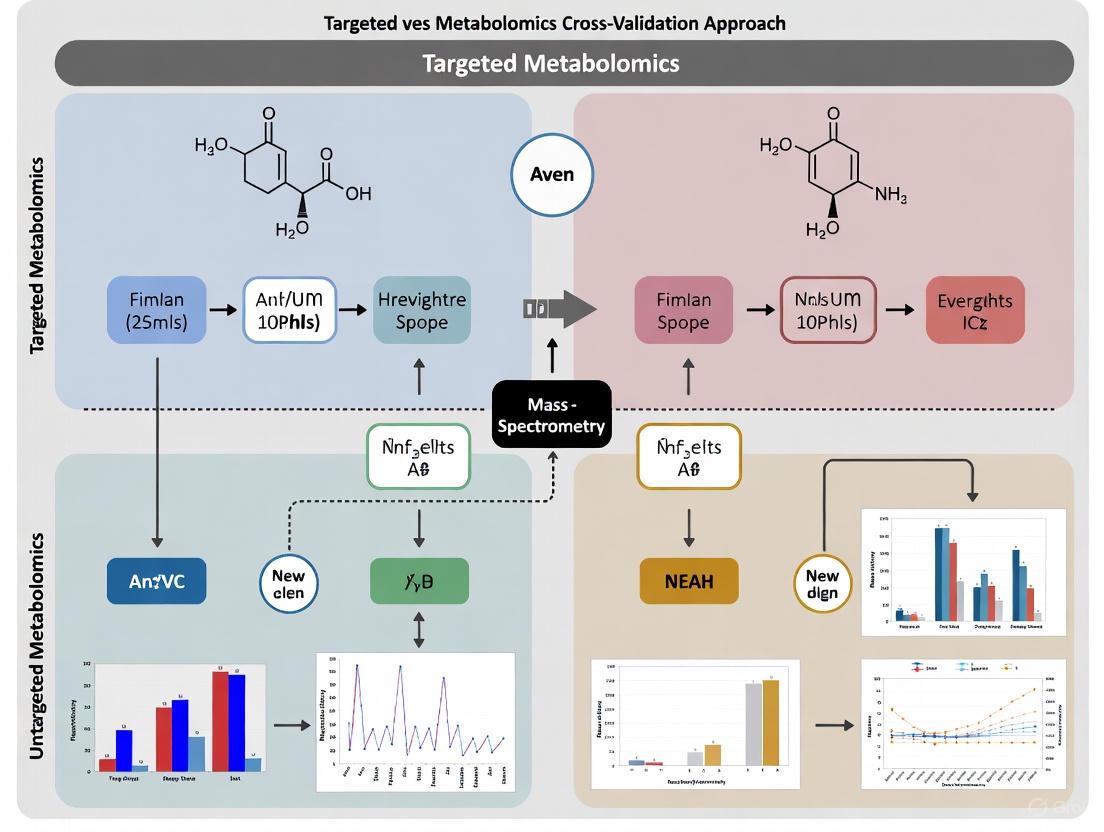
This article provides a comprehensive guide for researchers and drug development professionals on implementing robust cross-validation strategies in metabolomics studies.
Targeted vs Untargeted Metabolomics: A Strategic Guide to Cross-Validation and Biomarker Workflows
Abstract
This article provides a comprehensive guide for researchers and drug development professionals on implementing robust cross-validation strategies in metabolomics studies. It details the distinct roles of untargeted metabolomics for comprehensive biomarker discovery and targeted metabolomics for precise validation, covering foundational principles, methodological workflows, troubleshooting for data quality, and rigorous validation frameworks. By synthesizing recent advances and practical applications, it offers a clear roadmap for developing clinically translatable metabolic biomarkers, effectively bridging the gap between exploratory research and clinical application.
Untargeted vs Targeted Metabolomics: Defining Your Discovery and Validation Pathway
In modern biochemical research, metabolomics has emerged as a powerful approach for understanding metabolic phenotypes in health and disease. The field is fundamentally divided between two methodological philosophies: untargeted metabolomics, which serves primarily for hypothesis generation by comprehensively capturing global metabolic signatures, and targeted metabolomics, which functions for hypothesis testing through precise quantification of predefined metabolites [1] [2]. This philosophical divide represents more than merely technical differences in analytical approaches; it embodies distinct frameworks for scientific inquiry that address complementary aspects of biological discovery.
The untargeted approach embraces discovery-based science, casting a wide analytical net to capture broad metabolic perturbations without prior assumptions about which metabolites might be significant. This exploratory philosophy enables researchers to identify novel metabolic pathways and unexpected biochemical relationships, making it particularly valuable for investigating poorly characterized disease mechanisms [3] [4]. In contrast, the targeted approach employs focused, quantitative assays optimized for specific metabolites, providing rigorous validation of metabolic changes hypothesized to be biologically significant. This confirmatory philosophy offers superior sensitivity, precision, and quantitative accuracy for defined analyte panels, making it essential for clinical translation and biomarker validation [1] [5].
Understanding this core philosophical divide—and more importantly, how to bridge it through cross-validation strategies—is critical for researchers aiming to advance metabolic science from initial discovery to clinical application. This Application Note provides detailed protocols and frameworks for implementing an integrated metabolomics workflow that leverages the complementary strengths of both approaches.
Comparative Framework: Untargeted vs. Targeted Metabolomics
Table 1: Philosophical and Technical Comparison of Untargeted and Targeted Metabolomics
| Characteristic | Untargeted Metabolomics | Targeted Metabolomics |
|---|---|---|
| Core Philosophy | Hypothesis generation, discovery-driven | Hypothesis testing, confirmation-driven |
| Analytical Scope | Global, comprehensive coverage | Focused, predefined metabolites |
| Quantification | Semi-quantitative or relative | Absolute with calibrated quantification |
| Primary Output | Metabolic patterns and novel discoveries | Precise concentration values |
| Key Strengths | Ability to find unexpected metabolites, broad pathway coverage | High accuracy, reproducibility, clinical applicability |
| Typical Applications | Biomarker discovery, pathway elambiguation, novel mechanism identification | Biomarker validation, clinical diagnostics, metabolic monitoring |
| Data Complexity | High, requiring advanced multivariate statistics | Lower, amenable to traditional statistical tests |
The distinction between these approaches extends beyond technical implementation to fundamental differences in experimental design and data interpretation. Untargeted metabolomics employs information-dependent acquisition modes on high-resolution mass spectrometers to capture broad metabolic profiles, generating hypotheses about which metabolic pathways might be relevant to the biological question under investigation [1] [4]. Targeted metabolomics, conversely, utilizes optimized multiple reaction monitoring (MRM) transitions on triple-quadrupole instruments to achieve highly sensitive and specific quantification of metabolites previously identified as potentially significant [1] [5].
This complementary relationship creates a powerful framework for metabolic research when properly integrated. The discovery power of untargeted profiling generates candidate biomarkers and pathway hypotheses, while the precision of targeted analysis provides rigorous validation through absolute quantification in larger cohorts [2]. This sequential approach mitigates the limitations of each method when used in isolation—specifically, the semi-quantitative nature and lower reproducibility of untargeted methods, and the restricted scope and potential for confirmation bias in targeted approaches.
Cross-Validation in Practice: Disease Research Applications
Rheumatoid Arthritis Diagnostic Biomarker Discovery
A recent multi-center study exemplifies the power of integrating untargeted and targeted metabolomics, analyzing 2,863 blood samples across seven cohorts to identify diagnostic biomarkers for rheumatoid arthritis (RA) [1]. The research employed a sequential cross-validation workflow beginning with untargeted metabolomic profiling on an Orbitrap Exploris 120 mass spectrometer to identify candidate biomarkers distinguishing RA from osteoarthritis and healthy controls.
Six metabolites—imidazoleacetic acid, ergothioneine, N-acetyl-L-methionine, 2-keto-3-deoxy-D-gluconic acid, 1-methylnicotinamide, and dehydroepiandrosterone sulfate—were identified as promising diagnostic biomarkers through this discovery phase [1]. These candidates were subsequently validated using targeted approaches with absolute quantification, demonstrating robust discriminatory power with area under the curve (AUC) values ranging from 0.8375 to 0.9280 for distinguishing RA from healthy controls across geographically distinct validation cohorts [1]. Notably, the classifier performance remained strong for seronegative RA patients, who present diagnostic challenges using conventional serological markers, highlighting the clinical potential of this metabolomics-driven approach.
Table 2: Performance Metrics of Rheumatoid Arthritis Metabolite Classifiers Across Validation Cohorts
| Comparison Group | AUC Range | Key Metabolite Biomarkers | Cohort Geographic Diversity |
|---|---|---|---|
| RA vs. Healthy Controls | 0.8375 - 0.9280 | Imidazoleacetic acid, Ergothioneine, N-acetyl-L-methionine | Three distinct regions of China |
| RA vs. Osteoarthritis | 0.7340 - 0.8181 | 2-keto-3-deoxy-D-gluconic acid, 1-methylnicotinamide, Dehydroepiandrosterone sulfate | Five medical centers |
| Seronegative RA Detection | Independent of serological status | Multiple metabolite panel | Performance maintained across cohorts |
Diabetic Retinopathy Progression Monitoring
A separate study investigating metabolic alterations in diabetic retinopathy (DR) further demonstrates the value of cross-validating untargeted and targeted findings [2]. Researchers initially conducted untargeted metabolomic profiling on serum samples from patients with type 2 diabetes mellitus (T2DM) across different stages of retinopathy, followed by targeted analysis to confirm key metabolic changes.
This integrated approach identified L-Citrulline, indoleacetic acid, chenodeoxycholic acid, and eicosapentaenoic acid as significant metabolites distinguishing DR progression stages [2]. The study notably found that samples in the DR stage showed lower serum levels of L-Citrulline and higher levels of indoleacetic acid compared to T2DM samples without retinopathy. Furthermore, during progression from non-proliferative to proliferative diabetic retinopathy, serum levels of chenodeoxycholic acid and eicosapentaenoic acid decreased significantly [2]. These findings were subsequently validated using enzyme-linked immunosorbent assay (ELISA), confirming the metabolic changes and highlighting the importance of cross-validation through orthogonal analytical methods.
Inflammatory Bowel Disease Subtyping
Research on inflammatory bowel disease (IBD) has similarly benefited from integrated metabolomic approaches. A targeted metabolomics study of central carbon metabolism in urinary samples from IBD patients and controls identified distinct metabolic signatures for Crohn's disease (CD) and ulcerative colitis (UC) [5]. Using UHPLC-MS/MS quantification of 49 metabolites, researchers found that six metabolites—xylose, isocitric acid, fructose, L-fucose, N-acetyl-D-glucosamine, and glycolic acid—differentiated UC from controls, while three metabolites—xylose, L-fucose, and citric acid—distinguished CD from controls [5].
Machine learning algorithms applied to these targeted metabolomic data achieved impressive diagnostic classification, with mean AUC values of 0.84 for UC and 0.93 for CD [5]. This application demonstrates how targeted metabolomics, informed by prior untargeted discoveries, can generate clinically useful diagnostic tools for differentiating disease subtypes with similar clinical presentations.
Experimental Protocols
Protocol 1: Untargeted Metabolomic Profiling for Hypothesis Generation
Principle: Comprehensive detection of metabolic features in biological samples to identify potential biomarkers and perturbed pathways without prior selection bias.
Sample Preparation:
- Protein Precipitation: Mix 50 μL of biological sample (plasma, serum, or urine) with 200 μL of prechilled extraction solvent (methanol:acetonitrile, 1:1 v/v) containing deuterated internal standards [1].
- Vortex and Sonicate: Agitate mixture for 30 seconds, followed by sonication in a 4°C water bath for 10 minutes [1].
- Protein Removal: Incubate at -40°C for 1 hour, then centrifuge at 12,000-14,000 rpm for 15 minutes at 4°C [1] [4].
- Supernatant Collection: Transfer cleared supernatant to LC-MS vials for analysis [1].
Liquid Chromatography Conditions:
- Column: Waters ACQUITY UPLC BEH Amide (2.1 × 50 mm, 1.7 μm) or similar HILIC column [1] [4].
- Mobile Phase: A) 25 mmol/L ammonium acetate/ammonium hydroxide in water (pH 9.75); B) Acetonitrile [1].
- Gradient: Optimized for polar metabolite separation (typically 5-95% A over 10-20 minutes) [1].
- Temperature: Autosampler maintained at 4°C; column at 40°C [4].
- Injection Volume: 2-5 μL [1] [4].
Mass Spectrometry Parameters:
- Platform: High-resolution mass spectrometer (e.g., Orbitrap Exploris 120, timsTOF Pro, or similar) [1] [4].
- Ionization: Electrospray ionization in both positive and negative modes.
- Resolution: ≥60,000 for full MS scans [1].
- Scan Range: m/z 50-1000.
- Data Acquisition: Information-dependent acquisition (IDA) mode collecting both MS1 and MS/MS spectra [1].
Quality Control:
- Pooled QC Samples: Prepare by combining equal aliquots from all samples [1] [6].
- System Suitability: Analyze QC samples throughout sequence to monitor instrument stability.
- Acceptance Criteria: Feature intensity RSD <20-30% in QC samples; retention time RSD <2% [6].
Protocol 2: Targeted Metabolite Validation for Hypothesis Testing
Principle: Precise quantification of predefined metabolites identified from untargeted discovery phase using optimized detection parameters and calibrated quantification.
Method Development:
- Standards Preparation: Accurately weigh and prepare individual stock solutions of target metabolites in 50% methanol-water [5].
- Calibration Curves: Combine appropriate volumes of stock solutions and dilute to obtain mixed working standard solutions at 12 concentration points, each injected in triplicate [5].
- Internal Standards: Prepare isotope-labeled internal standards (e.g., succinic acid-D4, L-carnitine-D3) in 50% methanol-water [5].
- MRM Optimization: Directly infuse individual standards to optimize compound-specific parameters including precursor/product ion pairs, collision energies, and fragmentor voltages.
Sample Preparation for Targeted Analysis:
- Aliquot and Spike: Mix 20-50 μL of biological sample with 10 μL of isotope internal standard mixture [5].
- Protein Precipitation: Add 140 μL of acetonitrile, vortex for 1 minute, and centrifuge at 14,000 rcf for 20 minutes at 4°C [5].
- Derivatization (if required): For carbonyl-containing metabolites, add 25 μL each of 200 mM 3-nitrophenylhydrazine hydrochloride and 120 mM EDC·HCl solution containing 6% pyridine, then incubate at 60°C for 40 minutes [5].
- Analysis Ready: Transfer supernatant to autosampler vials for UHPLC-MS/MS analysis.
Liquid Chromatography Conditions:
- Column: Appropriate for analyte polarity (e.g., HSS T3 for reversed-phase, BEH Amide for HILIC) [5] [6].
- Mobile Phase: Optimized for separation of target metabolites.
- Gradient: Tailored to target analytes with focus on resolution and peak shape.
- Flow Rate: 0.3-0.4 mL/min [6].
- Temperature: Column compartment 40°C; autosampler 10°C [6].
Mass Spectrometry Parameters:
- Platform: Triple-quadrupole mass spectrometer.
- Ionization: Electrospray ionization in positive/negative mode depending on analytes.
- Data Acquisition: Multiple reaction monitoring (MRM) mode.
- Dwell Time: Optimized for sufficient data points across peaks (typically 10-50 ms per transition).
- Collision Energy: Compound-specific optimized values.
Quantification and Validation:
- Calibration Curves: Plot peak area ratios (analyte/internal standard) against concentration using weighted linear regression [5].
- Quality Controls: Analyze QC samples at multiple concentrations throughout sequence.
- Validation Parameters: Determine limit of detection (LOD), limit of quantification (LOQ), linearity, precision, and accuracy [5].
Protocol 3: Integrated Cross-Validation Workflow
Principle: Sequential application of untargeted and targeted metabolomics with machine learning integration to generate and validate robust metabolic signatures.
Phase 1: Discovery Cohort Analysis
- Cohort Design: Recruit appropriate sample size for discovery (typically n=30-50 per group) [1] [2].
- Untargeted Profiling: Perform comprehensive metabolomic analysis following Protocol 1.
- Feature Selection: Identify significant metabolites using multivariate statistics (VIP >1.0, p <0.05) and fold-change thresholds [1] [4].
- Pathway Analysis: Conduct enrichment analysis using KEGG, MetaboAnalyst, or similar platforms to identify perturbed pathways [1] [4].
Phase 2: Assay Development
- Candidate Selection: Prioritize metabolites for targeted assay based on statistical significance, biological relevance, and structural diversity.
- Targeted Method: Develop and validate quantitative assay following Protocol 2.
- Cross-Platform Validation: Verify performance across different LC-MS platforms and laboratories [1].
Phase 3: Multi-Center Validation
- Validation Cohorts: Recruit independent cohorts from multiple centers with appropriate sample sizes (typically n=60-150 per group) [1].
- Targeted Analysis: Quantify candidate biomarkers in all validation cohorts using developed targeted method.
- Classifier Development: Build machine learning models (e.g., random forest, SVM, logistic regression) using metabolite panels [1] [5].
- Performance Evaluation: Assess classifier performance using AUC, sensitivity, specificity, and cross-validation [1].
- Clinical Correlation: Evaluate association with clinical parameters and disease subtypes [1] [2].
The Scientist's Toolkit: Essential Research Reagents and Materials
Table 3: Essential Research Reagents and Materials for Integrated Metabolomics
| Category | Specific Items | Function and Application |
|---|---|---|
| Chromatography Columns | Waters ACQUITY UPLC BEH Amide (HILIC), Waters HSS T3 (reversed-phase) | Metabolic separation based on polarity [1] [6] |
| Internal Standards | Deuterated compounds: L-carnitine-d3, succinic acid-D4, cholic acid-D4 | Quantification normalization and quality control [5] [6] |
| Sample Preparation | Methanol, acetonitrile (HPLC grade), ammonium salts, formic acid | Protein precipitation, metabolite extraction, mobile phase preparation [1] [6] |
| Reference Standards | Commercial metabolite libraries (e.g., IROA, Mass Spectrometry Metabolite Library) | Metabolite identification and quantification [5] |
| Derivatization Reagents | 3-nitrophenylhydrazine hydrochloride (3NPH), EDC·HCl with pyridine | Chemical derivatization for enhanced detection of carbonyl groups [5] |
| Quality Control Materials | Pooled quality control samples, calibration standard mixtures, process blanks | System suitability monitoring and data quality assessment [1] [6] |
Analytical Pathway Workflow
The philosophical divide between hypothesis generation (untargeted) and hypothesis testing (targeted) in metabolomics represents complementary rather than contradictory approaches to scientific inquiry. The integrated cross-validation framework presented in this Application Note provides a systematic methodology for leveraging the strengths of both approaches, enabling robust biomarker discovery and validation from initial discovery to clinical application. This sequential strategy maximizes both the discovery power of comprehensive metabolic profiling and the quantitative rigor of focused analyte quantification, ultimately accelerating the translation of metabolic research into clinically actionable insights.
As demonstrated across multiple disease applications—from rheumatoid arthritis and diabetic retinopathy to inflammatory bowel disease—this integrated approach consistently outperforms either method used in isolation. By adopting this philosophical and methodological framework, researchers can navigate the complex landscape of metabolic phenotyping with greater confidence, generating findings that are both biologically insightful and clinically relevant.
Untargeted metabolomics has emerged as a transformative approach in biological research, enabling the comprehensive analysis of small molecule metabolites within a biological system. Unlike targeted metabolomics, which focuses on the quantification of predefined metabolites, untargeted metabolomics takes an expansive, hypothesis-generating approach by detecting and quantifying all measurable metabolites in a sample without prior identification [7]. This methodology provides an unbiased view of the metabolome, allowing researchers to uncover novel compounds and unexpected metabolic pathways that might be missed in targeted analyses. The metabolome represents the final downstream product of genomic, transcriptomic, and proteomic processes, offering a dynamic snapshot of cellular function that integrates both genetic and environmental influences [8]. As such, untargeted metabolomics has become an indispensable tool for biomarker discovery, toxicological research, and understanding complex disease mechanisms across diverse fields including clinical diagnostics, pharmaceutical development, and nutritional science [3] [9] [7].
Core Principles of Untargeted Metabolomics
Fundamental Analytical Workflow
The untargeted metabolomics workflow consists of several critical steps, each requiring careful optimization to ensure comprehensive metabolite coverage and data quality. Sample preparation must be meticulously tailored to specific sample types, employing extraction protocols that maximize the range and quality of metabolites detected while maintaining reproducibility [7]. Data acquisition typically employs high-resolution mass spectrometry techniques, with liquid chromatography-mass spectrometry (LC-MS) excelling in detecting polar, larger molecular mass compounds, and gas chromatography-mass spectrometry (GC-MS) effectively handling smaller, less polar volatile compounds [7]. The volume and complexity of data generated necessitate advanced computational tools for processing, including peak detection, alignment, and normalization [3] [7]. Metabolite identification represents perhaps the most challenging step due to the vast chemical diversity of metabolites and limitations in reference databases, often requiring sophisticated computational tools and validation techniques [10] [7]. Statistical analysis methods such as Principal Component Analysis (PCA) and Partial Least Squares-Discriminant Analysis (PLS-DA) help identify patterns and distinguish between experimental groups, while pathway analysis tools like Mummichog enable researchers to contextualize findings within broader metabolic networks [11] [7].
Comparison with Targeted Metabolomics
The distinction between untargeted and targeted metabolomics approaches is fundamental to understanding their respective applications and limitations. While untargeted metabolomics aims for comprehensive coverage of the metabolome without prior selection of metabolites, targeted metabolomics focuses on precise quantitative analysis of predefined metabolite panels [8] [12]. Targeted approaches offer significant advantages in terms of sensitivity, accuracy, and quantitative precision, making them suitable for clinical validation and diagnostic applications [8] [12]. However, this comes at the cost of limited scope, as only pre-selected metabolites are analyzed, potentially missing novel biomarkers or unexpected metabolic perturbations. Untargeted metabolomics, in contrast, enables discovery of previously unknown metabolic signatures and pathways but faces challenges in metabolite identification, method reproducibility, and data management [7]. The integration of both approaches provides a powerful framework for biomarker development, beginning with initial screening and candidate identification through untargeted methods, followed by quantitative validation of selected metabolites using targeted assays [8].
Table 1: Comparison of Untargeted and Targeted Metabolomics Approaches
| Feature | Untargeted Metabolomics | Targeted Metabolomics |
|---|---|---|
| Analytical Scope | Comprehensive analysis without prior metabolite selection | Focused analysis of predefined metabolites |
| Primary Goal | Hypothesis generation, biomarker discovery | Hypothesis testing, biomarker validation |
| Throughput | High for discovery, lower for identification | High for targeted compounds |
| Quantitation | Semi-quantitative relative abundance | Absolute quantitation with high precision |
| Data Complexity | High, requiring advanced bioinformatics | Lower, more straightforward interpretation |
| Metabolite Identification | Major challenge, often incomplete | Known metabolites with reference standards |
| Best Applications | Exploratory research, novel biomarker discovery | Clinical validation, diagnostic applications |
Experimental Protocols and Methodologies
Sample Preparation Protocols
Proper sample preparation is critical for obtaining reliable and reproducible metabolomic data. The specific protocol varies depending on the sample matrix, with blood-derived samples being among the most common in clinical metabolomics studies. For plasma samples, recommended protocols involve resuspending 100 μL of sample in pre-chilled 80% methanol, followed by thorough vortexing [11]. After 5 minutes of incubation on ice, samples are centrifuged at 15,000 × g for 20 minutes at 4°C, with supernatants collected and diluted with LC-MS grade water to achieve a final concentration of 53% methanol [11]. Further centrifugation is performed before LC-MS analysis to remove particulate matter.
For dried blood spot (DBS) samples, which offer practical advantages for sample storage and transport, research has identified optimal extraction protocols. In studies on phenylketonuria, the most effective method involved gentle agitation overnight at 4°C with an evaporation step, using an extraction solvent composed of 80% acetonitrile and 20% water [13]. This protocol extracted 2 to 6 times more metabolites than other methods tested, with particularly improved extraction of amino acids and their derivatives [13].
Quality control measures are essential throughout sample preparation. The inclusion of quality control (QC) samples, typically comprising equal volumes of mixtures from all experimental samples, helps monitor chromatography-mass spectrometry system balance, stability, and instrument performance throughout the analysis [11]. Blank samples should also be included to identify and remove background ions.
Analytical Platforms and Data Acquisition
Ultra-high performance liquid chromatography coupled with tandem mass spectrometry (UHPLC-MS/MS) has become the cornerstone platform for untargeted metabolomics due to its high sensitivity, broad dynamic range, and extensive metabolite coverage [8] [11]. Typical analytical conditions for plasma samples utilize a Vanquish UHPLC system (Thermo Fisher) coupled to high-resolution mass spectrometers such as the Orbitrap Q Exactive HF or similar instruments [11]. Separation is commonly achieved using reversed-phase columns like the Waters ACQUITY BEH Amide column (2.1 mm × 50 mm, 1.7 μm) or Hypersil Gold column (100 × 2.1 mm, 1.9 μm) [8] [11].
Mobile phase conditions are optimized for comprehensive metabolite separation. For positive ion mode, eluents typically include 0.1% formic acid in water (eluent A) and methanol (eluent B), while negative ion mode uses 5 mM ammonium acetate (pH 9.0, eluent A) and methanol (eluent B) [11]. Gradient elution profiles generally span 12-16 minutes, with careful optimization to separate diverse metabolite classes. Mass spectrometry analysis is performed in both positive and negative electrospray ionization (ESI) modes to maximize metabolite coverage, with data acquisition often employing information-dependent acquisition (IDA) modes to collect both MS1 and MS2 spectra for metabolite identification [9].
The integration of multiple analytical platforms, including both LC-MS and NMR, provides even more comprehensive metabolome coverage, as these techniques offer complementary capabilities for detecting different metabolite classes [14].
Diagram 1: Untargeted Metabolomics Workflow. The comprehensive workflow spans sample preparation, instrumental analysis, and data processing stages, each requiring careful optimization for reliable results.
Data Processing and Statistical Analysis
The raw data generated from UHPLC-MS/MS analyses require sophisticated computational processing to extract meaningful biological information. Initial processing typically involves software tools like Compound Discoverer, XCMS, MS-DIAL, or MZmine for peak alignment, picking, and quantitation [11] [3]. Key processing parameters include mass tolerance (typically 5 ppm), signal intensity tolerance (30%), and minimum intensity thresholds, with peak intensities often adjusted to total spectral intensity for normalization [11].
Metabolite identification represents a significant challenge in untargeted metabolomics. Peaks are typically matched against databases such as mzCloud, HMDB, LIPIDMaps, and KEGG using precise mass, MS/MS fragmentation patterns, and retention time matching when authentic standards are available [11] [7]. For unknown compounds, computational tools like SIRIUS assist in predicting molecular structures [7].
Statistical analysis begins with multivariate methods including Principal Component Analysis (PCA) and Partial Least Squares-Discriminant Analysis (PLS-DA) to identify patterns and distinguish between experimental groups [11] [7]. Differentially abundant metabolites are typically identified based on criteria combining variable importance in projection (VIP) scores >1.0, fold change thresholds (>1.2 or <0.833), and p-values <0.05 from univariate statistical tests [11]. Pathway enrichment analysis using tools like Mummichog, Metabolite Set Enrichment Analysis (MSEA), or Over Representation Analysis (ORA) helps contextualize findings within biological pathways [10]. Recent comparisons of these methods suggest Mummichog outperforms both MSEA and ORA in terms of consistency and correctness for in vitro untargeted metabolomics data [10].
Applications in Biomarker Discovery
Disease Biomarker Identification
Untargeted metabolomics has demonstrated remarkable success in identifying novel biomarkers across a spectrum of diseases. In gastric carcinoma (GC), researchers identified 166 significantly altered metabolites (111 up-regulated and 55 down-regulated) in patient serum compared to healthy controls [15]. Among the top differentially abundant metabolites, eight showed significant elevation in an expanded cohort of 50 GC patients, with seven demonstrating area under the curve (AUC) values exceeding 0.7 in receiver operating characteristic (ROC) analysis, indicating substantial diagnostic potential [15]. Notably, methyclothiazide, epigallocatechin gallate, and dimethenamid showed significant positive correlation with T stage, while methyclothiazide and epigallocatechin gallate also correlated with N stage, suggesting potential for disease stratification [15].
In cardiovascular disease, untargeted metabolomics of heart failure with preserved ejection fraction (HFpEF) patients revealed 124 significantly different metabolites, with lipids and lipid-like molecules being notably altered [11]. Pathway analysis indicated primary involvement of tryptophan metabolism, with ROC analysis identifying phosphatidylcholines PC 18:1-20:5 (AUC: 0.833) and PC 18:1-18:1 (AUC: 0.824) as key discriminatory metabolites [11]. Validation by ELISA confirmed significantly elevated kynurenine and indole-3-acetic acid levels in HFpEF patients, highlighting the tryptophan-kynurenine pathway as a potential therapeutic target [11].
For rheumatoid arthritis (RA), a comprehensive multi-center study analyzing 2,863 blood samples identified six promising diagnostic biomarkers: imidazoleacetic acid, ergothioneine, N-acetyl-L-methionine, 2-keto-3-deoxy-D-gluconic acid, 1-methylnicotinamide, and dehydroepiandrosterone sulfate [8]. Machine learning models based on these metabolites demonstrated robust discriminatory power across geographically distinct cohorts, with AUC values ranging from 0.8375 to 0.9280 for distinguishing RA from healthy controls, and 0.7340 to 0.8181 for differentiating RA from osteoarthritis [8]. Importantly, the classifier performance remained effective for seronegative RA patients, addressing a critical clinical challenge in rheumatology [8].
Table 2: Key Biomarker Discoveries Using Untargeted Metabolomics
| Disease Area | Significant Findings | Diagnostic Performance | Biological Pathways |
|---|---|---|---|
| Gastric Carcinoma [15] | 8 significantly elevated metabolites including fenpiclonil, methyclothiazide, 5-hydroxyindoleacetate | AUC >0.7 for 7 metabolites | Multiple metabolic pathways disrupted |
| Heart Failure with Preserved EF [11] | 124 differentially abundant metabolites; elevated kynurenine and IAA | PC 18:1-20:5 (AUC: 0.833), PC 18:1-18:1 (AUC: 0.824) | Tryptophan metabolism, Lipid metabolism |
| Rheumatoid Arthritis [8] | 6 diagnostic biomarkers including imidazoleacetic acid, ergothioneine | AUC: 0.8375-0.9280 (vs HC), 0.7340-0.8181 (vs OA) | Immune-metabolic pathways |
| Lanmaoa asiatica Poisoning [9] | 914 differential metabolites; altered adenosine nucleotides | Adenosine monophosphate (AUC = 0.917), ADP (AUC = 0.935) | Oxidative phosphorylation, Morphine addiction pathway |
| Phenylketonuria [13] | Distinct metabolic profiles in dried blood spots | Differentiation of patients and controls | Amino acid metabolism, Multiple disrupted pathways |
Toxicological and Pharmacological Applications
Untargeted metabolomics has proven particularly valuable in toxicological research, where it helps elucidate mechanisms of toxicity and identify biomarkers of exposure and effect. In cases of Lanmaoa asiatica mushroom poisoning, which induces severe neuropsychiatric symptoms including hallucinations, metabolomic analysis revealed 914 differential metabolites in patient plasma compared to healthy controls [9]. Key alterations included significant upregulation of 5-methoxytryptophan (5-MTP) and protocatechuic acid, suggesting potential pharmacological relevance [9]. Pathway analysis identified disturbances in oxidative phosphorylation and the morphine addiction pathway, implicating mitochondrial dysfunction as a central mechanism in the toxicity [9]. Adenosine monophosphate (AUC = 0.917), adenosine 5'-diphosphate (AUC = 0.935), and adenosine 5'-triphosphate (AUC = 0.895) were identified as potential metabolic biomarkers and therapeutic targets, despite the generally favorable prognosis for affected patients [9].
In pharmacological research, untargeted metabolomics enables comprehensive assessment of drug metabolism and mechanism of action studies. The approach is particularly valuable for understanding the systemic effects of therapeutic interventions and identifying metabolic signatures associated with treatment response [10] [7]. For in vitro toxicological and pharmacological testing, enrichment analysis methods like Mummichog have demonstrated superior performance for identifying correct pathways affected by compounds with known mechanisms of action, providing greater confidence in mechanistic interpretations [10].
The Scientist's Toolkit: Essential Research Reagents and Materials
Successful untargeted metabolomics studies require careful selection of reagents, materials, and analytical platforms to ensure comprehensive metabolite coverage and data quality. The following table outlines essential components of the untargeted metabolomics toolkit.
Table 3: Essential Research Reagents and Solutions for Untargeted Metabolomics
| Category | Specific Examples | Function and Importance |
|---|---|---|
| Extraction Solvents | Methanol, Acetonitrile, Water (LC-MS grade) | Protein precipitation and metabolite extraction; 80% methanol and ACN:MeOH (1:4) commonly used [11] [9] |
| Internal Standards | Caffeine-13C3, L-Leucine-D7, L-Tryptophan-D5, Benzoic acid-D5 | Monitoring instrument stability, correcting for matrix effects, ensuring quantification reliability [9] |
| Chromatography Columns | Waters ACQUITY BEH Amide, HSS T3, Hypersil Gold | Metabolite separation; different selectivities for comprehensive coverage [8] [11] [9] |
| Mobile Phase Additives | Formic acid, Ammonium acetate, Ammonium hydroxide | Modifying pH and improving ionization efficiency in positive and negative modes [8] [11] |
| Quality Control Materials | Pooled QC samples, Process blanks, Reference standards | Monitoring system performance, identifying background contamination, ensuring data quality [11] |
| Data Processing Software | Compound Discoverer, XCMS, MS-DIAL, MZmine | Peak detection, alignment, and quantitative analysis of complex datasets [11] [3] |
| Metabolite Databases | mzCloud, HMDB, KEGG, LIPIDMAPS | Metabolite identification using mass, MS/MS spectra, and pathway information [11] [7] |
| Pathway Analysis Tools | Mummichog, MetaboAnalyst, MSEA | Functional interpretation and biological context of metabolomic findings [10] [7] |
Cross-Validation with Targeted Approaches
The integration of untargeted and targeted metabolomics represents a powerful framework for comprehensive biomarker discovery and validation. This cross-validation approach leverages the strengths of both methodologies while mitigating their individual limitations [8]. The typical workflow begins with untargeted analysis to identify differentially abundant metabolites and potential biomarker candidates in discovery cohorts. Promising candidates are then validated using targeted methods in larger, independent cohorts, often spanning multiple clinical centers to ensure robustness and generalizability [8].
This integrated approach was successfully demonstrated in a multi-center rheumatoid arthritis study, where candidate biomarkers were first identified through untargeted metabolomic profiling and subsequently validated using targeted approaches across 2,863 blood samples from seven cohorts [8]. The resulting metabolite-based classification models were evaluated across multiple independent validation cohorts, confirming their reproducibility and stability across different sample types and analytical platforms [8].
Similarly, in gastric carcinoma research, untargeted analysis initially revealed 166 significantly altered metabolites, with the top candidates subsequently validated in an expanded cohort of 50 patients and 50 healthy controls [15]. This two-stage approach confirmed both the diagnostic potential of the identified biomarkers and their correlation with disease severity, as determined by the tumor-node-metastasis staging system [15].
The cross-validation framework addresses key challenges in metabolomic biomarker development, including the need for large-scale validation, demonstration of clinical utility, and establishment of analytical robustness across different platforms and sample types [8] [12]. This integrated strategy facilitates the translation of discovered biomarkers from research settings to clinical applications.
Diagram 2: Integrated Untargeted-Targeted Metabolomics Framework. The complementary workflow illustrates how discovery-phase findings from untargeted metabolomics inform targeted validation studies, creating a rigorous path for biomarker development.
Untargeted metabolomics represents a powerful approach for comprehensive biomarker discovery, offering unparalleled ability to profile the complex metabolic alterations associated with disease states, toxicological responses, and physiological interventions. The methodology's strength lies in its hypothesis-generating nature, enabling researchers to identify novel metabolic signatures and pathways without predefined constraints. However, the full potential of untargeted metabolomics is best realized when integrated with targeted validation approaches, creating a rigorous framework for biomarker development that spans initial discovery to clinical application.
Current evidence demonstrates the substantial diagnostic potential of metabolomic biomarkers across diverse conditions including gastric carcinoma, heart failure, rheumatoid arthritis, and metabolic disorders. The continuing advancements in analytical technologies, computational tools, and multi-omics integration are poised to further enhance the scope and impact of untargeted metabolomics. As the field progresses toward greater standardization, improved metabolite identification, and more sophisticated data interpretation methods, untargeted metabolomics will undoubtedly continue to drive innovation in personalized medicine, toxicological research, and our fundamental understanding of biological systems.
Targeted metabolomics is a quantitative analytical approach focused on the precise measurement of a predefined set of metabolites within a biological system [16]. This hypothesis-driven methodology stands in contrast to untargeted approaches, prioritizing accuracy, sensitivity, and reproducibility over global metabolome coverage [17] [16]. Its primary strength lies in the ability to provide absolute quantification of specific metabolites, making it indispensable for clinical diagnostics, biomarker validation, and therapeutic monitoring [18] [12]. In the context of a cross-validation framework with untargeted metabolomics, targeted analysis serves as the critical validation step, confirming the quantitative changes of candidate biomarkers identified in discovery-phase studies [1] [16].
The foundational principle of targeted metabolomics is its reliance on a priori knowledge of specific metabolic pathways or mechanisms [12]. Researchers select a panel of metabolites based on established biochemical understanding, such as branched-chain amino acids (valine, leucine, isoleucine) in insulin resistance studies or specific acylcarnitines in cardiovascular disease [19] [12]. This focused strategy enables highly optimized sample preparation and instrument configuration for the compounds of interest, resulting in superior quantitative performance compared to untargeted methods [16].
Core Principles and Technical Workflow
Foundational Principles
The analytical robustness of targeted metabolomics is governed by several key principles. It employs authentic chemical standards and, crucially, stable isotope-labeled internal standards (SIL-IS) for each target analyte [17] [12]. These internal standards correct for matrix effects and ionization efficiency variations, ensuring high analytical accuracy [12]. The workflow is characterized by a linear dynamic range established through calibration curves, allowing for precise concentration determination across physiologically relevant levels [17].
The technique typically utilizes triple quadrupole mass spectrometers operating in Selected Reaction Monitoring (SRM) or Multiple Reaction Monitoring (MRM) modes [17]. These modes provide exceptional sensitivity and selectivity by monitoring specific precursor ion > product ion transitions unique to each metabolite [17]. This MRM-based approach significantly reduces background noise and minimizes false positives, which is essential for clinical applications [16].
Standardized Workflow
The following diagram illustrates the core workflow for a targeted metabolomics experiment, from hypothesis to biological insight.
Targeted Metabolomics Workflow
Detailed Procedural Protocol
Step 1: Hypothesis and Metabolite Panel Selection
- Objective: Define a specific biological question and select a predefined set of metabolites relevant to the pathway or disease under investigation [16] [12].
- Procedure: Based on literature and prior untargeted studies, curate a target list. For a cardiovascular disease study, this might include 29 amino acids and derivatives, 17 tryptophan pathway metabolites, 39 acylcarnitines, and others, totaling a panel of 98 metabolites [12].
- Critical Note: This step is hypothesis-driven and relies on existing biochemical knowledge.
Step 2: Sample Preparation and Extraction
- Objective: Extract target metabolites while removing proteins and other interferents, and normalize recovery using internal standards.
- Procedure:
- Aliquot 50 μL of plasma or serum [1].
- Add 200 μL of pre-chilled extraction solvent (e.g., methanol:acetonitrile, 1:1 v/v) containing a cocktail of deuterated SIL-IS [1] [12].
- Vortex vigorously for 30 seconds.
- Sonicate in a 4°C water bath for 10 minutes.
- Incubate at -40°C for 1 hour to precipitate proteins.
- Centrifuge at 13,800 × g for 15 minutes at 4°C.
- Transfer the supernatant to MS vials for analysis [1].
- Critical Note: The use of SIL-IS is mandatory for accurate quantification, correcting for matrix effects and preparation losses [12].
Step 3: Liquid Chromatography-Mass Spectrometry (LC-MS/MS) Analysis
- Objective: Separate and detect target metabolites with high specificity and sensitivity.
- Chromatography:
- System: Ultra-High-Performance Liquid Chromatography (UHPLC) [1] [12].
- Column: Choose based on analyte polarity (e.g., C18 for reversed-phase, HILIC for polar metabolites) [19] [17].
- Mobile Phase: Optimized gradients of water/organic modifiers, often with volatile buffers like ammonium acetate or formate [1].
- Mass Spectrometry:
- Critical Note: Method validation is required to define linear range, limit of detection (LOD), and limit of quantification (LOQ) for each analyte [12].
Step 4: Data Processing and Quantification
- Objective: Translate raw MS data into absolute metabolite concentrations.
- Procedure:
- Integrate peak areas for each metabolite and its corresponding SIL-IS from the chromatograms.
- Generate a calibration curve for each metabolite using authentic standards. The ratio of analyte peak area to SIL-IS peak area is plotted against concentration [17].
- Use the resulting calibration curve to calculate the absolute concentration of the analyte in the sample.
- Perform statistical analysis (e.g., ANOVA, t-tests) to determine significant changes between sample groups [17] [12].
Key Validation Parameters and Performance
For a targeted assay to be considered analytically valid, it must meet strict performance criteria. The following table summarizes the essential validation parameters and typical performance metrics achieved by a high-throughput targeted metabolomics assay for cardiovascular disease, as validated by Baskhanova et al. [12].
| Validation Parameter | Description | Exemplary Data from CVD Panel [12] |
|---|---|---|
| Linear Range | Concentration range over which the detector response is linear. | Established for all 98 metabolites |
| Limit of Detection (LOD) | The lowest detectable amount of analyte. | Determined for each analyte |
| Limit of Quantification (LOQ) | The lowest concentration that can be accurately measured. | Determined for each analyte |
| Accuracy | Closeness of the measured value to the true value. | 85-115% for most analytes |
| Precision | Reproducibility of the measurement (repeatability). | RSD < 15% for most analytes |
| Recovery | Efficiency of analyte extraction from the sample matrix. | Evaluated using the surrogate matrix approach |
The Scientist's Toolkit: Essential Reagents and Materials
The following table details the key research reagent solutions and materials essential for executing a robust targeted metabolomics protocol.
| Reagent / Material | Function and Importance |
|---|---|
| Stable Isotope-Labeled Internal Standards (SIL-IS) | Deuterated (2H) or carbon-13 (13C) labeled analogs of target analytes. Crucial for correcting for matrix suppression/enhancement and variable extraction efficiency, enabling absolute quantification [12]. |
| Authentic Chemical Standards | Pure, unlabeled reference compounds for each target metabolite. Used to build calibration curves and confirm chromatographic retention times [12]. |
| Surrogate Matrix | A matrix free of the target analytes (e.g., dialyzed plasma, charcoal-stripped serum) used to prepare calibration standards. This overcomes the challenge of finding a truly blank biological matrix for method validation [12]. |
| LC-MS Grade Solvents | High-purity solvents (water, methanol, acetonitrile) for mobile phases and sample extraction. Minimizes background noise and prevents instrument contamination [1]. |
| UHPLC Columns | Specialized analytical columns (e.g., C18 for reversed-phase, HILIC for polar compounds) for high-resolution separation of metabolites prior to MS detection, reducing ion suppression [19] [1]. |
Application in Cross-Validation Strategies
Targeted metabolomics plays a pivotal role in integrated omics strategies, serving as the confirmatory bridge between untargeted discovery and clinical application. The following diagram illustrates its role in a cross-validation workflow.
Role in Cross-Validation Workflow
This workflow is powerfully demonstrated in multi-center studies. For example, in a study aiming to diagnose Rheumatoid Arthritis (RA), untargeted metabolomics on thousands of samples identified initial candidate biomarkers [1]. These candidates were then transitioned to a targeted, quantitative MRM assay to validate a 6-metabolite panel. This targeted model was successfully validated across independent patient cohorts, achieving an Area Under the Curve (AUC) of 0.8375 to 0.9280 for distinguishing RA from healthy controls, proving the robustness of the cross-validation approach [1].
Similarly, in the diagnosis of Inborn Errors of Metabolism (IEMs), a study comparing global untargeted metabolomics (GUM) with traditional targeted metabolomics (TM) found that GUM had 86% sensitivity compared to TM for detecting known diagnostic metabolites [18]. This highlights that while GUM is a powerful discovery and screening tool, targeted methods remain the gold standard for definitive, quantitative diagnosis of specific genetic disorders [18].
Scope and Applications for Precise Quantification
Biomarker Validation and Clinical Diagnostics
Targeted metabolomics is the cornerstone of translational biomarker development. It provides the rigorous quantification required to move from putative biomarkers identified in untargeted studies to clinically validated assays [1] [18]. This is critical in areas like cardiovascular disease, where panels of amino acids, acylcarnitines, and tryptophan metabolites require precise measurement for risk stratification [12].
Pharmacometabolomics and Drug Development
In pharmacometabolomics, targeted analysis is used to understand drug metabolism, efficacy, and toxicity. By quantifying metabolites before and after drug intervention, researchers can identify metabolic signatures predictive of drug response (pharmacometabolomics) [20]. This application is vital for personalizing therapies and reducing adverse drug reactions, directly contributing to precision medicine [20].
Functional Validation of Genetic Findings
Targeted metabolomics is increasingly used to provide functional validation for genetic variants of unknown significance (VUS) found in genomic studies [18]. For instance, if a VUS is found in a metabolic enzyme gene, a targeted assay can quantify the enzyme's substrate and product, providing biochemical evidence for the variant's pathogenicity and strengthening the cross-validation between genomics and metabolomics [18].
Targeted metabolomics, with its foundational principles of precise quantification, sensitivity, and reproducibility, offers an indispensable scope for validating biological hypotheses and translating metabolomic discoveries into actionable insights. Its well-defined workflows, built around isotope-dilution and MRM on triple quadrupole MS, provide a level of analytical rigor that is a prerequisite for clinical application. When deployed within a cross-validation framework, it transforms the broad, hypothesis-generating power of untargeted metabolomics into specific, quantitatively robust, and clinically relevant knowledge, thereby solidifying its critical role in modern biomedical research and precision medicine.
Metabolomics has emerged as a vital component of systems biology, providing a direct readout of cellular physiological status by quantifying small molecule metabolites. The field primarily operates through two complementary approaches: untargeted metabolomics for global, hypothesis-generating analysis and targeted metabolomics for focused, hypothesis-driven validation. This application note delineates the integrated workflow between these strategies, detailing protocols for sample preparation, data acquisition, and bioinformatics analysis. By framing this within a cross-validation methodology, we provide a structured pathway for researchers to transition from novel biomarker discovery to rigorous biological validation, a process critical for advancing research in drug development and clinical diagnostics.
Metabolomics, the comprehensive study of low molecular weight molecules, has seen a dramatic increase in application since the 1990s, with over 75,000 citations on PubMed [16]. As the terminal downstream product of the genome, metabolites offer a vital component for understanding biological processes and disease states [16]. The metabolomics continuum is underpinned by two fundamental strategies:
- Untargeted Metabolomics: A global, comprehensive analysis aimed at measuring all detectable metabolites in a sample, both known and unknown. This approach is hypothesis-generating, flexible in sample preparation, and does not require internal standards, making it ideal for discovery-phase research and novel biomarker identification [16].
- Targeted Metabolomics: A focused analysis quantifying a predefined set of characterized and biochemically annotated metabolites. This hypothesis-driven approach uses isotopically labeled internal standards to achieve high precision and absolute quantification, making it optimal for validating specific metabolic changes or pathways [16].
The synergy between these approaches forms the basis of a powerful cross-validation strategy, where discoveries from untargeted screens are rigorously verified using targeted methods.
Comparative Workflow: From Untargeted to Targeted
Table 1: Core Differences Between Untargeted and Targeted Metabolomics
| Feature | Untargeted Metabolomics | Targeted Metabolomics |
|---|---|---|
| Primary Goal | Discovery, hypothesis generation | Validation, absolute quantification |
| Scope | All detectable metabolites (known & unknown) [16] | Predefined set of metabolites (~20 in most protocols) [16] |
| Quantification | Relative quantification [16] | Absolute quantification [16] |
| Sample Preparation | Global metabolite extraction [16] | Extraction optimized for specific metabolites [16] |
| Internal Standards | Not required [16] | Required (isotopically labeled) [16] |
| Data Output | Large, complex datasets requiring extensive processing [16] | Smaller, more manageable datasets |
| Key Advantage | Unbiased, can reveal novel metabolites [16] | High precision, low false positives [16] |
| Main Disadvantage | Can miss low-abundance metabolites; complex data analysis [16] | Limited scope; can miss metabolites of interest [16] |
The following workflow diagram illustrates the continuum from untargeted discovery to targeted validation, highlighting the key decision points and processes.
Diagram 1: Integrated Metabolomics Cross-Validation Workflow.
Detailed Experimental Protocols
Protocol for Untargeted Metabolomics Analysis
Objective: To comprehensively profile all measurable metabolites in a biological sample for hypothesis generation.
Sample Preparation and Metabolite Extraction:
- Sample Collection: Collect samples (cells, tissue, biofluids) under consistent conditions to minimize variability. For cells and tissues, perform rapid metabolic quenching using flash-freezing in liquid nitrogen or chilled methanol (-20°C to -80°C) to instantly halt enzyme activity [21].
- Metabolite Extraction: Use a biphasic liquid-liquid extraction system for broad metabolite coverage.
- Add a methanol/chloroform/water mixture (typical ratio 2:1:1) to the quenched sample [21].
- Vortex vigorously and centrifuge to separate phases.
- The upper polar phase (methanol/water) contains polar metabolites; the lower organic phase (chloroform) contains non-polar lipids [21].
- Collect both phases separately for analysis or choose the phase relevant to the research question.
- Quality Control (QC): Prepare a pooled QC sample by combining a small aliquot of every experimental sample. This QC sample is analyzed repeatedly throughout the analytical run to monitor instrument stability [22].
Data Acquisition:
- Platform Selection: Use Liquid Chromatography-Mass Spectrometry (LC-MS) for moderately polar to highly polar compounds (e.g., lipids, amino acids, organic acids) or Gas Chromatography-Mass Spectrometry (GC-MS) for volatile compounds or those that can be derivatized (e.g., sugars, organic acids) [22].
- Analysis: Inject samples in a randomized order. The QC sample is analyzed at the beginning, at regular intervals throughout the run, and at the end to assess data quality.
Data Processing and Analysis:
- Pre-processing: Use software like XCMS, MZmine, or MetaboAnalystR 4.0 for peak detection, retention time alignment, and feature quantification [22] [23]. This step converts raw spectral data into a data matrix of features (defined by m/z and retention time) and their intensities.
- Compound Identification: Match MS1 features (and MS2 spectra if available) against public databases (e.g., HMDB, MassBank) or in-house libraries. The Metabolomics Standards Initiative (MSI) levels guide identification confidence, from Level 1 (identified compound) to Level 4 (unknown compound) [22].
- Statistical Analysis: Perform multivariate statistical analysis like Principal Component Analysis (PCA) and Partial Least Squares-Discriminant Analysis (PLS-DA) to identify metabolite features that differentiate sample groups. Select biomarker candidates based on statistical significance (p-value) and fold-change.
Protocol for Targeted Metabolomics Validation
Objective: To absolutely quantify a specific panel of biomarker candidates identified from the untargeted discovery phase.
Sample Preparation and Metabolite Extraction:
- Extraction with Internal Standards: Add a known concentration of stable isotope-labeled internal standards (SIL-IS) for each target metabolite to the extraction solvent prior to sample processing. The SIL-IS corrects for losses during sample preparation and matrix effects during analysis [16] [21].
- Optimized Extraction: Use an extraction protocol optimized for the chemical properties of the target metabolites, which may differ from the global extraction used in untargeted analysis [16].
Data Acquisition:
- Platform Selection: Use Liquid Chromatography-Tandem Mass Spectrometry (LC-MS/MS) in Selected Reaction Monitoring (SRM) or Multiple Reaction Monitoring (MRM) mode.
- Method Development: For each target metabolite, optimize MS parameters (precursor ion, fragment ions, collision energy) using authentic chemical standards. The MRM mode enhances sensitivity and specificity by monitoring a specific transition from a precursor ion to a characteristic product ion.
Data Processing and Quantification:
- Peak Integration: Manually or automatically integrate the chromatographic peaks for each target metabolite and its corresponding SIL-IS.
- Absolute Quantification: Generate a calibration curve by analyzing serially diluted standards of known concentration. The ratio of the peak area of the target metabolite to the peak area of its SIL-IS is used to calculate the absolute concentration in the sample from the calibration curve [16].
The Scientist's Toolkit: Essential Reagents and Materials
Table 2: Key Research Reagent Solutions for Metabolomics
| Item | Function/Application | Examples/Notes |
|---|---|---|
| Methanol/Chloroform | Biphasic solvent system for global metabolite extraction; methanol extracts polar metabolites, chloroform extracts lipids [21]. | Classical Folch or Bligh & Dyer methods [21]. |
| Methyl tert-butyl ether (MTBE) | Non-polar solvent for efficient lipid extraction from biological samples [21]. | Often used as an alternative to chloroform [21]. |
| Stable Isotope-Labeled Internal Standards | Enables absolute quantification in targeted metabolomics; corrects for analyte loss and ion suppression [16] [21]. | e.g., 13C-, 15N-labeled amino acids; added prior to sample extraction. |
| Quality Control (QC) Materials | Monitors instrument performance and data quality throughout the analytical run. | A pooled sample from all study samples; commercial quality control sera [22]. |
| Authentic Chemical Standards | Required for compound identification in untargeted work and for creating calibration curves in targeted analysis. | Available from various commercial suppliers; purity should be >95%. |
| Reference Spectral Databases | Essential for annotating and identifying metabolites from MS/MS spectra. | HMDB, MassBank, LipidBlast, GNPS [23]. |
Integrated Data Analysis and Functional Interpretation
Modern bioinformatics tools are crucial for navigating the complex data generated in cross-validation studies. Platforms like MetaboAnalystR 4.0 provide a unified environment for processing both LC-MS1 and MS2 spectra from untargeted experiments (including deconvolution of chimeric spectra from DDA/DIA), performing database searches for compound identification, and conducting statistical and functional analysis [23]. Following targeted validation, functional interpretation involves mapping the quantified metabolites onto metabolic pathways using databases like KEGG to derive biological meaning and understand the mechanisms underlying the observed metabolic perturbations [22].
Application in Disease Research
The untargeted-to-targeted continuum has proven powerful in elucidating the pathogenesis of various diseases. For instance, a study on hyperuricemia used untargeted metabolomics to screen for novel candidate biomarkers, which were subsequently verified using targeted metabolomics [16] [24]. Similar integrated approaches have provided novel insights into the metabolic underpinnings of cardiovascular disease, neurodegenerative disease, diabetes, and cancer, often revealing disruptions in key pathways such as the tricarboxylic acid (TCA) cycle, amino acid metabolism, fatty acid metabolism, and glycolysis [16] [22].
The metabolomics continuum, which strategically moves from untargeted discovery to targeted validation, provides a robust framework for biochemical inquiry. This cross-validation approach leverages the strengths of each method while mitigating their respective weaknesses. By following the detailed protocols and utilizing the toolkit outlined in this note, researchers can systematically discover and validate metabolic biomarkers, accelerating the translation of metabolomic findings into tangible advances in basic research and drug development.
Metabolomics, the comprehensive study of small-molecule metabolites, has emerged as a powerful tool for understanding biochemical processes in health and disease. The field is primarily divided into two analytical approaches: targeted metabolomics, which focuses on the precise quantification of a predefined set of metabolites, and untargeted metabolomics, which aims to comprehensively profile as many metabolites as possible without prior selection [18]. While these approaches have traditionally been viewed as distinct paradigms, recent advances demonstrate their complementary nature in biomarker discovery and validation.
This comparative analysis examines the scope, data characteristics, and practical applications of both methodologies within a cross-validation framework. The integration of targeted and untargeted approaches creates a powerful pipeline for biomarker development—from initial discovery to clinical validation [1]. This side-by-side assessment provides researchers with a structured framework for selecting appropriate methodologies based on their specific research objectives, whether for exploratory biomarker discovery or clinical validation.
Fundamental Methodological Comparisons
Core Principles and Analytical Objectives
The fundamental distinction between targeted and untargeted metabolomics lies in their analytical philosophy and application goals. Untargeted metabolomics provides an unbiased, global overview of the metabolome, capturing broad metabolic perturbations across diverse pathways [3]. This approach is particularly valuable for hypothesis generation and discovering novel metabolic patterns without predefined constraints. In contrast, targeted metabolomics employs optimized methods for specific, pre-selected metabolites, offering superior quantification accuracy, sensitivity, and reproducibility essential for clinical validation and translational research [1] [25].
The analytical workflows differ significantly between these approaches. Untargeted methods typically use high-resolution mass spectrometry to detect thousands of metabolic features, only a fraction of which may be structurally identified [26]. Targeted methods utilize triple-quadrupole mass spectrometers operating in selected reaction monitoring mode, providing enhanced sensitivity and specificity for predetermined analytes [25]. This fundamental difference in scope versus precision dictates their respective positions in the research pipeline, with untargeted methods excelling in discovery phases and targeted methods providing the rigorous quantification needed for clinical application.
Comparative Performance Characteristics
Table 1: Direct Comparison of Targeted vs. Untargeted Metabolomics Approaches
| Parameter | Targeted Metabolomics | Untargeted Metabolomics |
|---|---|---|
| Analytical Scope | Predefined metabolites (dozens to hundreds) [25] | Global coverage (thousands of features) [26] |
| Quantitation | Absolute quantification using calibration curves & internal standards [25] | Relative quantification (fold-changes) [18] |
| Sensitivity | Higher (optimized for specific analytes) [1] | Lower (broad-range detection) |
| Reproducibility | High (standardized protocols) [1] | Variable (requires careful normalization) |
| Metabolite Identification | Confirmed with chemical standards [25] | Partial identification; many unknown features [26] |
| Throughput | Moderate to high (optimized methods) [25] | Lower (complex data processing) [3] |
| Best Applications | Clinical validation, biomarker verification, pathway-focused studies [1] [27] | Biomarker discovery, hypothesis generation, novel pathway identification [3] [2] |
| Data Complexity | Lower (structured data matrices) | High (complex, high-dimensional data) [3] |
Experimental Design and Workflow Integration
Cross-Validation Workflow Framework
The most effective applications of metabolomics increasingly employ a hybrid strategy that leverages the strengths of both targeted and untargeted approaches. This integrated workflow begins with untargeted discovery on a subset of samples to identify potentially discriminatory metabolites, followed by the development of targeted assays for precise quantification of these candidate biomarkers across larger validation cohorts [1]. This sequential approach bridges the gap between exploratory research and clinical application.
Experimental Protocols for Cross-Validation Studies
Untargeted Metabolomics Protocol for Biomarker Discovery
Sample Preparation:
- Protein precipitation using prechilled methanol and acetonitrile (1:1 v/v) containing deuterated internal standards [1]
- Vortex mixing (30 seconds) followed by sonication in a 4°C water bath for 10 minutes [1]
- Incubation at -40°C for 1 hour to precipitate proteins [1]
- Centrifugation at 13,800 × g for 15 minutes at 4°C [1]
- Transfer of supernatant to LC-MS vials for analysis [1]
LC-MS Analysis:
- Chromatography: Vanquish UHPLC system with Waters ACQUITY BEH Amide column (2.1 mm × 50 mm, 1.7 μm) [1]
- Mobile Phase: A) 25 mmol/L ammonium acetate/ammonium hydroxide in water (pH 9.75); B) acetonitrile [1]
- Mass Spectrometry: Orbitrap Exploris 120 MS operated in positive and negative ESI modes [1]
- Data Acquisition: Information-dependent MS/MS mode [1]
Data Processing:
- Use of computational tools like XCMS, MZmine, or MS-DIAL for peak detection and alignment [3]
- Feature annotation using database matching (KEGG, HMDB, METLIN) [26]
- Statistical analysis (multivariate and univariate) to identify significant features [1]
Targeted Metabolomics Protocol for Biomarker Validation
Sample Preparation:
- Minimal "dilute and shoot" protocol with appropriate dilution factors [25]
- Use of stable isotope-labeled internal standards for each analyte class [25]
- Preparation of calibration curves in matching biological matrix [25]
LC-MS/MS Analysis:
- Chromatography: Dual-column approach combining reversed-phase and HILIC separations [28] [25]
- Mass Spectrometry: Triple quadrupole MS operated in scheduled selected reaction monitoring mode [25]
- Quality Control: Injection of quality control samples and calibration standards throughout sequence [25]
Quantification and Validation:
- Peak integration and review using instrument software [27]
- Calculation of concentrations using calibration curves with internal standard correction [25]
- Method validation including linearity, precision, accuracy, and recovery assessments [25]
Data Characteristics and Analytical Outputs
Comparative Data Output Across Applications
Table 2: Representative Data Outputs from Various Application Studies
| Application Field | Untargeted Findings | Targeted Validation | Reference |
|---|---|---|---|
| Rheumatoid Arthritis Diagnosis | Initial identification of discriminatory metabolites from global profiling | 6 metabolites validated across 7 cohorts (2,863 samples); AUC: 0.734-0.928 [1] | [1] |
| Alzheimer's Disease | Discovery of potential metabolic signatures | LASSO/PLS models with 5 metabolites + APOE achieved AUC 0.84-0.90 [27] | [27] |
| Diabetic Retinopathy | Identification of L-Citrulline, IAA, CDCA, EPA as distinctive biomarkers | ELISA confirmation of 4 key metabolites across disease stages [2] | [2] |
| Genetic Disorders (IEMs) | Detection of 86% of diagnostic metabolites vs. targeted methods | Clinical sensitivity of 86% for 51 diagnostic metabolites [18] | [18] |
| Sports Nutrition | Characterization of metabolic responses to exercise | Pathway-focused quantification of energy metabolites [3] | [3] |
Data Structure and Complexity
The data outputs from targeted and untargeted approaches differ significantly in structure and complexity. Untargeted metabolomics generates high-dimensional data comprising thousands of metabolic features, many of which may be unidentified or partially characterized [3]. This dataset requires sophisticated bioinformatic pipelines for feature alignment, statistical analysis, and metabolite annotation. In contrast, targeted methods produce structured data matrices with precise concentrations for defined metabolites, enabling straightforward statistical analysis and clinical interpretation [1] [27].
The challenge of metabolite identification in untargeted studies has prompted the development of advanced annotation strategies. Recent approaches integrate data-driven and knowledge-driven networks to enhance annotation coverage and accuracy [26]. These network-based methods leverage metabolic reaction databases and MS/MS spectral similarity to propagate annotations, significantly improving the biological interpretability of untargeted datasets.
Applications in Disease Research and Biomarker Development
Diagnostic Biomarker Discovery and Validation
The complementary value of targeted and untargeted approaches is particularly evident in diagnostic biomarker development. In rheumatoid arthritis research, untargeted discovery identified potential biomarkers that were subsequently validated across multiple independent cohorts using targeted methods [1]. This cross-validated approach yielded a six-metabolite panel capable of distinguishing RA from healthy controls and osteoarthritis with robust diagnostic performance, demonstrating the clinical translation potential of integrated metabolomics.
Similarly, in Alzheimer's disease, targeted metabolomics combined with machine learning identified metabolite panels with strong discriminatory power [27]. The inclusion of APOE genotyping further improved classification accuracy, highlighting how metabolomic biomarkers can complement genetic risk factors for enhanced diagnostic precision. These findings underscore the importance of targeted validation in establishing clinically relevant biomarker panels.
Metabolic Pathway Analysis
The integration of targeted and untargeted data enables comprehensive pathway analysis across various disease contexts. In diabetic retinopathy, cross-validation of both approaches revealed disruptions in amino acid metabolism, bile acid pathways, and fatty acid metabolism across different stages of disease progression [2]. This multi-level assessment provided insights into the metabolic rewiring associated with DR progression, identifying potential therapeutic targets and prognostic markers.
The Scientist's Toolkit: Essential Research Reagents and Materials
Core Reagents and Analytical Materials
Table 3: Essential Research Reagents and Platforms for Metabolomics Studies
| Reagent/Solution | Function | Application Context |
|---|---|---|
| Deuterated Internal Standards | Correction for matrix effects & quantification variability | Essential for both targeted and untargeted approaches [1] [25] |
| AbsoluteIDQ p400 HR Kit | Targeted analysis of ~400 metabolites | Standardized targeted metabolomics [27] |
| NeoBase 2 MSMS Kit | Dried blood spot analysis for amino acids & acylcarnitines | Targeted screening of metabolic disorders [29] |
| Ammonium acetate/ammonium hydroxide | Mobile phase additive for HILIC separations | Untargeted polar metabolite analysis [1] |
| Methanol/acetonitrile (1:1) | Protein precipitation & metabolite extraction | Sample preparation for global untargeted profiling [1] |
| Stable isotope-labeled standards | Absolute quantification reference | Targeted metabolomics calibration [25] |
| Quality control pool samples | Monitoring instrumental performance & data quality | Essential for both approaches across large batches [1] |
Analytical Platforms and Instrumentation Strategies
LC-MS Platform Configurations
The choice of analytical platform significantly influences metabolomics coverage and data quality. For comprehensive metabolomic analysis, dual-column approaches that combine reversed-phase and hydrophilic interaction liquid chromatography have demonstrated superior coverage of the chemical diversity present in biological samples [28] [25]. This configuration enables analysis of both polar and nonpolar metabolites within a single analytical workflow, addressing a key limitation of single-column methods.
High-resolution mass spectrometers (Orbitrap, Q-TOF) are preferred for untargeted metabolomics due to their high mass accuracy and resolution, facilitating metabolite identification [1] [26]. In contrast, targeted analyses typically employ triple quadrupole instruments operated in SRM mode, providing enhanced sensitivity and dynamic range for precise quantification of predefined metabolites [25]. The integration of fast polarity switching and scheduled SRM acquisition further enhances the throughput and coverage of targeted methods.
Method Validation Parameters
For targeted metabolomics applications intended for clinical translation, rigorous method validation is essential. Key validation parameters include:
- Linearity: Assessment across physiological and pathological concentration ranges [25]
- Precision: Evaluation of intra- and inter-day reproducibility [25]
- Accuracy: Determination through spike-recovery experiments [25]
- Limits of detection and quantification: Establishment for each analyte [25]
- Carryover: Assessment to ensure sample integrity [25]
- Matrix effects: Evaluation to quantify ionization suppression/enhancement [25]
These validation steps ensure the reliability and robustness of quantitative metabolomic data for clinical decision-making.
Targeted and untargeted metabolomics represent complementary rather than competing approaches in modern metabolic research. Untargeted strategies provide the discovery power to identify novel metabolic alterations and generate hypotheses, while targeted methods offer the precision and reproducibility required for clinical validation and translation. The most impactful metabolomics studies strategically integrate both approaches, leveraging their respective strengths across the research continuum.
Future directions in metabolomics will focus on standardizing cross-validation workflows, improving metabolite annotation in untargeted studies, and developing more comprehensive targeted panels based on discoveries from untargeted profiling. As analytical technologies advance and computational methods become more sophisticated, the integration of targeted and untargeted metabolomics will continue to drive innovations in biomarker discovery, disease mechanism elucidation, and precision medicine.
From Raw Data to Robust Models: Methodological Workflows and Real-World Applications
Untargeted metabolomics has rapidly become a profiling method of choice for comprehensively analyzing the small molecule components of biological systems [30]. Unlike targeted approaches that focus on a predefined set of metabolites, untargeted metabolomics aims to measure as many metabolites as possible in a sample, making it ideal for hypothesis generation and biomarker discovery [31] [32]. This methodology surveys biochemical phenotypes directly, providing unique insight into health, disease, and mitochondrial bioenergetics by capturing the functional readout of physiological processes [30]. The workflow produces large, complex data files that are impractical to analyze manually, requiring sophisticated computational pipelines for meaningful biological interpretation [30] [33]. When framed within a broader thesis on targeted versus untargeted metabolomics cross-validation approaches, understanding the untargeted workflow becomes fundamental, as it often serves as the discovery engine that generates hypotheses for subsequent targeted validation.
Experimental Design and Sample Preparation
Experimental Design Considerations
Proper experimental design is critical for generating meaningful, reproducible metabolomics data. Key considerations include determining the number of biological replicates, incorporating quality control (QC) samples, and randomizing sample analysis to account for instrumental drift [32]. A minimum of three biological replicates is required, with five replicates preferred to ensure adequate statistical power [32]. Quality control samples—typically prepared by pooling small aliquots of all study samples—are analyzed throughout the acquisition sequence to monitor system stability and performance [32] [34]. For studies involving biofluids such as plasma, urine, or cerebral spinal fluid, consistent sample handling is essential to minimize pre-analytical variability [30] [32]. Immediate storage of samples at -80°C or in liquid nitrogen is recommended to prevent metabolite degradation, with freeze-thaw cycles kept to an absolute minimum [32].
Metabolite Extraction Protocols
The chemical diversity of the metabolome makes metabolite extraction a challenging task that requires balancing minimal matrix interference with maximum sample recovery [32]. For comprehensive coverage, a single-phase extraction protocol using organic solvents is widely employed. The following protocol is adapted for biofluids including plasma, urine, and CSF [30]:
- Internal Standard Extraction Solution Preparation: Prepare an extraction solvent of acetonitrile:methanol:formic acid (74.9:24.9:0.2, v/v/v). Spike this solvent with stable isotope-labeled internal standards (e.g., l-Phenylalanine-d8 at 0.1 μg/mL and l-Valine-d8 at 0.2 μg/mL) to monitor extraction efficiency and instrument performance [30].
- Sample Extraction: Combine biofluid samples with a measured volume of the internal standard extraction solution (e.g., a 1:3 ratio of sample to solvent) to precipitate proteins and extract metabolites.
- Precipitation and Recovery: Vortex the mixture thoroughly and incubate at -20°C for at least 1 hour. Centrifuge at high speed (e.g., 14,000-16,000 × g) for 15-20 minutes to pellet precipitated proteins.
- Sample Preparation for Analysis: Carefully collect the supernatant containing the metabolome and transfer it to a clean vial for LC-MS/MS analysis.
Table 1: Essential Research Reagent Solutions for Untargeted Metabolomics
| Reagent/Solution | Composition and Preparation | Primary Function in Workflow |
|---|---|---|
| Extraction Solvent [30] | Acetonitrile:methanol:formic acid (74.9:24.9:0.2, v/v/v). Store at -20°C. | Protein precipitation and comprehensive metabolite extraction from sample matrix. |
| Internal Standard (IS) Stock [30] | Stable isotope-labeled standards (e.g., l-Phenylalanine-d8, l-Valine-d8) in water:methanol. Nominal concentration 1000 μg/mL. Store at -20°C. | Monitoring sample preparation efficiency, instrument performance, and data quality. |
| IS Extraction Solution [30] | Extraction solvent spiked with internal standards (e.g., 0.1 μg/mL l-Phenylalanine-d8 and 0.2 μg/mL l-Valine-d8). | Integrated solution for simultaneous protein precipitation and quality control. |
| LC Mobile Phase A [30] | 10 mM ammonium formate and 0.1% formic acid in LC/MS-grade water. Stable for ~1 month. | Aqueous mobile phase for HILIC chromatography; promotes separation of polar metabolites. |
| LC Mobile Phase B [30] | 0.1% formic acid in LC/MS-grade acetonitrile. Stable for ~1 month. | Organic mobile phase for HILIC chromatography; initial elution conditions. |
LC-MS/MS Analysis and Data Acquisition
Chromatographic Separation
Liquid chromatography is critical for separating the complex mixture of metabolites prior to mass spectrometry detection. To maximize coverage of the diverse metabolome, orthogonal separation techniques are often employed [35].
- Reversed-Phase Liquid Chromatography (RP-LC): Most common for analyzing non-polar to moderately polar metabolites using hydrophobic stationary phases [35].
- Hydrophilic Interaction Liquid Chromatography (HILIC): Ideal for retaining and separating ionic and polar compounds not well-retained by RP-LC, such as amino acids, organic acids, and sugars [30] [35]. A typical HILIC method uses a silica column with a gradient from high to low organic solvent concentration [30].
- Ion Chromatography (IC): Particularly suited for charged or very polar metabolites, including sugar phosphates and amino acids, and is capable of resolving isomers and isotopes [35].
Mass Spectrometry Detection
High-resolution accurate mass (HRAM) instruments are the cornerstone of untargeted metabolomics due to their ability to separate isobaric species and provide putative identifications [31].
- Ionization Techniques: Electrospray ionization (ESI) is the most common "soft ionization" technique, producing intact molecular ions with minimal fragmentation [32] [35]. Analysis in both positive and negative ionization modes is required to maximize metabolome coverage [32].
- Mass Analyzers: Time-of-flight (TOF), Orbitrap, and Fourier transform ion cyclotron resonance (FTICR) mass analyzers are preferred for their high resolution and mass accuracy [32]. These systems enable the calculation of empirical formulas from detected ions.
- Data Acquisition Modes: Data-Dependent Acquisition (DDA) is frequently used, where the most abundant ions detected in a full MS1 scan are automatically selected for fragmentation (MS/MS) to generate structural information [33].
Diagram 1: LC-MS/MS analysis involves orthogonal separation techniques coupled to high-resolution mass spectrometry.
Data Processing and Analysis Workflow
The raw data generated from untargeted LC-MS/MS is complex and requires extensive computational processing to extract biological insights. The overall workflow can be divided into three main steps: profiling, compound identification, and interpretation [31].
Data Pre-processing and Statistical Analysis
Pre-processing transforms raw instrument data into a structured feature table suitable for statistical analysis. This crucial step includes feature detection, alignment, and normalization [33].
- Spectral Pre-processing: Raw data files are converted to an open format (e.g., mzML). Algorithms perform peak picking, deconvolution, and removal of background noise [31] [33].
- Feature Detection and Alignment: Software tools identify metabolic features characterized by mass-to-charge ratio (m/z), retention time (RT), and intensity. Features are then aligned across all samples in the experiment to correct for minor chromatographic shifts [33].
- Statistical Analysis and Biomarker Discovery: Processed data is analyzed using univariate and multivariate statistical methods. Principal Component Analysis (PCA) is commonly used to visualize sample groupings and identify outliers. To identify significantly altered metabolites between conditions, researchers often employ a combination of univariate tests (e.g., t-tests) and multivariate model metrics like Variable Importance in Projection (VIP) from Partial Least Squares-Discriminant Analysis (PLS-DA) [34]. Features with a p-value < 0.05 and VIP > 1.0 are typically considered statistically significant [34].
Table 2: Key Steps and Tools in Untargeted Metabolomics Data Processing
| Processing Stage | Key Objectives | Common Algorithms/Software |
|---|---|---|
| Spectral Pre-processing [31] [33] | Convert raw data, peak picking, noise reduction, baseline correction. | OpenMS, XCMS, MZmine, UmetaFlow |
| Feature Extraction [31] [33] | Detect and quantify all metabolites; align features across samples. | FeatureFinderMetabo (OpenMS), XCMS, MZmine2 |
| Statistical Analysis [31] [34] | Identify significant features; visualize patterns and groupings. | PCA, PLS-DA, t-tests (MetaboAnalyst, Python/R) |
| Compound Identification [31] [35] | Annotate significant features with putative metabolite names. | MS/MS spectral matching (mzCloud, METLIN, GNPS) |
| Pathway Analysis [31] [34] | Interpret biological meaning of altered metabolites. | KEGG, MetaCyc, HMDB (MetaboAnalyst) |
Metabolite Identification and Annotation
After statistical analysis, the significant features must be annotated or identified.
- Database Searching: High-resolution MS/MS spectra are searched against experimental spectral libraries such as mzCloud, METLIN, and GNPS for putative identifications [31] [35] [33].
- In-silico Fragmentation: For unknowns not found in libraries, in-silico tools like SIRIUS and CSI:FingerID can predict molecular formulas and structures from fragmentation spectra [33].
- Confidence Levels: Annotations are typically assigned a level of confidence (e.g., Level 1: confirmed with authentic standard; Level 2: putative annotation based on spectral similarity; Level 3: tentative candidate based on exact mass) [35].
Advanced Data Interpretation and Integration
Advanced computational methods are increasingly used to extract deeper biological meaning from metabolomic data. Network analysis tools, such as Molecular Networking via GNPS, group metabolites based on structural similarity revealed by their MS/MS spectra, facilitating the discovery of related compounds [33]. Furthermore, multivariate modeling interpretation can be enhanced by network-guided frameworks that group metabolites according to communities identified in metabolic networks, moving beyond predefined pathways to generate novel biological hypotheses [36]. The integration of machine learning is also gaining traction for identifying key metabolite biomarkers and building predictive models from complex datasets [37].
Diagram 2: Untargeted metabolomics data processing workflow transforms raw data into biological insights.
The untargeted metabolomics workflow—from meticulous sample preparation and comprehensive LC-MS/MS analysis to sophisticated data processing—provides a powerful platform for global biochemical profiling. The robustness of this workflow ensures the generation of high-quality, reproducible data capable of capturing the complex metabolic perturbations inherent to biological systems. In the context of cross-validation research, the untargeted workflow serves as the critical discovery engine. The putative metabolites and pathways it identifies provide the foundational hypotheses and candidate panels that can be rigorously validated using targeted, quantitative mass spectrometry methods. This synergistic approach, leveraging the breadth of untargeted analysis with the precision of targeted validation, represents a powerful strategy for advancing biomarker discovery, drug development, and systems biology.
Targeted analysis workflows represent a cornerstone of modern bioanalytical science, enabling the precise and reproducible quantification of specific molecules in complex biological systems. This application note details the core components of a robust targeted workflow, emphasizing high-throughput assays, the critical role of internal standards, and methods for absolute quantification. Framed within the context of a broader research thesis on cross-validation between targeted and untargeted metabolomics, we provide detailed protocols and resource tables to facilitate the implementation of these techniques. The integration of targeted and untargeted approaches provides a powerful strategy for biomarker validation and functional analysis, offering both comprehensive coverage and high-quality quantitative data for systems biology and diagnostic applications [38] [39].
In the era of multi-omics, the synergy between targeted and untargeted strategies is paramount. Untargeted metabolomics employs a top-down approach to provide a comprehensive, unbiased analysis of all detectable metabolites in a biological sample, making it ideal for discovery-based research and hypothesis generation [40]. In contrast, targeted metabolomics focuses on a predefined set of metabolites with related pathways of interest, allowing for superior detection sensitivity, dynamic range, and absolute quantification [40]. This targeted approach is indispensable for hypothesis testing, especially when validating findings from initial untargeted screens.
The convergence of these methodologies is powerfully illustrated in clinical research. For instance, a 2022 study on diabetic retinopathy (DR) in a Chinese population first used untargeted metabolomics to identify potential biomarkers and then employed targeted metabolomics to precisely quantify specific metabolites like L-Citrulline, indoleacetic acid, and eicosapentaenoic acid across different DR stages. This cross-validation confirmed the identity and concentration changes of key metabolites, with the authors noting that "the accuracy of targeted metabolomics for metabolite expression in serum is to some extent higher than that of untargeted metabolomics" [38]. This workflow ensures that biomarker candidates discovered in an untargeted manner are translated into robust, quantifiable assays suitable for clinical application.
Core Components of the Targeted Workflow
A reliable targeted quantification workflow rests on three fundamental pillars: high-throughput separation, mass spectrometry equipped with intelligent acquisition strategies, and the rigorous use of internal standards for normalization and quantification.
High-Throughput Separation and Analysis
Liquid chromatography (LC) is a central separation technique in targeted workflows. The choice between nanoflow, microflow, and conventional LC involves a trade-off between sensitivity, throughput, and robustness. While nanoflow LC offers superior sensitivity, it often lacks the speed and robustness required for large sample sets. Microflow LC presents a compelling alternative, providing higher throughput and better reproducibility with minimal sensitivity loss for the majority of analytes [41]. A systematic comparison demonstrated that "microflow LC-SRM provides higher throughput and better reproducibility, advantages that overshadow its slightly less sensitivity," and that "the results from the two LC-SRM platforms are highly correlated" [41]. For high-throughput applications, systems like the EvoSep One can process up to 100 samples per day, enabling rapid quantification of proteins across six orders of magnitude in complex matrices like human wound fluid [42].
Mass Spectrometry Acquisition Methods
Targeted mass spectrometry has evolved significantly. Selected Reaction Monitoring (SRM) or Multiple Reaction Monitoring (MRM) on a triple quadrupole mass spectrometer has been the gold standard for targeted experiments, offering excellent sensitivity and a broad linear dynamic range [43] [44]. This method isolates a specific precursor ion in the first quadrupole, fragments it in the second, and monitors a specific product ion in the third.
Advanced workflows like the SureQuant method represent a new paradigm. This approach uses isotopically labeled internal standards to trigger, in real-time, the high-resolution accurate-mass (HRAM) analysis of target peptides on an Orbitrap mass spectrometer. This intelligent acquisition "leverages internal standards to dynamically adjust scan parameters and automatically maximize data quality for targeted proteome analysis in real-time," overcoming traditional limitations in multiplexing, sensitivity, and selectivity [43].
The Essential Role of Internal Standards
Internal Standard Sets are reference compounds, typically isotopically labeled (e.g., with ¹³C or ¹⁵N), added to biological samples at the beginning of the preparation process [45]. Their primary functions are to:
- Correct for Technical Variability: Account for losses during sample preparation and variability in detector response.
- Enable Absolute Quantification: Serve as a calibrant for determining the precise concentration of endogenous metabolites or proteins.
- Normalize Data: Correct for signal fluctuations between MS runs, allowing for valid cross-sample comparisons [45].
The use of a stable isotope-labeled internal standard is the foundation of the absolute quantification protocol for intracellular metabolites. As described, the "ratio of endogenous metabolite to internal standard in the extract is determined using mass spectrometry. The product of this ratio and the unlabeled standard amount equals the amount of endogenous metabolite" [44]. This method controls for degradation during extraction and corrects for ion suppression, a phenomenon where the presence of other compounds in a complex mixture suppresses the ionization of the analyte [44].
Table 1: Types of Internal Standards and Their Applications
| Standard Type | Description | Primary Application | Example |
|---|---|---|---|
| Stable Isotope-Labeled (SIL) | Chemical analogs with heavy isotopes (e.g., ¹³C, ¹⁵N) | Absolute quantification; corrects for extraction & ionization | U-¹³C labeled metabolite extracts [45] [44] |
| Standard Sets | A mixture of multiple SIL compounds covering various metabolite classes | Data normalization; cross-platform comparability | IROA Internal Standard Sets [45] |
| AQUA Peptides | Synthetic peptides with heavy isotope-labeled residues | Absolute quantitation of proteins/peptides | Thermo Scientific AQUA Ultimate Heavy Peptides [43] |
Detailed Experimental Protocols
Protocol: Absolute Quantification of Intracellular Metabolites
This protocol, adapted from a established methodology, details the steps for absolute quantitation of endogenous metabolites in cultured cells using stable isotope-labeled internal standards [44].
Principle: Cells are grown in a stable isotope-labeled medium (e.g., uniformly ¹³C-labeled glucose) to near-complete isotopic enrichment. Metabolites are extracted in cold organic solvent spiked with known amounts of unlabeled internal standards. The concentration of an endogenous metabolite is calculated based on the ratio of the heavy (labeled, from the cell) to light (unlabeled, spiked standard) peak intensities and the known concentration of the spiked standard.
Materials and Reagents:
- Stable isotope-labeled growth medium (e.g., U-¹³C-Glucose)
- Unlabeled metabolite standards of known purity and concentration
- Extraction solvent: 40:40:20 (v/v/v) Acetonitrile/Methanol/Water (or 100% Methanol for specific metabolites like amino acids) [44]
- Cold PBS (Phosphate Buffered Saline), pH 7.4
- Liquid Chromatography system coupled to a Tandem Mass Spectrometer (e.g., Triple Quadrupole)
Procedure:
- Cell Culture and Labeling: Grow cells (e.g., E. coli, human fibroblasts) on a membrane filter placed on an agarose plate containing the labeled medium or in liquid culture with the labeled medium. This ensures near-complete isotopic enrichment of the intracellular metabolites.
- Metabolism Quenching and Extraction:
- Rapidly transfer the filter (or pour liquid culture) to cold organic extraction solvent (-20 °C to -40 °C) containing the spiked unlabeled standards.
- The solvent immediately quenches metabolism and initiates metabolite extraction.
- Vortex the mixture vigorously and incubate on ice or at -20 °C for a specified time (e.g., 15-30 minutes).
- Centrifuge the extract to pellet cell debris and proteins. Transfer the supernatant to a new tube.
- Sample Analysis by LC-MS/MS:
- Analyze the extract using a targeted LC-MS/MS method, such as MRM on a triple quadrupole mass spectrometer.
- For each metabolite, the mass spectrometer is programmed to monitor specific transitions for both the heavy (endogenous) and light (internal standard) forms.
- Data Analysis and Concentration Calculation:
- Quantify the peak intensities (height or area) for the heavy (H) and light (L) forms of each metabolite.
- Calculate the intracellular concentration using the formula:
Concentration (endogenous) = (Peak Intensity H / Peak Intensity L) × Concentration of spiked standard - Normalize the calculated amount to the intracellular volume or cell number of the extracted sample.
Protocol: SureQuant IS Targeted Protein Quantitation
The SureQuant workflow is a two-step process designed for intelligent, sensitive, and multiplexed quantitation of proteins using an Orbitrap-based mass spectrometer [43].
Principle: The method uses isotopically labeled internal standard (IS) peptides to trigger the high-resolution acquisition of their endogenous counterparts in real-time, maximizing instrument time for analytes of interest and ensuring high-quality data.
Materials and Reagents:
- SureQuant Targeted Mass Spec Assay Kit (or custom AQUA peptides)
- Multiplex Immunoprecipitation (mIP) reagents (if required for enrichment)
- LC-MS system: Orbitrap Exploris 480 or Eclipse Tribrid Mass Spectrometer
- Software: Proteome Discoverer, Skyline, or Biognosys SpectroDive
Procedure: Step 1: Survey Run
- Spik internal standard peptides into a representative sample matrix.
- Run a preliminary LC-MS analysis to verify the detection of each IS peptide and determine its signal intensity.
- Use software (e.g., Proteome Discoverer, Skyline) to export the optimal precursor ion, fragment ions, and triggering intensity for each IS.
- This step is typically performed once at the onset of a study.
Step 2: SureQuant Method Execution
- Program the mass spectrometer with the SureQuant method template, which includes the information exported from the Survey Run.
- For each cycle, the instrument first monitors the reference IS peptides with low fill times and resolution.
- Upon detection of an IS above its predefined trigger intensity, the instrument dynamically increases the fill time and resolution to acquire high-quality MS2 spectra for the corresponding endogenous peptide.
- This real-time, IS-triggered acquisition ensures high-quality data is collected for targets that are present, improving sensitivity and quantitative accuracy for large panels.
Table 2: Comparison of Targeted Mass Spectrometry Methods
| Characteristic | SRM/MRM (Triple Quadrupole) | SureQuant (Orbitrap) |
|---|---|---|
| Analytical Principle | Pre-defined monitoring of specific ion transitions | Internal Standard-triggered, intelligent acquisition |
| Multiplexing Capacity | Good for small-to-moderate panels (20-100 peptides) | High, for large panels (hundreds of targets) |
| Selectivity | High (MS/MS in space) | Very High (HRAM MS/MS) |
| Quantitative Workflow | Static method | Dynamic, data-dependent |
| Best Suited For | Well-established, smaller target panels; high-throughput routine labs | Complex matrices; large, multiplexed panels; maximizing sensitivity |
The Scientist's Toolkit: Research Reagent Solutions
Table 3: Essential Materials for Targeted Workflows
| Item | Function | Example Products & Vendors |
|---|---|---|
| Internal Standard Sets | Normalization and absolute quantification across metabolite classes | IROA Technologies Internal Standard Sets (U-¹³C labeled) [45] |
| Stable Isotope-Labeled Media | Uniform labeling of cellular metabolites for absolute quantitation | U-¹³C-Glucose, U-¹⁵N-Nitrate media formulations [44] |
| SureQuant Assay Kits | Validated, modular reagents for multiplexed target protein quantitation | Thermo Scientific SureQuant AKT/mTOR Pathway Kit [43] |
| AQUA Peptides | Isotopically labeled peptides for absolute protein quantitation | Thermo Scientific AQUA Ultimate Heavy Peptides [43] |
| Chromatography Columns | High-resolution separation of analytes prior to MS detection | Thermo Scientific EASY-Spray LC Columns [43] |
| Data Analysis Software | Processing, analysis, and visualization of targeted MS data | Skyline, Biognosys SpectroDive, Proteome Discoverer [43] |
Workflow and Pathway Visualizations
Targeted vs. Untargeted Cross-Validation
Absolute Quantification of Metabolites
SureQuant Intelligent Acquisition
Machine Learning for Metabolite-Based Classifier Development
Metabolite-based classifiers developed through machine learning (ML) represent a transformative approach for disease diagnosis and biological investigation. These classifiers leverage small-molecule metabolites that offer a direct snapshot of physiological and pathological states. The integration of untargeted and targeted metabolomics within a cross-validation framework is crucial for developing robust, clinically applicable models. Untargeted workflows enable the comprehensive discovery of candidate biomarkers, while targeted methods provide the precise quantification necessary for validation and clinical translation [8]. This protocol details the application of ML for building metabolite-based classifiers, framing the methodology within a broader research strategy that emphasizes the synergistic validation of targeted and untargeted approaches. The following sections provide a detailed experimental roadmap, from sample preparation to model validation, for researchers and drug development professionals.
Metabolomics, the comprehensive analysis of small-molecule metabolites, occupies a unique position in the omics hierarchy. As the downstream product of genomic, transcriptomic, and proteomic activity, the metabolome most closely reflects the current phenotypic state of a biological system [46]. This makes it exceptionally powerful for discerning disease-specific signatures.
The development of a metabolite-based classifier typically follows a structured pipeline involving distinct phases of discovery and validation [8]:
- Untargeted Metabolomics: This initial, hypothesis-generating phase aims to profile as many metabolites as possible in a biological sample without prior selection. It is ideal for identifying novel biomarker candidates and altered metabolic pathways associated with a disease or trait.
- Targeted Metabolomics: This hypothesis-testing phase focuses on the precise, absolute quantification of a predefined set of metabolites, typically those shortlisted from untargeted discovery. The use of chemical standards and stable isotope-labeled internal standards ensures high specificity, reproducibility, and accuracy, making it suitable for clinical validation [8] [46].
- Machine Learning Integration: ML algorithms are employed to analyze the complex, high-dimensional data generated in both phases. They are used to identify patterns, select the most informative features (metabolites), and ultimately construct classification models that can accurately distinguish between sample groups (e.g., diseased vs. healthy).
This protocol outlines a complete workflow, from sample collection to a validated ML model, with an emphasis on how targeted and untargeted data are cross-validated to ensure the resulting classifier is both biologically insightful and clinically robust.
Experimental Protocols & Workflows
The end-to-end process for developing an ML-based metabolite classifier integrates wet-lab procedures and computational analysis, with cross-validation between untargeted and targeted methods at its core. The diagram below illustrates this multi-stage workflow.
Detailed Sample Preparation Protocol
Standardized sample handling is critical for generating reliable and reproducible metabolomic data.
2.2.1 Materials & Reagents
- EDTA-coated Blood Collection Tubes or Serum Separator Tubes: For plasma or serum collection, respectively [8].
- Pre-chilled Methanol and Acetonitrile (1:1, v/v): Organic solvents for protein precipitation and metabolite extraction [8].
- Deuterated Internal Standards: Added to the extraction solvent to monitor and correct for technical variability during sample preparation and MS analysis [8].
- Ammonium Acetate and Ammonium Hydroxide: For preparing mobile phases for liquid chromatography (LC) [8].
2.2.2 Step-by-Step Procedure
- Collection: Collect venous blood into appropriate tubes (e.g., EDTA for plasma).
- Processing: Centrifuge blood samples promptly to separate plasma/serum from cellular components.
- Storage: Immediately aliquot and flash-freeze the supernatant at -80°C or in liquid nitrogen until analysis.
- Metabolite Extraction: a. Thaw samples on ice. b. Aliquot 50 µL of plasma/serum into a new tube. c. Add 200 µL of pre-chilled extraction solvent (methanol:acetonitrile 1:1 with internal standards). d. Vortex vigorously for 30 seconds. e. Sonicate in a 4°C water bath for 10 minutes. f. Incubate at -40°C for 1 hour to precipitate proteins. g. Centrifuge at 13,800 × g for 15 minutes at 4°C.
- Preparation for LC-MS: Carefully transfer the supernatant (containing the metabolites) to glass autosampler vials for LC-MS/MS analysis [8].
2.2.3 Quality Control
- Prepare a pooled Quality Control (QC) sample by combining equal aliquots from all individual samples. This QC sample is analyzed repeatedly throughout the analytical sequence to monitor instrument stability and data quality [8].
Untargeted vs. Targeted Metabolomics Analysis
The core analytical phase involves two complementary LC-MS/MS approaches, the outputs of which are cross-validated.
Table: Comparison of Untargeted and Targeted Metabolomics Approaches
| Parameter | Untargeted Metabolomics | Targeted Metabolomics |
|---|---|---|
| Goal | Hypothesis generation, global biomarker discovery | Hypothesis testing, precise validation |
| Metabolite Coverage | Broad, covers 1000s of unknown features | Narrow, focuses on dozens of predefined metabolites |
| Quantification | Semi-quantitative (relative abundance) | Absolute quantification |
| Standards | Limited use of internal standards for QC | Extensive use of chemical & isotope-labeled standards |
| Output | List of candidate biomarker metabolites [8] | Validated, quantitative data for classifier construction [8] |
| Role in Cross-Validation | Discovery phase | Validation phase |
Machine Learning Classifier Development
With quantitative data from targeted metabolomics, the process of building the classifier begins. The general workflow for constructing an ML model involves several defined steps [46]:
- Defining the Training Dataset: Identifying the labeled data (e.g., patient vs. control) used to teach the algorithm.
- Input Feature Representation: Transforming the quantified metabolite levels into feature vectors that the algorithm can process.
- Algorithm Selection: Choosing an appropriate ML algorithm (e.g., SVM, Random Forest) based on the data and question.
- Model Training & Validation: Training the algorithm on a subset of the data and tuning its parameters using a validation set.
- Model Testing: Performing an unbiased evaluation of the final model's performance on a held-out test set.
The following diagram illustrates the specific data flow for classifier development and validation in a multi-center study context, a key step for ensuring generalizability [8].
The Scientist's Toolkit: Research Reagent Solutions
Table: Essential Materials for Metabolomic Classifier Development
| Item | Function / Application |
|---|---|
| Stable Isotope-Labeled Internal Standards | Enables precise absolute quantification in targeted MS by correcting for matrix effects and instrument variability [8]. |
| LC-MS/MS Grade Solvents (Methanol, Acetonitrile, Water) | Ensures minimal background noise and ion suppression for high-sensitivity metabolite detection [8]. |
| UHPLC System with Reversed-Phase/ HILIC Columns | Provides high-resolution separation of complex metabolite mixtures prior to mass spectrometry [8]. |
| High-Resolution Mass Spectrometer | The core instrument for untargeted profiling and targeted quantification; detects m/z and abundance of metabolites [8]. |
| Commercial Metabolite Databases (e.g., METLIN, HMDB) | Essential for annotating and identifying metabolites from mass spectra in untargeted studies [46]. |
| Machine Learning Software/Libraries (e.g., Scikit-learn, R Caret, XGBoost) | Provides the algorithmic toolkit for feature selection, model building, and validation [46] [37]. |
Performance Metrics and Validation
Robust validation is the cornerstone of a reliable classifier. The model's performance must be rigorously assessed using independent data.
Table: Classifier Performance in a Multi-Center Validation Study
This table summarizes the performance metrics from a validated metabolite-based classifier for Rheumatoid Arthritis (RA), demonstrating the model's robustness across different patient groups and geographical locations [8].
| Validation Cohort | Comparison | Area Under the Curve (AUC) | Key Performance Insight |
|---|---|---|---|
| Geographically Distinct Cohorts | RA vs. Healthy Controls (HC) | 0.8375 – 0.9280 | Demonstrates high and robust diagnostic power [8]. |
| Multi-Center Cohorts | RA vs. Osteoarthritis (OA) | 0.7340 – 0.8181 | Shows good specificity in distinguishing from a confounder disease [8]. |
| Seronegative RA Subgroup | RA vs. HC/OA | Performance independent of serological status | Highlights utility for diagnosing patients negative for standard markers (RF/anti-CCP) [8]. |
Rheumatoid arthritis (RA) is a chronic autoimmune disease that poses significant diagnostic challenges, particularly for the 30-60% of patients who are seronegative for conventional markers like anti-cyclic citrullinated peptide (anti-CCP) antibodies [47]. This application note details a comprehensive metabolomics approach for developing and validating a diagnostic model for RA, framed within a broader thesis on targeted versus untargeted metabolomics cross-validation. The workflow exemplifies how an initial untargeted discovery phase can be successfully translated into a validated targeted assay with clinical potential.
The documented strategy addresses a critical clinical need: improving diagnostic accuracy for seronegative RA patients who often experience delayed diagnosis and treatment, potentially leading to accelerated disease progression and irreversible joint damage [1]. By integrating multi-center cohort design with advanced machine learning, this approach demonstrates a framework for bringing metabolomic biomarkers closer to clinical implementation.
Experimental Design & Workflow
Integrated Metabolomics Strategy
The development of a robust diagnostic model requires a systematic approach that leverages the complementary strengths of untargeted and targeted metabolomics. This integrated strategy progresses from initial discovery to clinical validation, with each phase addressing distinct research questions while building toward the same end goal.
Cohort Design and Sample Characteristics
The study incorporated a multi-center design with 2,863 blood samples from seven independent cohorts across five medical centers, ensuring geographical and clinical diversity [1]. This comprehensive approach enhances the generalizability of findings across different populations and clinical settings.
Table 1: Study Cohort Composition
| Cohort Type | RA Patients | OA Patients | Healthy Controls | Recruitment Sites |
|---|---|---|---|---|
| Exploratory | 30 | 30 | 30 | The First Affiliated Hospital of Fujian Medical University |
| Discovery | 450 | 450 | 450 | The First Affiliated Hospital of Fujian Medical University |
| Validation 1 | 106 | 102 | 106 | The First Affiliated Hospital of Fujian Medical University |
| Validation 2 | 62 | 67 | 62 | The First Affiliated Hospital of Lanzhou University |
| Validation 3 | 108 | 98 | 108 | Guanghua Hospital, Shanghai |
| Validation 4 | 82 | 77 | 82 | Xinhua Hospital, Shanghai |
| Validation 5 | 121 | 91 | 151 | Tongren Hospital, Shanghai |
All RA patients were diagnosed according to the 2010 ACR/EULAR classification criteria [1]. Osteoarthritis (OA) patients served as an important disease control group, fulfilling the 1987 ACR clinical guidelines for OA diagnosis [1]. Healthy controls were recruited during routine physical examinations with medical records confirming no clinical evidence of disease at enrollment.
Methodologies
Untargeted Metabolomics Profiling
Sample Preparation Protocol
The untargeted discovery phase employed comprehensive sample processing to capture a wide range of metabolites:
- Sample Extraction: Each 50 μL biological sample was mixed with 200 μL of prechilled extraction solvent (methanol:acetonitrile, 1:1 v/v) containing deuterated internal standards [1]
- Protein Precipitation: Samples were vortexed for 30 seconds, sonicated in a 4°C water bath for 10 minutes, incubated at -40°C for 1 hour, then centrifuged at 12,000 rpm for 15 minutes at 4°C [1]
- Quality Control: Quality control (QC) samples (n=10) were prepared by pooling equal aliquots from all individual specimens to monitor analytical performance [1]
LC-MS/MS Analysis Parameters
Polar metabolites were separated using a Vanquish UHPLC system (Thermo Fisher Scientific) equipped with a Waters ACQUITY BEH Amide column (2.1 mm × 50 mm, 1.7 μm) with the following parameters [1]:
- Mobile Phase A: 25 mmol/L ammonium acetate and 25 mmol/L ammonium hydroxide in water (pH 9.75)
- Mobile Phase B: Acetonitrile
- Injection Volume: 2 μL
- Autosampler Temperature: 4°C
- Mass Spectrometer: Orbitrap Exploris 120 operated in both positive and negative electrospray ionization modes
- Data Acquisition: Information-dependent MS/MS mode
Targeted Metabolomics Validation
Following candidate identification, targeted metabolomics provided absolute quantification of promising biomarkers using optimized parameters for sensitivity and specificity:
- Targeted Extraction: Employed isotope-labeled internal standards for precise quantification of specific metabolites [48]
- Quantification Method: Used calibration curves and authentic isotope-labeled internal standards for absolute quantification [48]
- Analytical Platform: Leveraged LC-MS/MS systems optimized for the predefined metabolite panel [1]
Machine Learning Classification
Multiple machine learning algorithms were employed to develop classification models based on the validated metabolite panel:
- Algorithm Selection: Utilized a range of machine learning algorithms including random forest, logistic regression, support vector machine, and extreme gradient boosting [1] [49]
- Model Validation: Employed cross-validation and independent validation cohorts to assess performance [1]
- Performance Metrics: Evaluated using area under the receiver operating characteristic curve (AUC), sensitivity, and specificity [1]
Results & Data Analysis
Identified Metabolic Biomarkers
The integrated approach identified six metabolites as promising diagnostic biomarkers for RA, with distinct patterns that effectively differentiated RA from both healthy controls and osteoarthritis patients.
Table 2: Validated Metabolic Biomarkers for RA Diagnosis
| Metabolite | Biological Significance | Direction in RA | Potential Role in RA Pathogenesis |
|---|---|---|---|
| Imidazoleacetic acid | Histamine metabolism product | Elevated | Linked to inflammatory processes and immune cell activation |
| Ergothioneine | Antioxidant amino acid derivative | Decreased | Reduced antioxidant capacity contributing to oxidative stress |
| N-acetyl-L-methionine | Methionine metabolism intermediate | Altered | Disrupted sulfur amino acid metabolism affecting redox balance |
| 2-keto-3-deoxy-D-gluconic acid | Sugar acid metabolite | Altered | Potential indicator of altered energy metabolism pathways |
| 1-methylnicotinamide | Nicotinic acid metabolite | Altered | Linked to NAD+ metabolism and mitochondrial function |
| Dehydroepiandrosterone sulfate | Neurosteroid precursor | Decreased | Altered steroidogenesis potentially contributing to inflammation |
Model Performance Metrics
The diagnostic models demonstrated robust performance across multiple independent validation cohorts, with consistent results across geographical regions and sample types.
Table 3: Performance of Metabolite-Based Classification Models Across Validation Cohorts
| Validation Cohort | RA vs HC (AUC) | RA vs OA (AUC) | Seronegative RA Performance | Sample Type |
|---|---|---|---|---|
| Cohort 1 | 0.9280 | 0.8181 | Independent of serological status | Plasma |
| Cohort 2 | 0.8375 | 0.7340 | Independent of serological status | Plasma |
| Cohort 3 | 0.8650 | 0.7895 | Independent of serological status | Plasma |
| Cohort 4 | 0.8540 | 0.7510 | Independent of serological status | Serum |
The consistent performance across different sample types (plasma and serum) and geographical locations highlights the robustness of the identified metabolite panel [1]. Particularly noteworthy is the model's effectiveness in diagnosing seronegative RA, addressing a critical clinical gap where conventional serological markers fall short.
Metabolic Pathways in RA
The identified biomarkers map to several key metabolic pathways that are disrupted in rheumatoid arthritis, providing insights into the underlying disease mechanisms.
The Scientist's Toolkit
Essential Research Reagents and Materials
Successful implementation of this metabolomics workflow requires specific reagents and analytical tools optimized for both untargeted discovery and targeted validation phases.
Table 4: Essential Research Reagents and Analytical Solutions
| Category | Specific Products/Platforms | Application in Workflow |
|---|---|---|
| Chromatography | Waters ACQUITY BEH Amide column (1.7 μm) | Metabolite separation for polar compounds |
| Mass Spectrometry | Orbitrap Exploris 120 Mass Spectrometer | High-resolution untargeted analysis |
| Internal Standards | Deuterated isotope-labeled internal standards | Quantification accuracy in targeted analysis |
| Sample Collection | EDTA-coated tubes (plasma), clot-activator serum tubes | Standardized blood sample processing |
| Quality Controls | MassCheck Amino Acids, Acylcarnitines Controls | System performance monitoring |
| Data Processing | Analyst 1.6.0, ChemoView 2.0.2 Software | Peak alignment and quantitative analysis |
Comparative Metabolomics Approaches
The choice between targeted and untargeted metabolomics strategies depends on research objectives, with each approach offering distinct advantages and limitations.
Table 5: Strategic Comparison of Metabolomics Approaches for RA Biomarker Development
| Feature | Untargeted Metabolomics | Targeted Metabolomics |
|---|---|---|
| Primary Objective | Hypothesis generation, novel biomarker discovery | Hypothesis testing, biomarker validation |
| Metabolite Coverage | Comprehensive (1000+ features) | Focused (typically 20-200 metabolites) |
| Quantification | Relative (fold-changes) | Absolute (nmol/L or μg/mL) |
| Standardization | Lower, platform-dependent | High, with validated protocols |
| Reproducibility | Moderate, requires rigorous QC | High, with internal standards |
| Data Complexity | High, requires advanced bioinformatics | Straightforward, concentration-based |
| Clinical Translation Potential | Challenging for direct implementation | Feasible with regulatory validation |
Discussion
Advancing RA Diagnosis Through Metabolomics
This integrated metabolomics approach demonstrates significant potential for improving RA diagnosis, particularly for seronegative patients who pose diagnostic challenges in clinical practice. The consistent performance of the six-metabolite panel across multiple validation cohorts [1] suggests robust diagnostic capability that complements existing clinical tools.
The metabolic disruptions reflected in the biomarker panel align with current understanding of RA pathophysiology, including oxidative stress, dysregulated energy metabolism, and altered amino acid metabolism [50]. These findings not only provide diagnostic utility but also offer insights into the metabolic underpinnings of the disease, potentially informing future therapeutic strategies.
Cross-Validation Strategy Insights
The successful application of both untargeted and targeted metabolomics in this workflow highlights their complementary nature in biomarker development. The untargeted phase enabled comprehensive metabolic profiling without pre-conceived hypotheses, identifying novel metabolic alterations in RA [16]. The subsequent targeted phase provided rigorous validation and absolute quantification of the most promising candidates, essential steps for clinical translation [48].
This cross-validation approach mitigates the limitations of either method used in isolation: the untargeted approach alone risks generating findings that lack quantitative rigor, while targeted analysis alone might miss novel biological insights. The hybrid strategy balances discovery power with analytical validation, creating a more reliable pathway from initial discovery to clinical application.
This application note demonstrates a validated framework for developing metabolomics-based diagnostic models for rheumatoid arthritis. The integrated use of untargeted discovery followed by targeted validation across multi-center cohorts represents a robust methodology for biomarker development that balances discovery power with clinical applicability.
The resulting six-metabolite panel shows particular promise for addressing the critical diagnostic gap in seronegative RA, potentially enabling earlier intervention and improved patient outcomes. Furthermore, the metabolic pathways highlighted by these biomarkers offer biological insights that could inform future research into RA mechanisms and therapeutic strategies.
This workflow serves as a template for the systematic development of metabolic biomarkers, demonstrating how cross-validation strategies can bridge the gap between initial discovery and clinical implementation in the context of complex autoimmune diseases.
Cardiovascular diseases (CVDs) remain the leading cause of mortality worldwide, accounting for an estimated 18.6 million deaths annually [51]. In the evolving landscape of personalized medicine, targeted metabolomics has emerged as a powerful diagnostic approach that offers new prognostic markers by quantifying specific metabolic panels related to pathophysiological processes [12]. Unlike untargeted methods that broadly survey the metabolome, targeted metabolomics focuses on precise quantitative analysis of pre-selected metabolites, providing superior sensitivity, accuracy, and quantitative precision essential for clinical diagnostics [52]. This application note examines a recently validated high-throughput HPLC-MS/MS assay for simultaneous quantification of 98 plasma metabolites, highlighting its utility within a broader cross-validation framework that integrates both targeted and untargeted metabolomic approaches [53] [54].
The fundamental strength of metabolomics in CVD research lies in its ability to capture the dynamic physiological state closest to phenotypic manifestation. Metabolites serve as sensitive indicators that reflect the influence of both genetic predisposition and environmental factors, offering real-time snapshots of pathological processes [12] [52]. Whereas genomic and proteomic analyses reveal disease predisposition and intermediate pathways, metabolomics provides the final functional readout of cellular activity, integrating various endogenous and exogenous signals to reveal metabolic signatures of cardiovascular dysfunction [52].
Integrated Workflow: Combining Untargeted Discovery with Targeted Validation
A robust metabolomics framework leverages the complementary strengths of both untargeted and targeted approaches, as demonstrated in recent multi-center studies [8]. The established paradigm begins with untargeted analysis for hypothesis generation, followed by targeted validation for clinical application.
Comparative Advantages of Metabolomics Approaches
Table 1: Strategic comparison of untargeted and targeted metabolomics approaches
| Parameter | Untargeted Metabolomics | Targeted Metabolomics |
|---|---|---|
| Primary Objective | Hypothesis generation, novel biomarker discovery [19] | Hypothesis validation, precise quantification [12] |
| Analytical Focus | Global metabolome coverage [18] | Pre-defined metabolite panels [12] |
| Throughput | Moderate (complex data processing) [8] | High (streamlined analysis) [54] |
| Quantification | Semi-quantitative or relative [8] | Absolute with internal standards [53] |
| Clinical Utility | Discovery tool (0.7% diagnostic yield) [18] | Validation tool (86% sensitivity) [18] |
| Cross-Platform Reproducibility | Limited without standardization [8] | High with validated methods [53] |
This integrated framework demonstrates particular value in cardiovascular research, where untargeted approaches can identify novel metabolic signatures associated with conditions like heart failure, while targeted methods enable precise quantification of specific metabolites like branched-chain amino acids (BCAAs) and acylcarnitines for risk stratification [52]. The sequential application of these complementary approaches facilitates the translation of experimental findings into clinically applicable diagnostics.
Experimental Protocol: High-Throughput Targeted Metabolomics Assay
Reagents and Materials
Table 2: Essential research reagents and solutions for HPLC-MS/MS targeted metabolomics
| Reagent Category | Specific Examples | Function in Protocol |
|---|---|---|
| Chemical Standards | Amino acids, nucleosides, water-soluble vitamins, acylcarnitines [12] | Quantitative calibration and metabolite identification |
| Isotope-Labeled Internal Standards | Stable isotope-labeled amino acids and acylcarnitines [12] | Normalization of extraction efficiency and matrix effects |
| Derivatization Reagents | Phenylisothiocyanate derivatives [12] | Enhancement of retention and sensitivity for polar metabolites |
| Extraction Solvents | Optimized methanol-water chloroform combinations [19] | Protein precipitation and metabolite extraction |
| Chromatography Materials | C18 columns for reversed-phase separation [19] | Metabolic separation based on physicochemical properties |
| Surrogate Matrix | Processed plasma or synthetic alternatives [12] | Calibration curve preparation in absence of analyte-free matrix |
Sample Preparation Protocol
- Protein Precipitation: Mix 50 μL plasma with 200 μL prechilled extraction solvent (methanol:acetonitrile, 1:1 v/v) containing deuterated internal standards [8].
- Vortex and Sonicate: Vortex for 30 seconds followed by sonication in a 4°C water bath for 10 minutes.
- Incubation and Centrifugation: Incubate at -40°C for 1 hour, then centrifuge at 12,000 rpm (13,800 × g) for 15 minutes at 4°C.
- Supernatant Collection: Carefully transfer resulting supernatants into glass autosampler vials for analysis.
- Quality Control: Prepare quality control (QC) samples by pooling equal aliquots from all individual specimens (n=10) to monitor analytical performance [8].
Instrumentation and Analysis Parameters
The validated method employs a Vanquish UHPLC system (Thermo Fisher Scientific) coupled to an Orbitrap Exploris 120 mass spectrometer [8] [54]:
- Chromatography: Waters ACQUITY BEH Amide column (2.1 mm × 50 mm, 1.7 μm)
- Mobile Phase:
- Phase A: 25 mmol/L ammonium acetate and 25 mmol/L ammonium hydroxide in water (pH 9.75)
- Phase B: Acetonitrile
- Mass Spectrometry:
- Ionization: Positive and negative electrospray ionization (ESI) modes
- Resolution: Full MS 60,000; MS/MS 15,000
- Sheath gas: 50 arbitrary units
- Capillary temperature: 320°C
Method Validation Metrics
The assay was validated according to European Medicines Agency (EMA) guidelines assessing [53] [54]:
- Linearity: Across physiological concentration ranges
- Accuracy: 85-115% for most analytes
- Precision: Intra-day and inter-day CV < 15%
- Matrix Effects: Minimal ion suppression/enhancement
- Recovery: Consistent extraction efficiency
- Stability: Bench-top, freeze-thaw, and long-term stability
Analytical Workflow and Metabolic Pathways
The analytical pathway for targeted metabolomics involves sample preparation, chromatographic separation, mass spectrometric detection, and data analysis, with particular attention to chemical derivatization to enhance sensitivity for polar metabolites.
Key Cardiovascular Metabolic Pathways
The targeted panel encompasses several metabolically interconnected pathways relevant to cardiovascular pathophysiology:
- Amino Acid Metabolism: Branched-chain amino acids (valine, leucine, isoleucine) show strong association with CVD risk [52]
- Tryptophan-Kynurenine Pathway: Elevated kynurenine/tryptophan ratio indicates inflammatory processes in CVD [12]
- Fatty Acid Oxidation: Acylcarnitine profiles reflect mitochondrial dysfunction in heart failure [12]
- Nitric Oxide Metabolism: Dimethylarginines (ADMA, SDMA) inhibit nitric oxide synthase, promoting vasoconstriction [12]
Application Data: Metabolic Signatures in Cardiovascular Disease
Quantitative Metabolite Panels
Table 3: CVD-targeted metabolite classes and their pathophysiological significance
| Metabolite Class | Number of Analytes | Representative Compounds | Cardiovascular Relevance |
|---|---|---|---|
| Amino Acids & Derivatives | 29 | Valine, leucine, isoleucine, asymmetric dimethylarginine (ADMA) | BCAA associated with heart failure onset; ADMA inhibits NO synthase [12] [52] |
| Tryptophan Pathway Metabolites | 17 | Kynurenine, tryptophan, kynurenine/tryptophan ratio | Marker of inflammatory status in cardiovascular pathologies [12] |
| Acylcarnitines | 39 | Short-, medium-, and long-chain acylcarnitines | Indicators of mitochondrial β-oxidation defects in heart muscle [12] |
| Nucleosides | 4 | Adenosine, inosine | Purine metabolism markers related to energy status and ischemia [12] |
| Water-Soluble Vitamins | 3 | Vitamin B6, folate | Cofactors in homocysteine metabolism and endothelial function [12] |
| Other Metabolites | 6 | Creatinine, choline | Renal function and phospholipid metabolism indicators [12] |
Analytical Performance Metrics
The validated method demonstrates robust performance characteristics suitable for clinical research applications:
- Throughput: High-throughput capability for large-scale epidemiological studies [54]
- Sensitivity: Lower limits of quantification sufficient to detect physiological concentrations
- Precision: CV < 15% for intra-day and inter-day measurements [53]
- Accuracy: 85-115% recovery for most analytes across quality control levels [53]
- Linearity: R² > 0.99 for calibration curves using surrogate matrix approach [12]
Discussion: Integration with Multi-Omics Frameworks
Targeted metabolomics serves as a critical bridge between discovery-phase untargeted metabolomics and clinical implementation. Recent large-scale initiatives like the UK Biobank metabolomic dataset, which includes approximately 250 metabolites measured in 500,000 participants, highlight the growing importance of metabolomics in cardiovascular risk prediction [55]. When combined with genomic and proteomic data, targeted metabolomic profiles provide unique insights into the functional consequences of genetic variants and protein activity, enabling more comprehensive risk stratification [55] [52].
The clinical utility of targeted metabolomics is further enhanced through integration with machine learning approaches. Automated machine learning (AutoML) platforms have demonstrated capability to process complex metabolomic datasets, identifying key determinants of cardiovascular outcomes such as age, Lp(a), troponin T, BMI, and cholesterol with good predictive accuracy (AUC 0.6249 to 0.9101) [51]. These computational approaches facilitate the development of tailored predictive models that can leverage metabolomic signatures for improved cardiovascular risk assessment.
The validated high-throughput HPLC-MS/MS assay for targeted metabolomics represents a significant advancement in cardiovascular disease research. By enabling simultaneous quantification of 98 metabolites across key pathological pathways, this methodology provides researchers and drug development professionals with a robust tool for biomarker validation and metabolic phenotyping. When employed within an integrated framework that combines untargeted discovery with targeted validation, this approach facilitates the translation of metabolic signatures into clinically actionable insights, ultimately supporting the development of personalized preventive strategies and therapeutic interventions for cardiovascular diseases.
The continuing evolution of targeted metabolomic technologies, coupled with emerging computational approaches and large-scale biomolecular databases, promises to further enhance our understanding of cardiovascular pathophysiology and refine risk prediction models for improved patient outcomes.
Metabolomics, the comprehensive analysis of small molecules in biological systems, is traditionally divided into two distinct approaches: targeted and untargeted metabolomics. Targeted metabolomics is a hypothesis-driven approach focused on the precise identification and absolute quantification of a predefined set of known metabolites, offering high specificity and sensitivity but limited to typically around 20 metabolites [16] [56]. In contrast, untargeted metabolomics adopts a discovery-oriented, global perspective to measure as many metabolites as possible—both known and unknown—within a sample, providing broad coverage but with relative quantification and lower precision [16] [57]. The strength of one approach often represents the weakness of the other, creating a methodological divide that researchers have sought to bridge.
Semi-targeted and widely-targeted metabolomics have emerged as hybrid strategies that integrate the discovery power of untargeted methods with the precision of targeted approaches [58]. These innovative frameworks enable researchers to simultaneously perform hypothesis-led verification and discovery-led analysis, thereby maximizing the biological insights gained from valuable and often limited samples. By combining multiple analytical techniques and data acquisition strategies, these approaches mitigate the pitfalls of individual methods and represent a significant advancement in metabolomic methodology [16] [56]. This application note details the protocols, applications, and practical implementation of these emerging directions in metabolomics research.
Methodological Frameworks and Comparative Analysis
Semi-Targeted Metabolomics: A Unified Workflow
Semi-targeted metabolomics is designed to provide both targeted verification and untargeted discovery capabilities from a single sample injection, making it particularly valuable for laboratories with limited access to samples, time, and resources [58]. The primary focus is the confident annotation and accurate quantification of a predefined set of metabolites, while the secondary focus involves discovering new molecular connections through untargeted analysis of the same dataset [58].
A key advantage of this approach is its efficiency; traditionally, metabolomics experiments required separate injections for untargeted and targeted analysis [58]. The semi-targeted workflow utilizes high-resolution accurate mass spectrometry (HRAM) on platforms such as Orbitrap technology, enabling simultaneous acquisition of quantitative data on known metabolites and discovery data for unknown features [58]. This methodology has demonstrated robust performance in applications such as cancer metabolomics, where one study successfully quantified 78 out of 110 targeted cancer-related metabolites while simultaneously profiling 4,651 features in an untargeted manner [58].
Widely-Targeted Metabolomics: Large-Scale Precision Profiling
Widely-targeted metabolomics represents another hybrid approach that combines the comprehensive data acquisition of untargeted methods with the precise quantification of targeted techniques [59] [56]. This method typically employs a two-step process: first, untargeted metabolomics using high-resolution mass spectrometers (e.g., Q-TOF) is performed to collect primary and secondary mass spectrometry data from various samples for high-throughput metabolite identification; second, targeted metabolomics using low-resolution QQQ mass spectrometers in Multiple Reaction Monitoring (MRM) mode is applied to accurately quantify metabolites based on the previously detected targets [56].
The widely-targeted approach leverages large-scale metabolite databases to achieve extensive coverage. For instance, one service platform has curated a database of over 280,000 metabolites, including 3,000 in-house metabolites not found in public databases, enabling identification of typically over 1,400 metabolites per sample [59]. This methodology was pioneered in plant metabolomics, where researchers optimized MRM conditions for 497 compounds and applied them to high-throughput analysis across multiple plant species, demonstrating its utility for large-scale metabolite profiling and comparative metabolomics [60].
Comparative Analysis of Metabolomics Approaches
Table 1: Comparison of Metabolomics Methodologies
| Feature | Untargeted | Targeted | Semi-Targeted | Widely-Targeted |
|---|---|---|---|---|
| Goal | Detect all possible metabolites (known and unknown) [61] | Measure specific, predefined metabolites [61] | Focused analysis with flexibility for unexpected discoveries [61] [58] | Combine wide coverage with accurate quantification [59] |
| Scope | Broad (hundreds to thousands of compounds) [61] | Narrow (dozens to ~100 compounds) [61] | Moderate (dozens of known + some exploratory unknowns) [61] | Large (hundreds to thousands of metabolites) [59] |
| Quantification | Relative quantification [16] | Absolute quantification [16] | Medium to high (depending on targeted portion) [61] | Accurate relative or absolute quantification [59] |
| Standards Required | Not necessarily [16] | Yes (internal and/or external standards) [16] | Usually required for known/targeted portion [61] | Required for quantification [59] |
| Throughput | Lower due to complex data processing [16] | High for targeted analytes [57] | High (single injection for both) [58] | High for large metabolite sets [60] |
| Best Used For | Discovery and hypothesis generation [16] | Validation and precise measurement [16] | When need both reliable quantification and discovery [61] | Large-scale profiling with quantitative accuracy [59] |
Experimental Protocols and Workflows
Semi-Targeted Metabolomics Protocol
Sample Preparation and Extraction
- Sample Collection: Collect biological samples (plasma, serum, tissue, or cells) using standardized protocols. For plasma, collect venous blood into EDTA-coated tubes; for serum, use clot-activator serum separator tubes [8].
- Protein Precipitation: Mix 50 μL of biological sample with 200 μL of prechilled extraction solvent (methanol and acetonitrile, 1:1 v/v) containing deuterated internal standards [8].
- Metabolite Extraction: Vortex the mixture for 30 seconds, followed by sonication in a 4°C water bath for 10 minutes [8].
- Incubation and Centrifugation: Incubate samples at -40°C for 1 hour to precipitate proteins, then centrifuge at 13,800 × g for 15 minutes at 4°C [8].
- Sample Transfer: Carefully transfer the resulting supernatants into glass autosampler vials for LC-MS analysis [8].
Liquid Chromatography Conditions
- System: UHPLC system (e.g., Vanquish UHPLC, Thermo Fisher Scientific) [8]
- Column: Waters ACQUITY BEH Amide column (2.1 mm × 50 mm, 1.7 μm) or equivalent [8]
- Mobile Phase:
- Phase A: 25 mmol/L ammonium acetate and 25 mmol/L ammonium hydroxide in water (pH 9.75)
- Phase B: Acetonitrile
- Autosampler Temperature: 4°C [8]
- Injection Volume: 2 μL [8]
Mass Spectrometry Parameters
- Platform: High-resolution mass spectrometer (e.g., Orbitrap Exploris 120) [8]
- Ionization Modes: Both positive and negative electrospray ionization (ESI) modes [8]
- Data Acquisition: Information-dependent MS/MS mode [8]
- Instrument Parameters:
- Sheath gas flow rate: 50 arbitrary units
- Auxiliary gas: 15 arbitrary units
- Capillary temperature: 320°C
- Full MS resolution: 60,000
- MS/MS resolution: 15,000
Data Processing and Analysis
- Targeted Quantification: Process data using software (e.g., Thermo Scientific TraceFinder) for accurate quantification of predefined metabolites [58].
- Untargeted Profiling: Reprocess the same dataset using discovery software (e.g., Thermo Scientific Compound Discoverer) for global metabolic changes [58].
- Statistical Analysis: Perform multivariate statistical analysis to identify significantly altered metabolites in both targeted and untargeted datasets.
- Pathway Analysis: Conduct pathway enrichment analysis to identify affected metabolic pathways.
Widely-Targeted Metabolomics Protocol
Database Development and MRM Optimization
- Authentic Compound Library: Construct a library of commercially available authentic compounds selected from metabolite databases (KEGG, AraCyc, KNApSAcK) [60].
- Sample Preparation: Dissolve compounds in appropriate solvents (water, methanol, ethanol, acetone, or chloroform) depending on solubility. Adjust concentrations to 250 μM for stock solutions [60].
- Automated FIA Analysis: Perform automated flow injection analysis (FIA) with tandem quadrupole mass spectrometry (TQMS) to optimize MRM conditions [60].
- Parameter Optimization:
- First quadrupole (Q1): Optimize MS conditions using fast polarity switching with six levels of cone voltage
- Second quadrupole (Q2): Optimize MS/MS conditions using fast polarity switching with six levels of collision voltage [60]
- Condition Validation: Perform experiments in triplicate for each compound to ensure reproducibility of MRM conditions [60].
Sample Analysis with UPLC-TQMS
- Chromatographic Separation: Use UPLC system for metabolite separation with optimized gradient elution [60].
- MRM Detection: Analyze samples using TQMS in MRM mode with previously optimized conditions [60].
- Quality Control: Include quality control samples (pooled from all specimens) to monitor instrument performance [8].
- Metabolite Quantification: Quantify metabolites based on MRM peak areas using internal standards for normalization.
Data Integration and Interpretation
- Peak Alignment: Align peaks across multiple samples using retention time and MRM transitions.
- Metabolite Identification: Identify metabolites by matching MRM transitions and retention times with authentic standards.
- Multivariate Analysis: Perform hierarchical cluster analysis and batch-learning self-organizing map analysis to identify metabolite accumulation patterns [60].
Workflow Visualization
Diagram 1: Integrated Workflow for Semi-Targeted and Widely-Targeted Metabolomics. The workflow shows parallel pathways for semi-targeted (using HRAM) and widely-targeted (using FIA/MRM) approaches, converging at the data analysis stage.
Essential Research Reagents and Materials
Table 2: Essential Research Reagent Solutions for Hybrid Metabolomics
| Reagent/Material | Function | Application Examples |
|---|---|---|
| Authentic Chemical Standards | Confirm metabolite identity by matching retention time, accurate mass, and fragmentation patterns [58] [60] | Method development and validation for targeted metabolite panels |
| Stable Isotope-Labeled Internal Standards | Normalize for sample preparation variations and instrument performance; enable absolute quantification [16] [57] | Correct for matrix effects and quantify metabolite concentrations |
| Dual Extraction Solvents | Comprehensive metabolite extraction with optimal recovery of diverse chemical classes [8] | Methanol:acetonitrile (1:1 v/v) for polar metabolites; chloroform:methanol for lipids |
| LC-MS Grade Solvents | Minimize background noise and ion suppression in mass spectrometry [8] | Acetonitrile, methanol, and water for mobile phase preparation |
| Quality Control Pooled Samples | Monitor instrument performance and reproducibility across batches [8] | Pooled aliquots from all study samples analyzed throughout sequence |
| Curated Metabolite Databases | Annotate metabolites using MS/MS spectral matching and retention time [59] [60] | In-house databases (e.g., MetwareBio's 280,000 metabolite database) |
| 96-Well Plate formatted Libraries | High-throughput optimization of MRM conditions for hundreds of metabolites [60] | Automated analysis of authentic compounds for widely-targeted methods |
Applications and Case Studies
Rheumatoid Arthritis Biomarker Discovery
A comprehensive study exemplifying the power of combining untargeted and targeted approaches involved the development of metabolite-based classifiers for rheumatoid arthritis (RA) diagnosis [8]. This multi-center investigation analyzed 2,863 blood samples from seven cohorts comprising RA, osteoarthritis, and healthy control subjects. The research followed a systematic framework:
- Initial Discovery: Untargeted metabolomic profiling identified candidate biomarkers through comparative analysis of patient groups [8].
- Targeted Validation: Selected candidates were validated using targeted approaches to ensure accurate quantification and reproducibility [8].
- Model Development: Machine learning algorithms created classification models based on six identified metabolites: imidazoleacetic acid, ergothioneine, N-acetyl-L-methionine, 2-keto-3-deoxy-D-gluconic acid, 1-methylnicotinamide, and dehydroepiandrosterone sulfate [8].
- Multi-Center Validation: The classifiers demonstrated robust discriminatory power across three geographically distinct cohorts, with area under the curve (AUC) values ranging from 0.8375 to 0.9280 for RA vs. healthy controls, and 0.7340 to 0.8181 for RA vs. osteoarthritis [8].
This study highlights the clinical utility of hybrid metabolomics approaches, particularly for improving diagnosis of seronegative RA cases where conventional serological markers (rheumatoid factor and anti-CCP antibodies) are unavailable [8].
Hyperuricemia Pathogenesis Studies
Research on hyperuricemia pathogenesis successfully employed a sequential hybrid approach, using untargeted metabolomics for initial biomarker screening followed by targeted metabolomics for verification of identified biomarkers [16] [56]. This strategy allowed researchers to discover novel candidate biomarkers without prior hypotheses, then rigorously validate them using quantitative approaches, providing fresh insights into disease mechanisms [16].
Plant Comparative Metabolomics
The widely-targeted approach has proven particularly valuable in plant metabolomics, where researchers applied UPLC-TQMS with optimized MRM conditions for 497 compounds to analyze 14 plant accessions from Brassicaceae, Gramineae, and Fabaceae [60]. This methodology enabled quantification of approximately 100 metabolites in each sample and revealed distinct metabolite accumulation patterns across plant families through hierarchical cluster analysis [60]. The study demonstrated the practicality of large-scale metabolite profiling for comparative metabolomics, establishing a framework that could process thousands of biological samples efficiently [60].
Implementation Considerations
Technical Requirements and Barriers
Implementing semi-targeted or widely-targeted metabolomics approaches requires addressing several technical considerations:
Instrumentation Platforms
- Semi-Targeted: High-resolution accurate mass spectrometers (e.g., Orbitrap platforms) capable of both qualitative and quantitative analysis [58]
- Widely-Targeted: Combination of high-resolution MS (Q-TOF) for discovery and triple quadrupole MS (QQQ) for quantification [59] [56]
Data Processing Solutions Sophisticated software solutions are essential for handling the complex data generated by hybrid approaches. Platforms must enable:
- Fast data processing with accurate quantification for targeted analysis [58]
- Differential analysis and confident metabolite annotation for discovery components [58]
- Integration of spectral libraries and databases for compound identification [58]
Database Comprehensiveness The effectiveness of hybrid approaches depends heavily on the quality and scope of metabolite databases. Limitations in available chemical standards for less common metabolites remain a challenge, sometimes requiring custom synthesis [58].
Method Selection Framework
Choosing between semi-targeted and widely-targeted approaches depends on research goals and resources. Researchers can evaluate methods based on a three-dimensional framework considering:
- Peak Identification Capability: Ability to correctly identify peaks to compounds [62]
- Normalization Effectiveness: Capacity to correct sample-to-sample or preparation variations [62]
- Source Error Correction: Capability to correct for in-source errors and inefficiencies [62]
Diagram 2: Method Selection Framework for Metabolomics Approaches. This decision tree guides researchers in selecting the most appropriate metabolomics strategy based on their specific research requirements and constraints.
Semi-targeted and widely-targeted metabolomics represent significant methodological advancements that effectively bridge the historical divide between discovery-oriented and quantitative metabolomics. By enabling simultaneous acquisition of hypothesis-led and discovery-led datasets, these hybrid approaches allow scientists to maximize biological insights from valuable samples while maintaining analytical rigor [58]. The integration of high-resolution mass spectrometry with sophisticated data processing solutions has transformed metabolomics from a specialized technique to a more accessible and powerful tool for biomedical research, clinical diagnostics, and pharmaceutical development [58].
As metabolomics continues to evolve, these hybrid approaches are poised to play an increasingly important role in multi-omics integration, providing a more complete understanding of biological systems by connecting metabolic phenotypes with genomic, transcriptomic, and proteomic data [16] [56]. The ongoing development of comprehensive metabolite databases, improved analytical platforms, and advanced data processing solutions will further enhance the utility and implementation of semi-targeted and widely-targeted methodologies across diverse research and clinical applications [59] [60].
Navigating Challenges: Strategies for Data Quality, Batch Effects, and Scaling
Addressing Data Complexity and Metabolite Identification in Untargeted Workflows
Untargeted metabolomics provides a comprehensive, unbiased profile of all detectable small molecules within a biological system, serving as a powerful hypothesis-generating tool for discovering novel biomarkers and unexpected metabolic pathways [63] [48]. However, the immense data complexity and challenges in metabolite identification remain significant bottlenecks in translating raw experimental data into meaningful biological insights [26] [64]. This application note details integrated strategies and practical protocols to address these challenges, positioning them within a cross-validation framework that leverages targeted methodologies for verification and validation.
The fundamental challenge stems from the vast structural diversity of metabolites and the limitations of existing metabolite databases. Even with advanced Fourier-transform ion cyclotron resonance mass spectrometry (FT-ICR-MS) — offering extreme mass resolution and accuracy — distinguishing isomeric compounds and identifying completely novel metabolites without chemical standards remains analytically demanding [63] [26]. The subsequent sections outline a systematic approach to navigate these complexities, from experimental design through data interpretation, providing researchers with a structured workflow to enhance the reliability and biological relevance of their untargeted metabolomics findings.
Core Challenges in Untargeted Metabolomics
Data Complexity and Analytical Limitations
The analytical performance of untargeted metabolomics hinges on the ability to distinguish compounds with similar masses using high resolution and accurate mass measurement [63]. Despite technological advancements, several persistent challenges complicate metabolite identification:
- Ion Suppression: In electrospray ionization (ESI), a finite amount of charge in spray droplets favors compounds with higher ionization efficiency, suppressing the ionization of less efficient molecules. This effect is particularly pronounced in complex biological samples and can be mitigated by using alternative ionization sources like Atmospheric Pressure Chemical Ionization (APCI) or effective sample clean-up protocols [63].
- Isomer Differentiation: Compounds with identical molecular formulas but different structures cannot be distinguished by mass-to-charge (m/z) values alone. While liquid chromatography (LC) separation can resolve isomers, it introduces variable ion populations. Coupling with ion mobility separation (e.g., Trapped Ion Mobility Spectrometry, TIMS) provides an effective alternative by separating ions based on their collisional cross-sections [63].
- Incomplete Metabolite Databases: The vast number of rare or unknown metabolites from secondary metabolism presents a significant obstacle for comprehensive compound identification [63].
Data Analysis and Interpretation Bottlenecks
The extreme-resolution data generated by platforms like FT-ICR-MS is computationally intensive, requiring advanced software tools for peak assignment, normalization, isotopic pattern recognition, and molecular formula determination [63]. The lack of efficient cross-network interaction strategies between data-driven and knowledge-driven networks has traditionally limited annotation propagation, constraining both coverage and efficiency [26].
Table 1: Key Challenges and Corresponding Solutions in Untargeted Metabolomics
| Challenge Category | Specific Challenge | Emerging Solution |
|---|---|---|
| Analytical Limitations | Ion Suppression | Alternative ionization sources (APCI, APPI), sample clean-up (SPE, LLE) [63] |
| Isomer Differentiation | Chromatographic separation, Ion Mobility-MS (e.g., TIMS) [63] | |
| Dynamic Range & Sensitivity | High-field FT-ICR-MS, signal processing "boosters" for lower-field instruments [63] | |
| Data Interpretation | Incomplete Databases | Curated molecular formula libraries, GNN-predicted reaction networks [63] [26] |
| Annotation Coverage | Two-layer interactive networking (e.g., MetDNA3) [26] | |
| Computational Demand | Advanced algorithms (Fourier Transform post-processing), optimized workflows [63] |
Integrated Strategies for Enhanced Metabolite Annotation
Advanced Instrumentation and Data Acquisition
The exceptional mass accuracy and resolution of FT-ICR-MS make it particularly suitable for untargeted analysis, enabling precise molecular formula assignment by detecting the fine isotopic structure of molecules [63]. The technology allows for direct infusion analysis, providing an unbiased sampling of the metabolome without chromatographic separation, though LC-MS/MS remains the cornerstone for most applications due to its robustness and accessibility [63] [8].
Recent innovations focus on integrating ion mobility separation with mass spectrometry. For instance, gated Trapped Ion Mobility Spectrometry (gTIMS) coupled with FT-ICR-MS allows precise control over ion mobility separation, effectively distinguishing isomers while maintaining the characteristic resolving power and mass accuracy of FT-ICR-MS [63]. This integration is crucial for characterizing complex mixtures like bio-oils and isomeric glycan mixtures.
Computational and Networking Approaches
Networking strategies have emerged as powerful tools for annotating metabolites lacking chemical standards. A significant advancement is the development of a two-layer interactive networking topology that integrates data-driven and knowledge-driven networks [26].
- Knowledge Layer Construction: This involves curating a comprehensive metabolic reaction network (MRN) using graph neural network (GNN)-based prediction of reaction relationships. This MRN significantly enhances coverage and topological connectivity beyond what is available in standard knowledge bases like KEGG, MetaCyc, and HMDB [26].
- Data and Knowledge Integration: Experimental data (metabolic features) are pre-mapped onto the knowledge-based MRN through sequential MS1 m/z matching, reaction relationship mapping, and MS2 similarity constraints. This establishes direct metabolite-feature relationships between the two network layers, enabling recursive annotation propagation [26].
This strategy, implemented in tools like MetDNA3, has demonstrated remarkable performance, annotating over 1,600 seed metabolites with chemical standards and more than 12,000 putatively annotated metabolites through network-based propagation in common biological samples [26].
Diagram 1: Two-Layer Interactive Networking for Metabolite Annotation. This workflow integrates knowledge-driven and data-driven networks to enable recursive annotation, significantly improving coverage and accuracy [26].
Experimental Protocols
Protocol: Untargeted Metabolomics Using UPLC-MS/MS
This protocol is adapted from a clinical study investigating metabolic profiles in mushroom poisoning, which identified 914 differential metabolites and implicated disturbances in specific biochemical pathways [9].
I. Sample Preparation (Plasma)
- Collection: Collect venous blood into EDTA-coated vacuum tubes. Centrifuge at 4,000 rpm for 10 min at 4°C to separate plasma.
- Aliquot and Store: Dispense plasma into pre-cooled tubes, flash-freeze in liquid nitrogen, and store at -80°C.
- Extraction:
- Thaw samples on ice.
- Combine 50 µL of plasma with 300 µL of ice-cold extraction solution (Acetonitrile:Methanol, 1:4, v/v) containing a mixture of relevant internal standards.
- Vortex vigorously for 3 minutes.
- Centrifuge at 12,000 rpm for 10 min at 4°C.
- Transfer 200 µL of supernatant to a new tube and incubate at -20°C for 30 min.
- Centrifuge again at 12,000 rpm for 3 min at 4°C.
- Transfer 180 µL of the final supernatant to a glass vial for LC-MS analysis.
II. LC-MS/MS Analysis (Information-Dependent Acquisition - IDA)
- Chromatography:
- System: Ultra-High-Performance Liquid Chromatography (e.g., Shimadzu LC-30A or Thermo Vanquish).
- Column: For reversed-phase, use a HSS T3 column (e.g., 1.8 µm, 2.1 mm × 100 mm). For hydrophilic interaction, use a BEH Amide column.
- Gradient: Employ a binary gradient with a flow rate of 0.4 mL/min. Example: 5% to 99% organic solvent over 6.5 minutes, followed by re-equilibration.
- Mass Spectrometry:
- Platform: High-resolution mass spectrometer (e.g., SCIEX TripleTOF 6600+ or Orbitrap Exploris 120).
- Acquisition:
- Operate in both positive and negative electrospray ionization (ESI) modes.
- Use information-dependent acquisition (IDA): a full MS1 scan (resolution ≥ 60,000) followed by MS/MS scans on the most intense ions.
- Set source parameters: Ion Source Gas 1 (GS1): 50 psi, Curtain Gas (CUR): 35 psi, Temperature: 400°C.
III. Quality Control
- Prepare a pooled Quality Control (QC) sample by combining equal aliquots of all experimental samples.
- Inject the QC sample multiple times at the beginning of the run to condition the system and periodically throughout the sequence to monitor instrument stability [8].
Protocol: Implementing a Two-Layer Networking Analysis with MetDNA3
This protocol leverages the MetDNA3 tool to enhance annotation coverage and accuracy after initial data acquisition and feature detection [26].
I. Prerequisite Data Preparation
- Feature Table: Generate a table containing MS1 features with m/z, retention time (RT), and intensity values across all samples using tools like XCMS, MZmine, or MS-DIAL.
- MS2 Spectra: Ensure MS/MS spectra are assigned to the corresponding MS1 features.
II. MetDNA3 Analysis Workflow
- Initial Upload: Upload the feature table and MS2 spectral data file (.msp or .mgf format) to the MetDNA3 web server (http://metdna.zhulab.cn/).
- Seed Annotation:
- MetDNA3 will first perform MS1 matching against a built-in database of known metabolites using a precise m/z tolerance (e.g., ± 5 ppm).
- Metabolites identified with high confidence in this step serve as "seeds" for network propagation.
- Network Propagation:
- The algorithm maps the experimental features onto its curated Metabolic Reaction Network (MRN).
- It then propagates annotations recursively from the seed metabolites to neighboring, unannotated features based on reaction relationships and MS2 spectral similarity constraints.
- Result Interpretation:
- The output provides different levels of annotation confidence: confirmed (by standard), annotated by network, and putative.
- Results can be exported for further pathway and enrichment analysis.
Table 2: The Scientist's Toolkit: Essential Reagents and Software for Untargeted Workflows
| Category / Item | Specific Example | Function / Application |
|---|---|---|
| Sample Preparation | ||
| Extraction Solvent | ACN:MeOH (1:4, v/v) [9] | Efficient extraction of polar and moderately polar metabolites |
| Internal Standards | Isotope-labeled compounds (e.g., Leucine-D7, Tryptophan-D5) [9] [48] | Monitoring instrument stability; semi-quantification |
| Chromatography | ||
| Reversed-Phase Column | ACQUITY HSS T3 Column [9] | Separation of a wide range of mid-to-non-polar metabolites |
| HILIC Column | ACQUITY BEH Amide Column [8] | Separation of polar and hydrophilic metabolites |
| Data Processing & Annotation | ||
| Feature Detection | XCMS, MZmine, MS-DIAL [65] | Peak picking, alignment, and creation of a feature table |
| Molecular Networking | GNPS [26] | Data-driven organization of MS/MS spectra based on similarity |
| Annotation Propagation | MetDNA3 [26] | Knowledge-driven recursive annotation using a reaction network |
| Data Visualization | MetaboDirect [63] | Processing, exploration, and visualization of FT-ICR-MS data |
The Cross-Validation Pathway: Integrating Untargeted and Targeted Approaches
The transition from untargeted discovery to targeted validation is a cornerstone of robust metabolomics research, bridging the gap between hypothesis generation and clinical application [8]. This integrated framework mitigates the limitations of untargeted methods, such as relative quantification and challenges in reproducibility, by leveraging the high sensitivity, specificity, and absolute quantification capabilities of targeted assays [48].
A prime example of this successful integration is demonstrated in the development of a diagnostic model for Rheumatoid Arthritis (RA). The process involved:
- Untargeted Discovery: Global metabolomic profiling of plasma samples from an exploratory cohort (30 RA, 30 OA, 30 HC) identified a broad spectrum of differential metabolites [8].
- Candidate Selection & Targeted Validation: A panel of six promising metabolite biomarkers was validated using targeted LC-MS/MS in a large, multi-center discovery cohort (1,350 participants) [8].
- Model Building & Validation: Machine learning models based on the six metabolites were constructed and successfully validated across five independent cohorts, achieving AUCs of 0.8375–0.9280 for distinguishing RA from healthy controls [8].
This workflow ensures that the discovered metabolic signatures are not only statistically significant but also quantitatively robust and translatable across diverse populations and clinical settings.
Diagram 2: Untargeted to Targeted Cross-Validation Workflow. This framework outlines the pathway from broad discovery to clinically applicable biomarker validation, enhancing the translational potential of metabolomic findings [8].
Addressing data complexity and improving metabolite identification requires a multifaceted strategy combining cutting-edge instrumentation, sophisticated computational networking, and rigorous cross-validation. The protocols and strategies outlined herein—ranging from robust UPLC-MS/MS methods and ion mobility separation to the powerful two-layer networking of MetDNA3—provide a concrete roadmap for researchers. By systematically implementing these approaches and embedding untargeted workflows within a larger framework that includes targeted validation, scientists can significantly enhance the accuracy, coverage, and biological impact of their metabolomics research, ultimately driving discoveries in biomarker identification, drug development, and precision medicine.
Overcoming Limited Scope and Prior Knowledge Dependence in Targeted Approaches
Targeted metabolomics provides exceptional sensitivity and quantification for analyzing predefined metabolites but faces significant limitations in scope and its dependency on prior biochemical knowledge. This application note details integrated strategies that combine untargeted discovery with targeted validation, leveraging advanced instrumentation and statistical learning methods to overcome these inherent constraints. We present validated protocols for a cross-validation workflow, demonstrate its application in a clinical aging study, and provide a comparative analysis of statistical methodologies to guide researchers in refining targeted metabolomic approaches for more comprehensive and insightful metabolic phenotyping.
Targeted metabolomics is a cornerstone of quantitative metabolic analysis, focusing on the precise measurement of a predefined set of metabolites, often chosen for their relevance to a specific biological pathway or disease state [66]. This approach provides high sensitivity, specificity, and absolute quantification using internal standards and calibration curves [16] [66]. However, its focused nature introduces two principal limitations: a restricted scope that captures only a narrow slice of the metabolome (typically around 20 metabolites in most protocols), and a dependence on prior knowledge, which can cause researchers to miss novel or unexpected metabolic perturbations [16] [56]. These constraints can hinder discovery and limit the systems-level understanding of metabolic networks.
Emerging strategies address these challenges by systematically integrating untargeted and targeted philosophies. This application note outlines practical protocols and data analysis frameworks to implement these solutions, enabling researchers to expand the scope of their targeted analyses while mitigating the risks of prior knowledge bias.
Integrated Workflow for Expanded Metabolite Coverage
The following workflow (Figure 1) illustrates a synergistic approach that merges the discovery power of untargeted metabolomics with the quantitative rigor of targeted methods.
Figure 1. An integrated metabolomics workflow. The process begins with an untargeted discovery phase to identify potential biomarkers, which then informs the development of a targeted, quantitative validation phase.
Protocol: Widely-Targeted Metabolomics Method Development
This protocol details the establishment of a large-scale targeted method, expanding coverage to hundreds of metabolites by leveraging high-resolution mass spectrometry (HRMS) [56] [67].
Principle: Combine the high MS2 spectral coverage of an improved Data-Dependent Acquisition (DDA) mode with the quantitative precision of triple quadrupole mass spectrometry (TQ-MS) in Multiple Reaction Monitoring (MRM) mode [67].
Materials & Reagents:
- Biological Samples: Plasma, serum, tissue homogenates, or cell cultures.
- Chemical Standards: A library of >300 purified metabolite standards for method development and calibration [67].
- Solvents: HPLC-grade methanol (MeOH), acetonitrile (ACN), and ultrapure water.
- Additives: MS-grade formic acid, ammonium formate, or ammonium acetate.
- Equipment: UHPLC system coupled to both a High-Resolution Mass Spectrometer (e.g., Q-TOF) and a TQ-MS (e.g., QQQ).
Procedure:
- Sample Preparation:
Novel NFSWI-DDA Acquisition on HRMS:
- Chromatography: Separate metabolites on a reversed-phase C18 column (e.g., 2.1 x 100 mm, 1.8 µm) with a gradient elution using water and ACN, both containing 0.1% formic acid [67].
- MS Acquisition: Employ the Non-Fixed Size Window Island DDA (NFSWI-DDA) mode. This innovative mode [67]:
- Divides the full mass scan range into multiple non-fixed, independent windows.
- Iteratively performs DDA within each window, significantly increasing MS2 coverage and reproducibility compared to traditional DDA.
- Generates high-quality MS2 spectra for a broad range of metabolites.
MRM Ion Pair Library Construction:
- Process the HRMS data to identify metabolite features and their associated fragment ions.
- Construct a comprehensive library of precursor ion → product ion transitions (MRM transitions) for the detected metabolites.
Large-Scale Targeted Quantification on TQ-MS:
- Transfer the developed MRM transitions to the TQ-MS.
- Use the same chromatographic conditions to analyze samples in dynamic MRM (dMRM) mode.
- Use the chemical standards to create calibration curves for absolute quantification.
Validation: Assess the method's linear dynamic range, sensitivity (LOD/LOQ), and repeatability (both intra- and inter-day precision) [67]. This approach has been validated to quantify over 300 metabolites in a single run, dramatically expanding the scope of traditional targeted analyses [67].
Application Note: Identifying Metabolic Biomarkers of Active Aging
A 2025 study on active aging provides a paradigm for using machine learning with untargeted metabolomics to guide focused biological inquiry, thereby overcoming prior knowledge dependence [37].
Objective: To identify key plasma metabolites and underlying metabolic processes associated with physical fitness in elderly individuals.
Experimental Workflow (Figure 2):
Figure 2. A data-driven workflow for identifying and validating metabolic processes linked to active aging, minimizing reliance on prior hypotheses [37].
Protocol Summary:
- Cohort Clustering: From physical performance measurements (e.g., walking distance, muscle strength), generate a Body Activity Index (BAI) using Canonical Correlation Analysis (CCA). Cluster subjects into high and low BAI groups [37].
- Machine Learning-Driven Biomarker Discovery: Apply an automated machine-learning classifier (e.g., XGBoost) to the untargeted metabolomics data to distinguish the fitness groups. This unbiased analysis identified aspartate as a dominant fitness marker, achieving an AUC of 91.5% for a two-group model [37].
- Dynamic Metabolic Analysis: Use the COVRECON workflow, a method for inverse Jacobian analysis, on the metabolomics data from the high and low BAI groups. This analysis infers causal molecular dynamics and identified aspartate-amino-transferase (AST) activity as a dominant process distinguishing the groups [37].
- Targeted Validation: Confirm the finding with routine clinical blood tests, which showed significant differences in AST and ALT levels between the groups [37].
Conclusion: This study demonstrates a powerful strategy to move from an untargeted survey to a specific, mechanistically insightful hypothesis about AST activity in active aging, all driven by the data rather than purely by prior literature.
The Scientist's Toolkit: Reagents & Computational Solutions
Table 1: Essential Research Reagent Solutions
| Item | Function in Protocol | Example Application / Note |
|---|---|---|
| Internal Standards (Isotope-Labeled) | Correct for variability in sample processing and analysis; enable absolute quantification [66]. | Critical for targeted metabolomics; may not be required for initial untargeted discovery [16]. |
| Chemical Standard Library | Metabolite identification and creation of calibration curves for quantification [67]. | Used to build an MRM library for large-scale targeted methods; >300 standards were used in the NFSWI-DDA protocol [67]. |
| MeOH/ACN (1:1, v/v) | Global metabolite extraction and protein precipitation [67]. | Optimal solvent for maximal metabolite coverage in untargeted and sample prep for targeted approaches [67]. |
| Hyperparameter Tuning | Optimize the performance and generalizability of statistical learning models (e.g., LASSO, SPLS) [68]. | Essential for achieving robust variable selection and avoiding overfitting, especially in smaller sample sizes [68]. |
Quantitative Comparison of Statistical Method Performance
Selecting the appropriate statistical method is critical for reliably selecting metabolites for downstream targeted validation. A 2022 large-scale comparison evaluated traditional and statistical learning methods across various metabolomics dataset types [68] [69].
Table 2: Performance of Statistical Methods in Metabolomics Analysis
| Method | Type | Optimal Use Case (Dataset Size) | Key Strength | Key Weakness / Consideration |
|---|---|---|---|---|
| FDR (univariate) | Traditional | Small sample sizes (N < 200), binary outcomes [68]. | Simplicity of implementation and interpretation. | High false positive rate in large samples due to metabolite correlations; less biologically informative [68]. |
| LASSO | Sparse Multivariate | Large sample sizes, high-dimensional data (M >> N) [68]. | Performs variable selection, reducing false positives from correlated metabolites [68]. | Tuning parameter selection is sensitive and critical for performance [68]. |
| SPLS/SPLS-DA | Sparse Multivariate | Large sample sizes, high-dimensional non-targeted data [68]. | High selectivity and lowest potential for spurious results; robust statistical power [68]. | Can have a higher false positive rate in the smallest sample sizes (N=50-100) [68]. |
| Random Forest | Statistical Learning | -- | Good performance for complex interactions. | Does not naturally provide variable selection for prioritizing individual metabolites [68]. |
Recommendation: For high-dimensional untargeted datasets typical of discovery studies, sparse multivariate methods (LASSO and SPLS) are strongly favored over univariate approaches. They demonstrate greater selectivity and lower potential for spurious relationships, especially as the number of study subjects increases [68] [69]. This ensures that the metabolite list carried forward for targeted validation is both reliable and biologically relevant.
The limitations of scope and prior knowledge in targeted metabolomics are not terminal but can be effectively addressed through structured, integrated workflows. By adopting the protocols and strategies outlined herein—such as the widely-targeted NFSWI-DDA method, machine-learning-guided discovery, and robust multivariate statistical analysis—researchers can systematically expand the power of targeted metabolomics. This approach enables a more comprehensive and unbiased exploration of the metabolome, leading to more validated discoveries and a deeper understanding of metabolic health and disease.
Batch Effect Correction and Retention-Time Drift in Large-Scale Studies
In large-scale metabolomics studies, batch effects and retention-time (RT) drift represent significant technical challenges that can compromise data quality and biological interpretation. Batch effects refer to unwanted technical variations introduced by differences in sample processing batches, instrumental conditions, reagent lots, or operator techniques [70]. These systematic errors reduce repeatability and reproducibility, potentially obscuring true biological signals and leading to false discoveries [71]. Similarly, RT drift—the gradual shift in the retention time of molecular features across analytical runs—complicates feature alignment and quantification, particularly in untargeted LC-MS studies where thousands of metabolites are measured simultaneously [71].
The cross-validation between targeted and untargeted metabolomics approaches further highlights the impact of these technical variations. As demonstrated in a study on diabetic retinopathy, different metabolite profiles can emerge from the same sample set when analyzed using targeted versus untargeted methods, partly due to differential susceptibility to batch effects and alignment issues [38]. This technical variability necessitates robust correction protocols to ensure data reliability across platforms and study designs.
Methodologies for Batch Effect Correction
Experimental Design Strategies for Batch Effect Minimization
Preventing batch effects begins with strategic experimental design that anticipates and mitigates technical variations before data acquisition:
- Single-Batch Processing: Whenever feasible, process all samples in a single batch to eliminate inter-batch variability [70].
- Randomized Injection Order: In large-scale studies requiring multiple batches, randomize sample injection order across biological groups to prevent confounding between technical and biological factors [70].
- Quality Control (QC) Samples: Incorporate pooled QC samples—created by combining small aliquots from all study samples—at regular intervals throughout the analytical sequence (e.g., every 10-14 samples) [71] [70]. These QCs monitor system stability and facilitate post-acquisition correction.
- Reference Materials: Include well-characterized reference materials in each batch to enable ratio-based normalization, which has demonstrated superior performance in confounded batch-group scenarios [72].
- Technical Replicates: Distribute technical replicates across different batches to assess and correct for between-batch variations [70].
Computational Approaches for Batch Effect Correction
Several computational strategies have been developed to address batch effects in metabolomics data, each with distinct advantages and limitations:
Table 1: Comparison of Batch Effect Correction Methods in Metabolomics
| Method | Strategy | Data Requirements | Advantages | Limitations |
|---|---|---|---|---|
| Internal Standard-Based | Normalization using spiked isotopically-labeled compounds | Isotope-labeled standards for target metabolites | High precision for specific metabolites; absolute quantification | Limited coverage; not suitable for untargeted studies [70] |
| Quality Control-Based (SVR, RSC) | Regression modeling using QC sample intensities | Multiple QC samples throughout sequence | Effective for time-dependent drift; preserves biological variance | Requires sufficient QCs; may over-correct with few QCs [70] [73] |
| Ratio-Based Scaling | Scaling feature intensities relative to reference materials | Reference materials in each batch | Superior in confounded designs; simple implementation | Dependent on reference material quality and stability [72] |
| Statistical Methods (ComBat) | Empirical Bayes framework | Batch labels | No QCs required; handles multiple batches | Less effective with time-dependent drift; may over-correct [70] |
| Cluster-Based Drift Correction | Within-batch correction using multiple drift patterns | Injection order and batch labels | Accommodates multiple drift patterns within batch | Complex implementation; requires precise metadata [71] |
Handling Non-Detects in Batch Correction
A critical consideration in batch effect correction involves managing non-detects—features with intensities below reliable detection limits. Different imputation strategies significantly impact correction efficacy:
- Avoid Zero Imputation: Replacing non-detects with zero values often leads to suboptimal corrections due to the extreme nature of this value [73].
- Recommended Approaches: Using half the detection limit or employing censored regression methods that incorporate the information that values fall below a threshold without specifying exact values generally yields superior results [73].
- QC-Based Imputation: When using QC samples for correction, ignoring non-detects and modeling only detected values or using censored regression provides more reliable correction parameters [73].
Protocols for Retention-Time Drift Correction
Between-Batch Feature Alignment
Systematic misalignment of molecular features between batches represents a major challenge in multi-batch studies. The following protocol addresses between-batch alignment:
- Feature Detection: Perform peak picking and feature detection within each batch using established tools (e.g., XCMS, OpenMS).
- Batch-Level Aggregation: Aggregate feature presence/missingness patterns across batches to identify systematically misaligned features [71].
- Similarity Assessment: Calculate similarity scores between potentially corresponding features based on m/z (typically within 10-20 ppm), retention time (within a defined window, e.g., 30-60 seconds), and MS/MS spectra when available.
- Feature Merging: Merge similar features that are orthogonally present between batches using algorithms that prioritize true biological signals over technical artifacts [71].
- Validation: Verify alignment quality using internal standards and reference materials with known retention times.
This alignment approach has been shown to recover approximately 15% more true features while correctly separating previously erroneously aligned features [71].
Within-Batch Retention-Time Correction
Within-batch RT drift correction requires distinct approaches:
- Reference Compound Identification: Select stable internal standards or consistently detected endogenous compounds as retention time anchors.
- Drift Pattern Modeling: Apply cluster-based approaches that accommodate multiple drift patterns within a single batch, as single-pattern assumptions often fail in complex samples [71].
- Correction Model Application: Implement local regression (LOESS) or spline-based models to adjust retention times relative to reference compounds.
- Quality Assessment: Monitor correction quality through reduction in QC sample coefficient of variation (CV); successful implementations reduce median CV from >20% to <15% [71].
Performance Assessment and Validation
Quantitative Metrics for Correction Efficacy
Evaluating the success of batch effect and RT drift correction requires multiple assessment metrics:
Table 2: Performance Metrics for Batch Effect and RT Drift Correction
| Metric Category | Specific Metrics | Target Values | Interpretation |
|---|---|---|---|
| Technical Precision | Coefficient of Variation (CV) in QC samples | <15% after correction | Indicates analytical precision improvement [71] |
| Batch Separation | Principal Variance Component Analysis (PVCA) | Batch effect contribution <10% | Quantifies residual batch effects [74] |
| Signal Quality | Signal-to-Noise Ratio (SNR) | Higher values after correction | Improved separation of biological groups [72] |
| Classification Accuracy | Sample clustering by biological group | Increased after correction | Enhanced biological signal preservation [72] |
| Differential Expression | Matthews Correlation Coefficient (MCC) | Closer to 1 after correction | Improved true positive/negative identification [74] |
Cross-Validation Between Targeted and Untargeted Approaches
The integration of targeted and untargeted metabolomics provides a unique opportunity for methodological validation:
- Confirmatory Analysis: Use targeted metabolomics to verify putative biomarkers identified through untargeted discovery [38].
- Platform Comparison: Cross-validate metabolite changes observed in both approaches, prioritizing consistently altered metabolites.
- Method-Specific Insights: Acknowledge that each approach provides complementary information, with targeted methods offering superior accuracy and precision for known metabolites, while untargeted approaches enable hypothesis-free discovery of novel biomarkers [16].
In diabetic retinopathy research, this cross-validation approach confirmed distinctive metabolites including L-Citrulline, indoleacetic acid, chenodeoxycholic acid, and eicosapentaenoic acid across both targeted and untargeted platforms, strengthening their validity as biomarkers [38].
The Scientist's Toolkit: Essential Research Reagents and Materials
Table 3: Essential Research Reagents and Materials for Batch-Effect-Corrected Metabolomics
| Reagent/Material | Function | Application Notes |
|---|---|---|
| Pooled QC Sample | Monitoring technical variation; correction anchor | Prepare from equal aliquots of all study samples; matrix-matched to biological samples [71] [70] |
| Reference Materials | Cross-batch normalization; quality benchmarking | Use well-characterized materials like NIST SRM or commercial metabolite standards [72] |
| Isotopically-Labeled Internal Standards | Retention time alignment; quantification reference | Select compounds covering different chemical classes; add before sample extraction [70] |
| Solvent Blanks | Contamination monitoring; background subtraction | Analyze after high-concentration samples; use same solvent as extraction method [73] |
| Quality Control Plasma/Serum | Long-term performance monitoring | Commercial quality control materials for inter-laboratory comparison [74] |
Integrated Workflow Diagrams
Comprehensive Batch Effect and RT Drift Correction Workflow
Targeted-Untargeted Cross-Validation Workflow
Scalable Data-Processing Strategies for Thousands of Samples
In modern metabolomics, the integration of targeted and untargeted approaches has emerged as a powerful paradigm for comprehensive metabolic profiling, particularly when scaling to studies involving thousands of samples. This cross-validation framework leverages the complementary strengths of both methodologies: the hypothesis-generating capability of untargeted analysis for novel biomarker discovery, and the precise, quantitative rigor of targeted methods for validation and clinical translation [75] [1]. The scalability of this integrated approach is critical for large-scale biomedical studies, such as those found in precision medicine initiatives and multi-center clinical trials, where reproducibility and data integrity across vast sample sets are paramount.
Untargeted metabolomics provides a global, unbiased analysis of all measurable small molecule metabolites within a biological system, serving as an essential discovery tool for identifying novel metabolic alterations associated with disease states [75]. In contrast, targeted metabolomics focuses on the precise quantification of a predefined set of metabolites, offering high sensitivity, specificity, and absolute quantification capabilities necessary for rigorous biomarker validation [75] [76]. The sequential application of untargeted screening followed by targeted validation creates a robust framework for metabolomic investigation, ensuring that discovered biomarkers undergo rigorous verification before clinical implementation.
Experimental Protocols for Large-Scale Metabolomic Studies
Sample Preparation Protocol for Diverse Matrices
Consistent sample preparation is fundamental for ensuring data quality in large-scale metabolomic studies. The following protocol has been validated across multiple sample types, including cells, tissues, and biofluids [76]:
- Primary and Cultured Cells: Aspirate media completely from adherent cells. Add 1 mL (for 6-well plates) or 4 mL (for 10 cm² plates) of 80% cold methanol (-80°C) per sample. Incubate at -80°C for 10 minutes, scrape cells, and collect all material. Centrifuge at 14,000 rpm at 4°C for 10 minutes to pellet insoluble material [76].
- Tissues, Organs, and Tumors: Place 50-200 mg of tissue in 1 mL of 80% cold methanol (-80°C). Homogenize using steel beads and a tissue lyser with multiple rounds of 45-second shaking at room temperature. Centrifuge at 14,000 rpm at 4°C for 10 minutes [76].
- Cultured Media and Sera: Extract metabolites from equivalent volumes (typically ~200 µL) by adding 100% cold methanol (-80°C) with a 1:4 sample-to-methanol ratio (80% methanol final). Process as above [76].
- Normalization: Normalize samples by volume corresponding to protein concentration (for cells) or tissue weight (for tissues). Dry samples under vacuum and suspend in 1:1 H₂O/methanol solution for LC-MS analysis [76].
All steps should be performed quickly on dry ice to stop metabolism immediately, with a minimum of three biological replicates (n ≥ 3) per distinct experimental condition [76].
LC-MS/MS Analysis Parameters
For large-scale targeted metabolomics, the following instrument parameters have been successfully applied to analyze over 200 metabolites across 635 samples [76]:
Table 1: LC-MS/MS Instrument Parameters for Targeted Metabolomics
| Parameter | Reversed-Phase (RPLC) | HILIC |
|---|---|---|
| Column | Waters Acquity UPLC BEH TSS C18 (2.1 × 100 mm, 1.7 µm) | Waters Acquity UPLC BEH amide (2.1 × 100 mm, 1.7 µm) |
| Ionization Mode | Positive | Negative |
| Mobile Phase A | 0.5 mM NH₄F + 0.1% formic acid in water | 20 mM NH₄OAc in water at pH 9.6 |
| Mobile Phase B | 0.1% formic acid in acetonitrile | Acetonitrile (ACN) |
| Gradient | B held at 1% (1.5 min), ↑80% (15 min), ↑99% (17 min), hold (2 min) | B held at 85% (1 min), ↓65% (12 min), ↓40% (15 min), hold (5 min) |
| Flow Rate | 0.2 mL/min | 0.2 mL/min |
| Injection Volume | 3 µL | 3 µL |
| Column Temperature | 40°C | 40°C |
This dual-chromatography approach provides complementary coverage of metabolites, with RPLC effective for nonpolar and weakly polar metabolites, and HILIC optimal for hydrophilic, polar compounds such as amino acids and sugars [76]. The use of dynamic Multiple Reaction Monitoring (dMRM) enhances sensitivity and coverage of target metabolites [76].
Scalable Data Processing Workflows and Computational Tools
Software Solutions for Large-Scale Data Processing
The computational processing of LC-MS data from thousands of samples presents significant challenges in feature detection, alignment, and quantification. Recent advances in software tools have specifically addressed these scalability requirements:
Table 2: Computational Tools for Large-Scale Metabolomics Data Processing
| Software | Key Features | Performance Advantages | Reference |
|---|---|---|---|
| MassCube | Python-based open-source framework; Gaussian filter-assisted edge detection; 100% signal coverage | Processes 105 GB Astral MS data in 64 min; 8-24x faster than alternatives; 96.4% peak detection accuracy | [77] |
| Asari | Trackable algorithms; mass track concept for improved alignment; reduced feature correspondence errors | Substantial improvement in computational performance; highly scalable; better reproducibility | [78] |
| XCMS | Widely adopted; multiple algorithm options for feature detection | Established community support; extensive documentation | [78] |
| MZmine | Modular architecture; supports both targeted and untargeted workflows | Customizable pipelines; active development community | [78] |
Optimized Data Processing Workflow
The following workflow diagram illustrates a scalable data processing strategy for thousands of samples:
Scalable Metabolomics Data Processing and Cross-Validation Workflow
Mass alignment should be performed prior to elution peak detection in high-resolution metabolomics to minimize errors in feature correspondence [78]. The "mass track" concept, implemented in tools like asari, represents a series of LC-MS data points with the same consensus m/z value spanning the full retention time, improving alignment accuracy across large sample sets [78].
Quality Control Metrics for Large Studies
Implementing rigorous quality control is essential when processing thousands of samples. Key metrics include:
- Signal-to-Noise Ratio (S/N): Minimum threshold of 5-10 for reliable feature detection [77]
- Peak Resolution: Ability to distinguish isomeric compounds with similar m/z values [77]
- Retention Time Stability: Coefficient of variation < 2% across batches [76]
- mSelectivity Score: Measure of how well an m/z feature is distinguished from others under given mass resolution [78]
Performance Benchmarking of Scalable Strategies
Computational Efficiency Comparison
Recent benchmarking studies demonstrate the performance advantages of modern processing tools:
Table 3: Computational Performance Comparison for Large Data Sets
| Software | Processing Time | Feature Detection Accuracy | Memory Efficiency | Scalability to 1000+ Samples |
|---|---|---|---|---|
| MassCube | 64 min for 105 GB data | 96.4% (synthetic benchmark) | High (runs on laptop) | Excellent |
| Asari | Significant improvement over predecessors | Improved reproducibility | High | Excellent |
| MS-DIAL | 8-24x slower than MassCube | Moderate | Moderate | Good with limitations |
| XCMS | Variable, often slow | Inconsistent between tools | Low with large datasets | Requires optimization |
| MZmine | Moderate | ~60% match rate with XCMS | Moderate | Good with sufficient resources |
MassCube's efficiency stems from its signal clustering approach and Gaussian filter-assisted edge detection algorithm, which achieves 100% signal coverage while maintaining high accuracy [77]. This performance advantage becomes increasingly significant when processing datasets comprising thousands of samples, where computational time and resource requirements are major considerations.
Analytical Performance in Biological Studies
In a large-scale analysis of 42 heterogeneous datasets comprising 635 samples, targeted metabolomics demonstrated excellent reproducibility across diverse biological systems including cancer cell lines, tumors, primary cells, immune cells, organoids, and sera from human and mouse models [76]. Key findings included:
- The RPLC method showed overall better reproducibility than HILIC for most metabolites, including polar amino acids [76]
- Specific metabolites including methionine, phenylalanine, and taurine showed high confidence detection irrespective of experimental systems [76]
- Highly dynamic metabolites across all case-control paired samples included homocystine, reduced glutathione, and phosphoenolpyruvic acid [76]
The Scientist's Toolkit: Essential Research Reagents and Materials
Table 4: Essential Research Reagents and Materials for Large-Scale Metabolomics
| Item | Function | Application Notes |
|---|---|---|
| 80% Cold Methanol (-80°C) | Metabolite extraction; immediate metabolism quenching | Maintains metabolite stability; standardized across sample types |
| Deuterated Internal Standards | Quality control; quantification reference | Correct for technical variation; essential for cross-study comparisons |
| Waters Acquity UPLC BEH Columns | Chromatographic separation | C18 for RPLC; amide for HILIC; 1.7 µm particle size for high resolution |
| Ammonium Formate/Acetate | Mobile phase additives | Improve ionization efficiency; compatible with positive/negative ESI |
| Quality Control (QC) Pooled Samples | Process monitoring; signal correction | Analyze throughout sequence to monitor instrument performance |
| Stable Isotope-Labeled Standards | Absolute quantification | Required for targeted assays; validate biomarker candidates |
Application Case Study: Multi-Center Biomarker Validation
A recent large-scale study exemplifies the targeted-untargeted cross-validation approach for rheumatoid arthritis (RA) diagnostics [1]. The research involved:
- Sample Scale: 2,863 blood samples from seven cohorts across five medical centers [1]
- Discovery Phase: Untargeted metabolomics identified candidate biomarkers in exploratory and discovery cohorts [1]
- Validation Phase: Targeted metabolomics validated six promising diagnostic biomarkers across multiple independent validation cohorts [1]
- Classifier Performance: Machine learning models based on the six metabolites demonstrated robust discriminatory power with AUCs of 0.8375-0.9280 for RA vs. healthy controls, and 0.7340-0.8181 for RA vs. osteoarthritis across geographically distinct cohorts [1]
This study demonstrates the scalability of the integrated approach, with validation across different sample types (plasma and serum) and analytical platforms confirming the reproducibility and stability of the models [1]. The success of this multi-center validation highlights the importance of standardized protocols and scalable data processing strategies for producing clinically relevant results.
Ensuring Reproducibility and Stability Across Multi-Center Cohorts
In the evolving landscape of biomarker discovery, integrating targeted and untargeted metabolomics has emerged as a powerful strategy for enhancing the reliability of findings across diverse patient populations. This cross-validation approach addresses a fundamental challenge in translational research: the transition from discovery to clinically applicable biomarkers. While untargeted metabolomics provides a comprehensive, hypothesis-generating view of the metabolome, targeted metabolomics delivers the precise quantification necessary for clinical validation [79] [8]. The convergence of these methodologies within multi-center cohorts creates a robust framework for identifying metabolites that not only demonstrate statistical significance but also maintain analytical stability across different sites, instruments, and operators.
The reproducibility crisis in biomedical research has highlighted the necessity for standardized protocols and rigorous validation, particularly in multi-center studies where heterogeneity in sample processing, data acquisition, and analysis can introduce substantial variability [80]. Effective multi-center coordination requires systematic standardization of both technical protocols and data analysis workflows to ensure that results are comparable and reproducible [81]. This application note details established protocols and analytical frameworks for implementing a targeted versus untargeted metabolomics cross-validation approach, with emphasis on procedures that enhance reproducibility and stability across distributed research networks.
Experimental Design and Methodological Framework
Integrated Cross-Validation Workflow
The recommended workflow employs a sequential approach where untargeted discovery precedes targeted validation, creating a funnel that progressively filters candidate biomarkers while increasing analytical rigor. This design efficiently allocates resources by focusing costly targeted assays on the most promising candidates.
Stage 1: Untargeted Discovery Phase
- Objective: Comprehensive metabolite profiling to identify potential biomarkers without prior selection.
- Sample Set: Typically uses a "training set" of limited sample size (e.g., n=30-50 per group) [8].
- Technical Approach: Liquid chromatography-mass spectrometry (LC-MS) with high-resolution mass detectors operated in information-dependent acquisition mode to capture broad metabolite coverage [79] [8].
- Output: A panel of signature biomarker candidates showing differential abundance between study groups.
Stage 2: Cross-Validation and Prioritization
- Objective: To confirm detected signals and eliminate false positives using complementary analytical approaches.
- Technical Approach: Cross-reference untargeted findings with targeted quantitation on the same samples or a similarly matched set. Implement statistical cross-validation methods (e.g., holdout validation) to optimize biomarker panels [82].
- Output: A refined set of putative biomarkers with preliminary quantitative confirmation.
Stage 3: Multi-Center Targeted Validation
- Objective: Quantitative verification of putative biomarkers across multiple sites and larger cohorts.
- Sample Set: Large, independent sample sets (n=100+ per group) from multiple clinical centers [8].
- Technical Approach: Targeted LC-MS/MS using validated assays with stable isotope-labeled internal standards for precise absolute quantification [8].
- Output: Clinically validated biomarker panels with established performance characteristics across sites.
Table 1: Key Considerations for Multi-Center Metabolomics Study Design
| Design Element | Untargeted Discovery Phase | Targeted Validation Phase |
|---|---|---|
| Sample Size | Smaller training set (n=30-50/group) | Larger validation cohorts (n=100+/group) |
| Number of Sites | Single or few sites | Multiple centers (3+ sites recommended) |
| Technical Replicates | 3-5 per sample | 2-3 per sample |
| Primary Output | Metabolic features & pathways | Quantitative metabolite concentrations |
| Statistical Focus | Hypothesis generation | Hypothesis testing & confidence intervals |
Core Computational and Visualization Workflow
The following diagram illustrates the integrated computational workflow for cross-validation and metabolite annotation in multi-center studies:
Diagram 1: Two-layer interactive networking for metabolite annotation, integrating knowledge-driven and data-driven approaches to enhance annotation coverage and accuracy in untargeted metabolomics [26].
Experimental Protocols for Multi-Center Reproducibility
Standardized Sample Collection and Preparation
Consistent pre-analytical procedures are fundamental to multi-center reproducibility. The following protocol has been validated across multiple clinical sites:
Blood Collection and Processing
- Collect venous blood (6 mL) after minimum 8-hour fasting using standardized vacuum collection systems.
- For plasma: Use EDTA-coated tubes, centrifuge at 3000 rpm for 10 minutes at 4°C within 30 minutes of collection [38].
- For serum: Use clot-activator serum separator tubes, allow to clot for 30 minutes before centrifugation.
- Aliquot supernatant into 1.5 mL sterile tubes and store at -80°C immediately [38].
- Avoid freeze-thaw cycles (maximum 2 cycles recommended).
Metabolite Extraction for Untargeted Analysis
- Thaw samples on ice and vortex for 10 seconds.
- Aliquot 50 μL of biological sample into precooled microcentrifuge tubes.
- Add 200 μL of prechilled extraction solvent (methanol:acetonitrile, 1:1 v/v) containing deuterated internal standards.
- Vortex for 30 seconds, then sonicate in a 4°C water bath for 10 minutes.
- Incubate at -40°C for 1 hour to precipitate proteins.
- Centrifuge at 12,000 rpm (13,800 × g) for 15 minutes at 4°C.
- Transfer supernatant to glass autosampler vials for LC-MS analysis [8].
Quality Control Preparation
- Prepare quality control (QC) samples by pooling equal aliquots from all individual specimens.
- Include 10 QC replicates to monitor instrument performance and normalize data [8].
- Analyze QC samples at the beginning, throughout (every 6-10 samples), and at the end of each batch.
Instrumental Analysis and Data Acquisition
Untargeted LC-MS Analysis
- LC System: Ultra-high-performance liquid chromatography (e.g., Vanquish UHPLC)
- Column: Waters ACQUITY BEH Amide (2.1 mm × 50 mm, 1.7 μm) or equivalent HILIC column
- Mobile Phase: A) 25 mmol/L ammonium acetate/ammonium hydroxide in water (pH 9.75); B) acetonitrile
- Gradient: Optimized for polar metabolite separation (typically 15-20 minute method)
- MS System: High-resolution mass spectrometer (e.g., Orbitrap Exploris 120)
- Acquisition Mode: Information-dependent acquisition (IDA) with both positive and negative electrospray ionization
- Mass Resolution: Full MS resolution of 60,000; MS/MS resolution of 15,000 [8]
Targeted LC-MS/MS Validation
- LC System: Similar UHPLC platform as untargeted analysis
- Column: Reverse-phase or HILIC depending on metabolite polarity
- MS System: Triple quadrupole or Q-Trap instrument
- Acquisition Mode: Multiple reaction monitoring (MRM) or parallel reaction monitoring (PRM)
- Internal Standards: Stable isotope-labeled analogs for each target metabolite
- Calibration: 8-point calibration curve with authentic chemical standards [38]
Table 2: Key Research Reagent Solutions for Metabolomics Cross-Validation
| Reagent/Category | Specific Examples | Function & Importance |
|---|---|---|
| Internal Standards | Deuterated compounds, 13C-labeled metabolites | Normalize extraction efficiency, ionization variation, and instrument drift; essential for precise quantification |
| Chromatography Columns | Waters ACQUITY BEH Amide, C18 reverse-phase | Separate metabolites based on chemical properties; column consistency critical for multi-center retention time alignment |
| Extraction Solvents | Methanol, acetonitrile, methanol:acetonitrile (1:1) | Precipitate proteins while maintaining metabolite stability; solvent quality directly impacts detection sensitivity |
| Chemical Standards | Authentic metabolite standards, Biocrates kits | Confirm metabolite identity and enable absolute quantification; required for targeted assay development |
| Quality Control Materials | HeLa cell digest, NIST reference materials, pooled study samples | Monitor instrument performance, assess technical variability, and enable cross-site data harmonization |
Multi-Center Coordination and Standardization
Pre-Study Harmonization
- Conduct training sessions for all site personnel using standardized operating procedures.
- Distribute aliquots of common reference materials to all participating sites.
- Validate instrument performance at each site using standardized QC metrics before study initiation.
- Establish acceptance criteria for system suitability testing (e.g., peak width, retention time stability, signal intensity, number of detected features) [81].
Longitudinal Quality Monitoring
- Implement a centralized data monitoring system to track QC metrics across all sites.
- Define thresholds for triggering corrective actions (e.g., column replacement, instrument maintenance).
- Schedule regular inter-laboratory comparison tests using identical reference samples.
- Document all instrument maintenance and troubleshooting activities.
Data Analysis and Computational Integration
Cross-Validation Statistical Framework
The validation of metabolomics biomarkers progresses through a structured statistical framework to ensure robust performance:
Discovery Phase Analysis
- Process raw spectral data using tools like XCMS, MS-DIAL, or Progenesis QI.
- Apply quality assessment filters to remove unreliable features (CV > 30% in QCs).
- Conduct univariate and multivariate statistics (t-tests, ANOVA, PCA, PLS-DA) to identify differentially abundant features.
- Adjust for multiple testing using false discovery rate (FDR) correction.
Holdout Cross-Validation
- Split discovery cohort into training and test sets (typically 70:30 ratio).
- Build classification models using training data only.
- Test model performance on the held-out test set to estimate prediction accuracy.
- Optimize biomarker panels to minimize spurious associations [82].
Multi-Center Data Integration
- Apply batch correction algorithms (ComBat, EigenMS) to remove site-specific technical variation.
- Use mixed-effects models to account for both site-specific and population-level effects.
- Validate biomarker stability through leave-one-site-out cross-validation.
Metabolite Annotation and Pathway Analysis
Advanced annotation strategies are required to translate spectral features into biological insights:
Two-Layer Networking for Annotation
- Implement computational frameworks like MetDNA3 that integrate data-driven and knowledge-driven networks.
- Use MS1 m/z matching to connect experimental features to known metabolites in databases.
- Apply MS2 spectral similarity analysis to confirm structural relationships.
- Leverage reaction relationship mapping to propagate annotations through metabolic networks [26].
Pathway and Network Analysis
- Conduct enrichment analysis using metabolite set enrichment analysis (MSEA) or similar approaches.
- Map validated metabolites onto biochemical pathways using KEGG, Reactome, or BioCyc databases.
- Integrate metabolic findings with complementary omics data (genomics, proteomics) where available.
Case Study: Cross-Validation in Diabetic Retinopathy Biomarker Discovery
A recent study exemplifies the successful application of this cross-validation framework in identifying metabolic biomarkers for diabetic retinopathy (DR) progression in Chinese populations with type 2 diabetes.
Study Design and Multi-Center Approach
- The case-control study included 83 T2DM samples with disease duration ≥10 years and 27 matched controls.
- Participants were categorized into control, T2DM without DR, non-proliferative DR (NPDR), and proliferative DR (PDR) groups.
- Targeted metabolomics using high-resolution mass spectrometry with liquid chromatography was performed on plasma samples.
- Results were cross-validated with previous untargeted metabolomics findings from the same cohort [38].
Key Findings and Validated Biomarkers
- Cross-validation identified L-Citrulline, indoleacetic acid (IAA), 1-methylhistidine, phosphatidylcholines, hexanoylcarnitine, chenodeoxycholic acid (CDCA), and eicosapentaenoic acid (EPA) as distinctive biomarkers.
- DR stages showed lower serum levels of L-Citrulline and higher levels of IAA compared to T2DM without DR.
- During DR progression, CDCA and EPA levels in PDR were significantly lower than in NPDR stage.
- Four key metabolites (Cit, IAA, CDCA, EPA) were confirmed with ELISA, demonstrating translation across analytical platforms [38].
Reproducibility Assessment
- The study demonstrated that coordinated metabolomic data acquisition is feasible across multiple sites using standardized protocols.
- Targeted metabolomics provided more accurate metabolite quantification compared to untargeted approaches.
- The incorporation of independent validation using ELISA strengthened the reliability of the findings.
Table 3: Quantitative Performance Metrics from Multi-Center Metabolomics Studies
| Performance Metric | Untargeted Metabolomics | Targeted Metabolomics | Cross-Validation Approach |
|---|---|---|---|
| Typical CV for QC Samples | 15-30% | 5-15% | <10% for validated biomarkers |
| Number of Metabolites | 500-1000+ | 10-200 | 5-20 validated biomarkers |
| Inter-site Correlation | 0.6-0.8 | 0.8-0.95 | >0.9 for confirmed biomarkers |
| Sample Throughput | Moderate (10-20 min/sample) | High (5-10 min/sample) | Sequential (discovery then validation) |
| Confidence in Identification | Level 2-3 (putative) | Level 1 (confirmed with standard) | Level 1 for validated panel |
Ensuring reproducibility and stability in multi-center metabolomics studies requires systematic implementation of standardized protocols, rigorous quality control, and structured cross-validation. The integrated framework presented here, combining untargeted discovery with targeted validation, provides a robust approach for translating metabolic findings into clinically relevant biomarkers.
Critical success factors include:
- Pre-analytical standardization: Uniform sample collection, processing, and storage protocols across all sites.
- Analytical harmonization: Instrument qualification, standardized data acquisition methods, and common reference materials.
- Computational rigor: Advanced annotation strategies, appropriate statistical validation, and batch effect correction.
- Multi-center coordination: Continuous quality monitoring, regular communication, and centralized data management.
As metabolomics continues to evolve toward clinical application, these practices will be essential for generating reliable, reproducible data that can support precision medicine initiatives across diverse populations and healthcare settings.
Ensuring Rigor: A Framework for Biomarker Validation and Performance Assessment
The integration of metabolomics into clinical biomarker development requires a rigorous, multi-stage validation pipeline to ensure analytical robustness and clinical utility. This framework is particularly critical when leveraging the complementary strengths of targeted and untargeted metabolomics approaches. Untargeted metabolomics provides a comprehensive, hypothesis-generating view of the metabolome, enabling the discovery of novel metabolic signatures associated with disease states [1]. However, this approach faces challenges in quantification accuracy and cross-platform reproducibility, limiting its direct clinical applicability [1]. Targeted metabolomics addresses these limitations through precise, reproducible absolute quantification of predefined metabolites, making it more suitable for clinical implementation [1] [83]. This application note outlines a structured three-phase validation pipeline—discovery, pre-validation, and validation—for translating metabolomic findings into clinically applicable biomarkers, with special emphasis on cross-validation between targeted and untargeted methodologies.
Three-Phase Validation Pipeline: Workflow and Application
The following diagram illustrates the integrated workflow of the three-phase biomarker validation pipeline, highlighting the continuous interaction between targeted and untargeted metabolomics approaches:
Figure 1: Integrated workflow of the three-phase biomarker validation pipeline demonstrating continuous cross-validation between targeted and untargeted metabolomics approaches.
Experimental Protocols and Methodologies
Phase 1: Discovery Protocols
Objective: Identify potential metabolite biomarkers through comprehensive, unbiased metabolic profiling.
Sample Preparation Protocol:
- Extraction: Mix 50 μL biological sample with 200 μL prechilled methanol:acetonitrile (1:1, v/v) containing deuterated internal standards [1]
- Vortexing: 30 seconds followed by sonication in 4°C water bath for 10 minutes [1]
- Protein Precipitation: Incubate at -40°C for 1 hour, then centrifuge at 12,000 rpm (13,800 × g) for 15 minutes at 4°C [1]
- Storage: Transfer supernatant to glass autosampler vials for LC-MS/MS analysis [1]
LC-MS/MS Analysis Parameters:
- Column: Waters ACQUITY BEH Amide (2.1 mm × 50 mm, 1.7 μm) [1]
- Mobile Phase: A) 25 mmol/L ammonium acetate/ammonium hydroxide in water (pH 9.75); B) Acetonitrile [1]
- Injection Volume: 2 μL with autosampler maintained at 4°C [1]
- Mass Spectrometry: Orbitrap Exploris 120 operated in positive/negative ESI modes with information-dependent MS/MS acquisition [1]
Quality Control Measures:
- Prepare pooled QC samples (n=10) from equal aliquots of all specimens [1]
- Analyze QC samples throughout analytical batch to monitor system stability [84]
- Apply retention time alignment (CV <10%) and intensity filters (CV <30% in QC samples) [84]
Data Processing and Biomarker Identification:
- Process positive and negative ionization modes separately [84]
- Use k-nearest neighbors algorithm (k=10% group size) for missing value imputation [84]
- Implement tiered identification: Level 1 (authentic standards), Level 2 (GNPS library, cosine similarity >0.8), Level 3 (accurate mass matching <5 ppm against HMDB/METLIN/LipidMaps) [84]
- Apply multivariate statistical analysis (PLS-DA) with 5-fold cross-validation to identify differentially abundant metabolites [84]
Phase 2: Pre-validation Protocols
Objective: Establish analytical robustness and assess pre-analytical factors affecting candidate biomarkers.
Pre-analytical Factor Assessment:
- Sample Collection: Standardize venous blood collection into EDTA-coated tubes for plasma or clot-activator serum separator tubes for serum [1]
- Processing: Centrifuge promptly at 3,000 rpm for 10 minutes, aliquot, and store at -80°C or in liquid nitrogen [1] [84]
- Patient Selection: Control for age, sex, diet, medications, comorbidities, and environmental exposures [83]
- Stability Studies: Evaluate freeze-thaw cycles, storage duration, and temperature effects on target metabolites [83]
Analytical Validation Parameters:
- Precision: Intra-day and inter-day coefficient of variation (%CV) assessment
- Accuracy: Recovery studies using spiked samples with known concentrations
- Linearity: Calibration curves across physiologically relevant ranges
- Limit of Detection/Quantification: Signal-to-noise ratio determinations
- Specificity: Resolution from potentially interfering compounds [83]
Phase 3: Validation Protocols
Objective: Clinically validate biomarker performance across independent, multi-center cohorts.
Targeted Metabolite Quantification:
- Internal Standards: Utilize stable isotope-labeled analogs for each target metabolite [1]
- Calibration: Implement multi-point calibration curves with authentic chemical standards [1]
- Quality Assurance: Include quality control samples at low, medium, and high concentrations
- Platform Consistency: Validate across multiple LC-MS/MS systems and laboratories [1]
Multi-center Study Design:
- Cohort Recruitment: Enroll participants from geographically distinct medical centers [1]
- Sample Size Calculation: Ensure adequate statistical power for subgroup analyses
- Blinded Analysis: Implement blinding to clinical diagnosis during metabolomic analysis
- Standardized Protocols: Harmonize sample collection, processing, and analysis across sites [1]
Clinical Validation Metrics:
- Diagnostic Performance: Calculate sensitivity, specificity, AUC-ROC with confidence intervals
- Subgroup Analyses: Assess performance in seronegative patients, early disease, and comorbid conditions [1]
- Comparison to Standards: Benchmark against established clinical biomarkers (e.g., RF, anti-CCP for RA) [1]
Comparative Performance Data
The table below summarizes quantitative performance data from recent metabolomics biomarker validation studies:
Table 1: Performance metrics of metabolomic biomarkers across validation studies
| Study Focus | Sample Size | Key Metabolites Identified | Diagnostic Performance (AUC-ROC) | Validation Cohorts |
|---|---|---|---|---|
| Rheumatoid Arthritis Diagnostic Model [1] | 2,863 samples (7 cohorts) | Imidazoleacetic acid, Ergothioneine, N-acetyl-L-methionine, 2-keto-3-deoxy-D-gluconic acid, 1-methylnicotinamide, Dehydroepiandrosterone sulfate | RA vs. HC: 0.8375–0.9280RA vs. OA: 0.7340–0.8181 | 5 independent multi-center cohorts |
| Inherited Metabolic Disorders Algorithm [6] | 77 IMD patients (35 disorders)136 controls | Disorder-specific metabolic signatures | Top 1 diagnosis: 42%Top 3 diagnosis: 60% | Literature-based validation (95 IMD samples, 11 disorders) |
| Targeted vs. Untargeted Metabolomics Comparison [18] | 87 patients (51 diagnostic metabolites) | 81 metabolites compared | Sensitivity: 86% (95% CI: 78–91)Concordance range: 0–100% (mean: 50%) | 139 patients without diagnosis |
Table 2: Analytical validation parameters for clinical metabolomics
| Validation Parameter | Acceptance Criteria | Typical Challenges | Solutions |
|---|---|---|---|
| Pre-analytical Factors | Standardized collection, processing, and storage protocols | Effects of diet, medications, comorbidities on metabolome [83] | Strict participant selection, matched controls, covariate adjustment |
| Analytical Precision | CV <15% for most metabolites, <20% for low-abundance compounds [1] | Matrix effects, ion suppression, instrument drift | Stable isotope internal standards, batch correction, quality control samples [1] |
| Reproducibility | Consistent performance across platforms and laboratories | Method transferability, technical variations | Harmonized protocols, cross-validation studies, reference materials [83] |
| Clinical Sensitivity | >80% for diagnostic applications | Biological variability, disease heterogeneity | Multi-metabolite panels, disease stage-specific thresholds [1] |
The Scientist's Toolkit: Essential Research Reagents
Table 3: Essential research reagents and solutions for metabolomics biomarker validation
| Reagent Category | Specific Examples | Function | Technical Considerations |
|---|---|---|---|
| Internal Standards | L-carnitine-d3, Octanoyl-L-carnitine-d3, Palmitoyl L-carnitine-d3, Glutamine-13C5 [6] | Quantification normalization, compensation for matrix effects | Use stable isotope-labeled analogs for each target metabolite class |
| Extraction Solvents | Methanol, Acetonitrile (1:1, v/v) with formic acid [1] [6] | Protein precipitation, metabolite extraction | Pre-chill solvents to 4°C, maintain consistent solvent:sample ratios |
| Mobile Phase Additives | Ammonium acetate, Ammonium hydroxide, Formic acid [1] [6] | Chromatographic separation, ionization efficiency | Use LC-MS grade, prepare fresh daily, adjust pH precisely |
| Quality Control Materials | Pooled QC samples, Commercial reference materials, Methanol blanks [1] [84] | System suitability monitoring, background subtraction | Prepare from study samples, analyze throughout batch |
| Calibration Standards | Authentic chemical standards for target metabolites [1] | Absolute quantification, method calibration | Source from certified suppliers, prepare in appropriate matrix |
Metabolic Pathway Analysis and Interpretation
The diagram below illustrates the metabolic pathway analysis workflow for interpreting biomarker signatures in the context of biological systems:
Figure 2: Metabolic pathway analysis workflow for biological interpretation of metabolomic biomarker signatures.
The three-phase biomarker validation pipeline provides a systematic framework for translating metabolomic discoveries into clinically applicable tools. The continuous cross-validation between targeted and untargeted approaches ensures that biomarkers progressing through this pipeline maintain both discovery potential and analytical rigor. The integration of standardized protocols, rigorous quality control, and multi-center validation—as demonstrated in the rheumatoid arthritis study achieving AUCs of 0.8375–0.9280 across geographically distinct cohorts [1]—provides a template for successful biomarker implementation. This structured approach addresses the critical challenges in metabolomic biomarker development, including pre-analytical variability [83], analytical validation requirements [83], and clinical translation barriers [1], ultimately enhancing the reliability and clinical utility of metabolomics in precision medicine.
In the field of metabolomics, the transition from biomarker discovery to clinical validation presents a significant challenge, particularly in distinguishing true biological signals from false positives. Within the broader framework of targeted versus untargeted metabolomics research, cross-validation techniques serve as critical statistical safeguards to ensure the robustness and reliability of findings. The 'holdout' method, a fundamental form of cross-validation, plays a particularly vital role in this process by providing an unbiased assessment of model performance and eliminating spurious biomarkers before they advance to costly validation stages [82]. This protocol outlines the systematic application of the holdout method within metabolomics workflows, detailing its implementation in both discovery and pre-validation phases to enhance the fidelity of biomarker identification.
Theoretical Foundation: The Holdout Method in Metabolomics
Conceptual Framework
The holdout method operates on the principle of data partitioning, where a metabolomics dataset is divided into distinct subsets for training and testing purposes. This separation creates a simulation environment that mimics the real-world challenge of applying a model to unseen data. In metabolomics, this is crucial because models that merely memorize the training data (overfitting) rather than learning generalizable patterns will perform poorly on the holdout set, revealing their lack of true predictive power [85].
The fundamental question addressed by the holdout method is whether a model has memorized the training data or has truly generalized the underlying biological patterns. Memorization occurs when a model achieves high accuracy on training data but significantly drops in performance on new data, indicating it has learned noise and specificities rather than true metabolic signatures. Generalization, the desired outcome, reflects the model's ability to learn broad patterns that maintain predictive accuracy on independent datasets [85].
Comparative Position in Cross-Validation Taxonomy
The holdout method represents the most foundational approach in a spectrum of cross-validation techniques. While advanced methods like k-fold cross-validation involve multiple data splits and rotations of training/testing sets, the holdout method employs a single, definitive split. This simplicity makes it computationally efficient and easily interpretable, though it may produce higher variance in performance estimation compared to k-fold approaches that use more of the data for training in each iteration [86].
In the context of biomarker validation continuum, the holdout method specifically addresses the pre-validation phase, serving as a critical gatekeeper before candidates advance to large-scale cohort validation [82]. Its strategic position in the metabolomics workflow ensures that only the most promising biomarkers proceed to resource-intensive confirmation studies.
Application in Metabolomics Workflows
Integration with Biomarker Discovery Pipeline
The holdout method finds its primary application in the biomarker discovery pipeline, where it bridges the gap between initial discovery and full validation. The standard workflow incorporates holdout validation as follows:
Table 1: Phases of Biomarker Validation in Metabolomics
| Phase | Sample Set | Primary Objective | Holdout Method Application |
|---|---|---|---|
| Discovery | Small training set ("n" samples) | Generate panel of signature biomarker metabolites | Not typically applied in initial discovery |
| Pre-validation | Training set + Testing set (~100 people) | Eliminate false-positive biomarkers | Core application area for performance assessment |
| Validation | Large independent cohorts (1000+ samples) | Confirm clinical utility across populations | Used as internal validation step within cohorts |
This structured approach ensures that biomarkers identified in discovery phases undergo rigorous testing before advancing. The holdout method specifically addresses the pre-validation phase, where it serves to "eliminate spurious positive biomarkers before the validation stage" [82].
Workflow Implementation
The following diagram illustrates the complete metabolomics biomarker validation workflow with integrated holdout validation:
Experimental Protocol: Implementing Holdout Validation
Data Partitioning Strategy
The foundation of effective holdout validation lies in appropriate data partitioning. The standard approach involves:
Randomization: Before partitioning, the entire dataset should be randomly shuffled to eliminate ordering effects and ensure representative sampling across both training and holdout sets [85].
Partition Ratio: Allocate 80% of samples to the training set and 20% to the holdout set. This ratio provides sufficient data for model development while reserving an adequate sample size for meaningful performance evaluation [85].
Stratification: For classification problems, particularly with imbalanced class distributions (e.g., disease vs. control groups), implement stratified sampling to maintain equivalent class ratios in both training and holdout sets. This prevents skewed representation that could bias performance metrics [86].
Model Training and Evaluation Protocol
Procedure:
- Training Phase: Develop the classification model or biomarker signature using only the training set (80% of data). This includes all feature selection, parameter tuning, and algorithm optimization steps [85].
Holdout Phase: Apply the finalized model from step 1 to the holdout set (remaining 20% of data) without any further model modifications. Generate performance metrics based solely on these predictions [85].
Performance Assessment: Calculate relevant evaluation metrics comparing holdout predictions to actual values. Key metrics include:
- Area Under ROC Curve (AUC)
- Sensitivity and Specificity
- Precision and Recall
- Accuracy
Decision Gate: Compare holdout performance to pre-established thresholds. Biomarkers or models failing to meet minimum performance criteria are eliminated as false positives [82].
Technical Notes:
- The holdout set must remain completely separate throughout model development to maintain validity.
- Performance disparities between training and holdout sets (>10% typically indicates overfitting) guide model refinement decisions.
- For small sample sizes, consider repeated holdout validation or k-fold cross-validation to improve reliability.
Research Reagent Solutions for Metabolomics Validation
Successful implementation of holdout validation in metabolomics relies on specific analytical tools and platforms that ensure data quality and reproducibility.
Table 2: Essential Research Reagents and Platforms for Metabolomics Validation
| Category | Specific Examples | Function in Validation Pipeline |
|---|---|---|
| LC-MS Platforms | Waters ACQUITY UHPLC systems [8], Thermo Q-Exactive HF-X [87] | High-resolution separation and detection of metabolites in untargeted/targeted approaches |
| Chromatography Columns | Waters ACQUITY BEH Amide [8], HSS T3 C18 [87] | Compound separation to reduce ionization suppression and improve quantification |
| Isotope Standards | Deuterated internal standards [8] | Normalization of extraction efficiency and ionization variability for precise quantification |
| Sample Preparation | Ice-cold methanol/acetonitrile extraction [8] | Protein precipitation and metabolite stabilization prior to analysis |
| Quality Controls | Pooled QC samples [8] | Monitoring of instrument stability and data quality throughout analytical batches |
Applied Examples in Metabolic Biomarker Research
Case Study: Rheumatoid Arthritis Diagnostics
A comprehensive multi-center study demonstrates the effective application of holdout validation in rheumatology. Researchers developed metabolite-based classifiers to distinguish rheumatoid arthritis (RA) from osteoarthritis (OA) and healthy controls (HC) using 2,863 blood samples across seven cohorts [8].
Implementation:
- Six metabolite biomarkers were identified through untargeted metabolomics
- Classifiers were trained on discovery cohorts using machine learning algorithms
- Holdout validation across five independent cohorts confirmed robust performance
- Results: RA vs. HC classifiers achieved AUCs of 0.8375-0.9280 across geographically distinct validation cohorts [8]
This systematic approach prevented overfitting to cohort-specific patterns and confirmed the generalizability of the metabolic signature across populations and clinical settings.
Case Study: Diabetic Retinopathy Progression
Research on diabetic retinopathy (DR) biomarkers employed cross-validation to compare targeted and untargeted metabolomics approaches. The study identified key metabolites distinguishing DR progression stages in Chinese populations with type 2 diabetes [2].
Implementation:
- Cross-validation of untargeted and targeted metabolomics findings
- Identification of L-Citrulline, indoleacetic acid, and bile acids as significant biomarkers
- ELISA validation confirmed differential expression across DR stages
- Demonstration that targeted metabolomics provided higher accuracy for specific metabolite quantification [2]
This comparative validation approach ensured that only consistently identified metabolites across both methodological approaches advanced as candidate biomarkers.
Integration with Advanced Cross-Validation Frameworks
Complementary to K-Fold and Nested Cross-Validation
While the holdout method provides a straightforward validation approach, it often functions as part of a larger validation ecosystem in metabolomics studies:
Repeated Double Cross-Validation: As implemented in active aging metabolomics research, this approach involves multiple iterations of data splitting with holdout validation at each level to generate robust performance estimates [88] [37].
Nested Cross-Validation: This advanced technique uses an outer loop for performance estimation and an inner loop for parameter tuning, with holdout principles applied at both levels to prevent optimistic bias [86].
Time-Aware Holdout: For longitudinal metabolomics studies, time-based holdout ensures temporal validation where models are trained on earlier timepoints and tested on later ones, simulating real-world forecasting scenarios [85].
Performance Interpretation Guidelines
Effective application of the holdout method requires careful interpretation of results:
Performance Metrics Comparison: Training vs. holdout performance disparities indicate overfitting (e.g., >10% accuracy drop suggests significant overfitting) [85].
Statistical Significance: Apply appropriate statistical tests (e.g., permutation testing) to determine if holdout performance exceeds chance levels.
Clinical Relevance: Translate statistical performance to clinical utility by considering effect sizes and potential impact on patient stratification or diagnosis.
The holdout method represents a fundamental safeguard in metabolomics research, providing a critical barrier against false positive biomarkers during the pre-validation phase. Its proper implementation ensures that only robust, generalizable metabolic signatures advance to costly large-scale validation studies. When integrated within a comprehensive cross-validation framework and supported by appropriate analytical platforms, the holdout method significantly enhances the translational potential of metabolomics discoveries by eliminating spurious findings and confirming true biological signals. As metabolomics continues to evolve toward clinical application, rigorous validation approaches like the holdout method will remain essential for establishing reliable biomarkers that can genuinely impact patient care and therapeutic development.
In the fields of metabolomics and biomedical research, the development of robust diagnostic classifiers is paramount. The performance of these machine learning models must be evaluated with metrics that provide comprehensive insights into their predictive capabilities, particularly when applied to independent validation cohorts. The Area Under the Receiver Operating Characteristic Curve (AUC) serves as a fundamental metric for assessing classifier performance, especially in binary classification tasks common to biomarker discovery [89] [90]. When research is framed within the context of targeted versus untargeted metabolomics, the necessity for rigorous validation becomes even more critical, as these approaches present complementary strengths and weaknesses in biomarker identification and verification [38] [82] [8].
This document provides application notes and protocols for effectively utilizing AUC and independent cohort validation to assess classifiers, with specific emphasis on metabolomics research. We detail methodologies, data presentation standards, and experimental workflows to ensure research quality and translational potential.
Theoretical Foundation: AUC as a Performance Metric
Definition and Interpretation of AUC
The Receiver Operating Characteristic (ROC) curve is a graphical plot that illustrates the diagnostic ability of a binary classifier system as its discrimination threshold is varied. It is created by plotting the True Positive Rate (TPR or Sensitivity) against the False Positive Rate (FPR) at various threshold settings [91] [89].
- True Positive Rate (TPR): TPR = True Positives / (True Positives + False Negatives)
- False Positive Rate (FPR): FPR = False Positives / (False Positives + True Negatives)
The Area Under the ROC Curve (AUC) quantifies the overall ability of the model to discriminate between positive and negative classes across all possible thresholds [89]. The AUC value ranges from 0 to 1, with specific interpretations as follows:
- AUC = 1.0: Represents a perfect classifier.
- AUC = 0.5: Indicates a model with no discriminative power, equivalent to random guessing.
- AUC < 0.5: Suggests the model performs worse than random chance [91] [89] [90].
A key probabilistic interpretation of AUC is that it represents the probability that the classifier will rank a randomly chosen positive instance higher than a randomly chosen negative instance [89].
AUC in Context: Comparison with Other Metrics
While AUC provides a single scalar value representing overall performance, it should be considered alongside other metrics for a holistic evaluation [91]. Key metrics and their relationships are summarized in Table 1.
Table 1: Key Classification Metrics and Their Characteristics
| Metric | Formula | Strengths | Limitations | Ideal Use Cases |
|---|---|---|---|---|
| AUC | Area under the ROC curve | Threshold-independent; robust to class imbalance; provides aggregate performance [91] [89] [90]. | Does not provide insight at specific thresholds; can be optimistic for imbalanced data [91] [90]. | Model selection; comparing overall performance [91]. |
| Accuracy | (TP + TN) / (TP + FP + FN + TN) | Intuitive; easy to explain [91]. | Misleading with imbalanced datasets [91]. | Balanced classes; when all correct predictions are equally important. |
| F1-Score | 2 × (Precision × Recall) / (Precision + Recall) | Balances precision and recall; useful for imbalanced data [91]. | Depends on threshold selection; ignores true negatives [91]. | When seeking a balance between false positives and false negatives. |
| Precision | TP / (TP + FP) | Measures quality of positive predictions [91]. | Does not account for false negatives [91]. | When the cost of false positives is high (e.g., spam detection). |
| Recall (Sensitivity) | TP / (TP + FN) | Measures ability to find all positives [91]. | Does not account for false positives [91]. | When the cost of false negatives is high (e.g., medical diagnosis). |
The Critical Role of Independent Validation Cohorts
Model performance on training data is often an optimistic estimate of real-world performance due to overfitting, where a model learns patterns specific to the training set that do not generalize [92]. Independent validation is therefore essential.
An independent validation cohort consists of new samples, not used in model training, that are used to provide an unbiased estimate of model performance [92] [82] [8]. This is a cornerstone of rigorous biomarker development in metabolomics, as demonstrated in studies of clear cell renal cell carcinoma [92] and rheumatoid arthritis [8]. The process typically follows a multi-phase approach (discovery, pre-validation, and validation) to ensure that identified biomarkers are robust and generalizable [82].
Practical Application: Validation Protocols in Metabolomics
Workflow for Classifier Development and Validation
The following workflow diagram (Figure 1) outlines the key stages for developing and validating a classifier within a metabolomics context, integrating both untargeted and targeted approaches.
Figure 1: Workflow for classifier development and validation in metabolomics, highlighting the critical step of independent cohort validation.
Experimental Protocol for Multi-Cohort Validation
The following protocol is adapted from a recent multi-center study for rheumatoid arthritis biomarker discovery, which exemplifies best practices [8].
Objective: To develop and validate a metabolite-based classifier for disease diagnosis using a multi-cohort design.
Materials:
- Biological samples (e.g., plasma, serum, urine) from patients and matched healthy controls.
- Sample collection tubes (e.g., EDTA-coated for plasma, clot-activator for serum).
- Prechilled extraction solvents (e.g., methanol, acetonitrile).
- Liquid chromatography-tandem mass spectrometry (LC-MS/MS) system.
- Stable isotope-labeled internal standards.
- Statistical computing software (e.g., R, Python).
Procedure:
Cohort Design and Sample Collection:
- Establish multiple, independent cohorts from different geographical locations or clinical centers. A typical design includes:
- Exploratory Cohort: A small sample set (e.g., n=30 per group) for initial feasibility.
- Discovery/Training Cohort: A large sample set (e.g., n=450 per group) for model building.
- Independent Validation Cohorts: Several cohorts (e.g., n=60-150 per group) for unbiased performance testing [8].
- Collect venous blood according to standardized protocols. Process samples promptly (e.g., centrifugation) and store at -80°C or in liquid nitrogen.
- Establish multiple, independent cohorts from different geographical locations or clinical centers. A typical design includes:
Metabolomic Profiling:
- Untargeted Metabolomics (Discovery Phase): Perform on the discovery cohort to measure a broad range of metabolites without prior selection. This generates hypotheses for candidate biomarkers [38] [79] [8].
- Sample Preparation: Mix biological sample (e.g., 50 μL) with prechilled extraction solvent (e.g., 200 μL methanol:acetonitrile, 1:1 v/v) containing internal standards. Vortex, sonicate, incubate at -40°C to precipitate proteins, and centrifuge. Collect supernatant for analysis [8].
- LC-MS/MS Analysis: Use a UHPLC system equipped with a suitable column (e.g., Waters ACQUITY BEH Amide). Interface with a high-resolution mass spectrometer (e.g., Orbitrap Exploris 120). Acquire data in both positive and negative electrospray ionization modes [8].
- Targeted Metabolomics (Validation Phase): Perform on all cohorts to quantitatively validate the specific candidate biomarkers identified in the untargeted phase. This uses chemical standards for precise and reproducible absolute quantification [38] [8].
- Untargeted Metabolomics (Discovery Phase): Perform on the discovery cohort to measure a broad range of metabolites without prior selection. This generates hypotheses for candidate biomarkers [38] [79] [8].
Classifier Development and Validation:
- Model Training: Using data from the discovery cohort, train machine learning models (e.g., logistic regression, random forests, support vector machines) on the quantified metabolites from the targeted assay.
- Internal Validation: Apply cross-validation (e.g., k-fold) within the discovery cohort to assess and fine-tune model performance and mitigate overfitting.
- Independent Validation: Apply the final, locked model to each independent validation cohort. Calculate performance metrics including AUC, sensitivity, and specificity without any further model retraining [8].
Reporting: For each validation cohort, report the AUC with its 95% confidence interval, sensitivity, specificity, and other relevant metrics. The consistency of performance across diverse cohorts is the ultimate test of model robustness.
Data Presentation and Analysis
Structured tables are essential for clear communication of complex validation data. Below is a template based on real-world studies [92] [8], demonstrating how to present performance metrics across multiple cohorts.
Table 2: Example Performance Metrics of a Metabolite-Based Classifier Across Independent Validation Cohorts
| Validation Cohort | Sample Size (Case/Control) | AUC | 95% CI | Sensitivity (%) | Specificity (%) | Notes |
|---|---|---|---|---|---|---|
| Cohort 1 | 106 / 106 | 0.928 | 0.892 - 0.964 | 89.6 | 82.1 | Internal cohort |
| Cohort 2 | 62 / 62 | 0.892 | 0.825 - 0.959 | 85.5 | 79.0 | Different geographic region |
| Cohort 3 | 108 / 108 | 0.838 | 0.781 - 0.894 | 80.3 | 75.9 | Different geographic region |
| Cohort 4 | 82 / 82 | 0.845 | 0.778 - 0.912 | 86.6 | 70.7 | Different sample type (serum) |
| Cohort 5 | 121 / 151 | 0.865 | 0.820 - 0.910 | 83.5 | 77.5 | Includes seronegative cases |
Note: CI = Confidence Interval. Data adapted from a multi-center RA study [8] and a ccRCC validation study [92].
Comparative Analysis of Metabolomics Approaches
The choice between untargeted and targeted metabolomics significantly impacts the validation strategy. Table 3 contrasts these approaches.
Table 3: Comparison of Untargeted and Targeted Metabolomics in Biomarker Discovery and Validation
| Aspect | Untargeted Metabolomics | Targeted Metabolomics |
|---|---|---|
| Objective | Hypothesis generation; global profiling [38] [79] | Hypothesis testing; precise quantification [38] [8] |
| Coverage | Broad, analysis of many unknown metabolites [79] | Narrow, focused on predefined metabolites [82] |
| Output | Semi-quantitative relative levels [79] | Absolute quantification [8] |
| Role in Validation | Identifies candidate biomarkers [8] | Validates and quantifies candidate biomarkers across cohorts [82] [8] |
| Throughput | Lower, more complex data processing [79] | Higher, optimized for many samples [82] |
| Best Suited For | Discovery phase [82] | Pre-validation and validation phases [82] |
The Scientist's Toolkit
Essential Research Reagents and Materials
The following table lists key reagents and materials essential for conducting metabolomics studies for biomarker validation.
Table 4: Essential Research Reagents and Solutions for Metabolomics Validation
| Item | Function/Application | Example/Specification |
|---|---|---|
| EDTA-coated Blood Tubes | Plasma collection; prevents coagulation by chelating calcium. | Prevents metabolite degradation pre-processing [8]. |
| Clot-Activator Serum Tubes | Serum collection. | For serum-based assays [8]. |
| Methanol & Acetonitrile | Protein precipitation and metabolite extraction. | Prechilled 1:1 (v/v) mixture [8]. |
| Stable Isotope-Labeled Internal Standards | Normalization for MS analysis; corrects for technical variability. | Deuterated or 13C-labeled versions of target analytes [8]. |
| Chemical Standards | Targeted metabolite identification and absolute quantification. | Pure, authenticated reference compounds for calibration curves [38] [8]. |
| LC-MS/MS Grade Solvents | Mobile phase for liquid chromatography. | High purity to reduce background noise and ion suppression. |
| Quality Control (QC) Pool | Monitoring instrument stability and data quality. | Pooled from aliquots of all study samples [8]. |
Logical Decision Framework for Validation Strategy
The following diagram (Figure 2) outlines a logical decision process for navigating the validation workflow, helping researchers choose the appropriate path after initial discovery.
Figure 2: A decision framework for interpreting validation results and determining subsequent research steps.
Within the framework of a broader thesis on cross-validation approaches in metabolomics, this application note addresses a critical challenge: ensuring that metabolomic biomarkers and models retain predictive power across geographically and clinically diverse populations. The transition of metabolomic signatures from discovery in single cohorts to clinically useful tools requires rigorous validation across multiple, independent populations to prove generalizability and robustness [93] [8]. This document details the experimental protocols and analytical workflows for conducting such multi-center validation studies, leveraging a hybrid targeted-untargeted metabolomics strategy to maximize both discovery potential and quantitative accuracy.
The fundamental principle underpinning this approach is the use of untargeted metabolomics for initial biomarker discovery within exploratory cohorts, followed by the development of targeted assays for these candidate metabolites for precise, reproducible quantification in large, multi-center validation cohorts [38] [8]. This tandem methodology mitigates the limitations of either approach used in isolation—specifically, the high false-discovery potential of untargeted analysis and the narrow, hypothesis-bound focus of targeted methods.
Experimental Protocols for Multi-Center Metabolomic Validation
Core Study Design and Cohort Recruitment
A nested case-control design is recommended for its efficiency in analyzing low-prevalence outcomes using stored biospecimens from large, prospective cohorts.
- Cohort Configuration: The design must incorporate one exploratory cohort and at least three independent validation cohorts recruited from distinct geographical regions to test for geographical and genetic robustness [8].
- Participant Matching: Cases and controls should be matched for key clinical and demographic variables known to influence the metabolome. Table 1 outlines critical matching criteria and justification.
- Sample Size Consideration: For the discovery phase, a minimum of 30-50 participants per group is often sufficient [8]. Validation phases require larger sample sizes, typically exceeding 100 per group across multiple independent cohorts, to ensure statistical power for model validation [8].
Table 1: Key Pre-Analytical Variables for Participant Selection and Matching
| Variable | Rationale for Control | Practical Consideration |
|---|---|---|
| Age & Sex | Metabolite levels (e.g., amino acids, lipids) are highly dependent on age and sex [94]. | Match within pre-specified thresholds (e.g., ±3 years median age, ±5% proportion of males) [8]. |
| BMI | Obesity significantly alters energy metabolism and lipid profiles. | Record and include as a covariate in statistical models. |
| Comorbidities | Conditions like cachexia or IBS can confound the metabolic phenotype of interest [94]. | Apply strict exclusion criteria for comorbidities not related to the disease under study. |
| Medication | Drugs can have profound on-target and off-target metabolic effects. | Document thoroughly; consider exclusion or stratification. |
| Diet & Smoking | Major environmental influencers of the metabolome (e.g., betaine, blood lipids) [94]. | Record via questionnaires and adjust for statistically where possible. |
Standardized Sample Collection and Storage Protocol
Pre-analytical variability is a major source of error in multi-center studies. The following protocol must be standardized across all participating sites and documented in a detailed Standard Operating Procedure (SOP).
- Timing: Collect fasting blood samples (minimum 8-hour fast) to minimize dietary confounders [38].
- Blood Collection: Draw venous blood into EDTA-coated tubes for plasma. Serum can be collected using clot-activator serum separator tubes [8].
- Processing: Centrifuge samples at 3000 rpm for 10 minutes at 4°C within 30 minutes of collection [38].
- Aliquoting & Storage: Immediately transfer the plasma/serum supernatant into multiple 1.5 mL sterile tubes. Flash-freeze and store at -80°C or in liquid nitrogen [38] [8]. Avoid repeated freeze-thaw cycles.
Metabolomic Data Acquisition: Untargeted and Targeted Workflow
The following integrated workflow, summarized in Figure 1, outlines the sequential process from sample preparation to data analysis.
Figure 1: Integrated Untargeted and Targeted Metabolomics Workflow for Biomarker Cross-Validation.
Untargeted Metabolomics for Discovery (Exploratory Cohort)
- Sample Preparation:
- Thaw samples on ice.
- Aliquot 50 µL of sample into a new tube.
- Add 200 µL of pre-chilled methanol:acetonitrile (1:1, v/v) containing a cocktail of deuterated internal standards.
- Vortex for 30 seconds, sonicate in a 4°C water bath for 10 minutes, and incubate at -40°C for 1 hour to precipitate proteins.
- Centrifuge at 12,000-13,000 x g for 15 minutes at 4°C.
- Transfer the supernatant to LC-MS vials for analysis [8].
- LC-MS Analysis:
- Chromatography: Use a Vanquish UHPLC system with a reversed-phase or HILIC column (e.g., Waters ACQUITY BEH Amide, 2.1 x 50 mm, 1.7 µm).
- Mass Spectrometry: Interface with a high-resolution mass spectrometer (e.g., Orbitrap Exploris 120). Acquire data in both positive and negative electrospray ionization (ESI) modes in data-dependent acquisition (DDA) to collect MS1 and MS2 spectra [8].
- Data Preprocessing:
- Use software (e.g., XCMS, MS-DIAL) for peak picking, alignment, and integration.
- Apply a robust data-driven normalization method such as VSN (Variance Stabilizing Normalization) or PQN (Probabilistic Quotient Normalization) to reduce unwanted technical variance [95].
Targeted Metabolomics for Validation (Multi-Center Cohorts)
- Platform: Employ a targeted quantitative platform such as the Biocrates P500 kit or a custom-built assay on a triple quadrupole (QQQ) mass spectrometer.
- Sample Preparation:
- The protocol is often streamlined. For the Biocrates kit, 10 µL of plasma is pipetted onto a 56-well plate kit, dried under nitrogen, and derivatized with 5% phenylisothiocyanate (PITC) [38].
- LC-MS/MS Analysis:
- Chromatography: Optimized for rapid and specific separation of the pre-defined metabolite panel.
- Mass Spectrometry: Operate in Multiple Reaction Monitoring (MRM) mode for highest sensitivity and specificity. Use stable isotope-labeled internal standards for each analyte to correct for matrix effects and ionization efficiency variations [8].
- Data Analysis: Metabolite concentrations are calculated against authentic chemical standard curves, providing absolute quantification.
Data Analysis and Model Validation
- Statistical Analysis for Discovery:
- For the high-dimensional untargeted data, employ sparse multivariate models (e.g., sparse PLS-DA) which demonstrate greater selectivity and lower potential for spurious relationships compared to univariate methods, especially when the number of metabolites exceeds the number of subjects [69].
- Cross-validate findings using a previous untargeted dataset to identify the most robust candidate biomarkers, as demonstrated in the diabetic retinopathy study which cross-validated L-Citrulline, indoleacetic acid, and others [38].
- Machine Learning Model Building:
- Using the quantitatively accurate data from the targeted assay, train classifiers (e.g., XGBoost, Random Forest) on the discovery cohort to differentiate case vs. control groups.
- The model can be a linear combination (signature score) of the selected metabolites or a more complex algorithm.
- Multi-Center Validation:
- Apply the trained model to the independent validation cohorts without retraining.
- Evaluate performance using the Area Under the Receiver Operating Characteristic Curve (AUC). Robust, generalizable models will maintain a high AUC (e.g., >0.80) across all validation cohorts [8].
- Test for performance consistency across demographic subgroups (e.g., seronegative patients [8]) and geographical regions.
Analytical Validation of the Targeted Metabolite Assay
Before deploying a targeted assay in a multi-center validation study, a full analytical validation is required to establish its reliability. The key parameters to be evaluated are summarized in Table 2.
Table 2: Essential Analytical Validation Parameters for a Targeted Metabolomics Assay
| Parameter | Definition | Acceptance Criteria |
|---|---|---|
| Accuracy | Closeness of measured value to true value. | Typically 85-115% of known standard concentration. |
| Precision | Closeness of repeated measurements (Repeatability & Intermediate Precision). | Coefficient of Variation (CV) < 15%. |
| Linearity | Ability to provide results proportional to analyte concentration. | R² > 0.99 over the calibration range. |
| Lower Limit of Quantification (LLOQ) | Lowest concentration that can be reliably quantified. | CV and accuracy within ±20%. |
| Carryover | Measure of analyte transferred from a high-concentration sample to a subsequent one. | < 20% of LLOQ in blank sample following high calibrator. |
| Matrix Effects | Suppression or enhancement of ionization due to sample components. | Assessed by post-extraction spiking; signal variation should be < 15%. |
The Scientist's Toolkit: Essential Research Reagents & Platforms
Table 3: Key Reagents and Platforms for Cross-Validation Metabolomics
| Item | Function | Example(s) |
|---|---|---|
| Stable Isotope-Labeled Internal Standards | Correct for variability in sample preparation, ionization efficiency, and matrix effects during targeted MS analysis; enable absolute quantification. | Deuterated (e.g., d₃-Leucine), ¹³C-labeled analogs of target metabolites. |
| Biocrates AbsoluteIDQ p400 HR Kit | Commercial targeted metabolomics kit for the quantitative analysis of ~400 metabolites; provides a standardized workflow for multi-center studies. | Biocrates P500 Kit [38]. |
| Quality Control (QC) Pool | A pooled sample created from aliquots of all study samples; analyzed repeatedly throughout the analytical batch to monitor instrument stability and data quality. | N/A |
| LC-MS/MS System with MRM Capability | The core analytical platform for targeted metabolomics; triple quadrupole instruments provide the high sensitivity and specificity required for low-abundance metabolite quantification. | LC coupled to QQQ mass spectrometer [8] [94]. |
| UHPLC-HRMS System | The core analytical platform for untargeted metabolomics; high-resolution accurate mass (HRAM) instruments enable broad metabolite profiling and putative identification. | Vanquish UHPLC + Orbitrap Exploris MS [8]. |
The journey of a biomarker from its initial discovery to routine clinical application is a long and arduous process, requiring rigorous validation to ensure reliability, reproducibility, and clinical utility [96]. In the context of metabolomics, this path is particularly complex, often involving an iterative cross-validation approach between untargeted and targeted methodologies. Untargeted metabolomics provides a holistic, hypothesis-generating view of the metabolome, enabling the discovery of novel metabolic signatures associated with disease [8]. Subsequently, targeted metabolomics delivers precise, quantitative validation of candidate biomarkers using assays designed for specific metabolites, a crucial step for clinical translation [97] [8]. This application note outlines a structured framework and detailed protocols for navigating the critical validation phases, ensuring that metabolite biomarkers meet the stringent standards required for clinical use.
The Biomarker Validation Roadmap
A typical biomarker development pipeline is a stepwise process that transitions from broad discovery to focused clinical application [98]. The key phases include:
- Hypothesis and Candidate Identification: Using untargeted omics technologies to identify potential biomarker candidates correlated with disease pathways or clinical outcomes [98].
- Assay Development and Analytical Validation: Developing robust assays to detect and quantify the biomarker, followed by rigorous evaluation of analytical performance parameters including sensitivity, specificity, and reproducibility [98].
- Biomarker Validation: Assessing the scientific relevance of the candidate biomarker through content, construct, and criterion validity [98].
- Evaluation of Clinical Utility: Determining through clinical trials whether the biomarker improves diagnosis, prognosis, or therapeutic decision-making compared to existing standards [96] [98].
- Regulatory Qualification and Readiness: Preparing a comprehensive evidence dossier for regulatory agency review to achieve qualification for clinical use [98].
The following workflow diagram illustrates the integrated cross-validation pathway for metabolomic biomarkers, emphasizing the critical interaction between untargeted and targeted approaches.
Experimental Protocols for Cross-Validation
Protocol 1: Untargeted Metabolomics for Biomarker Discovery
Objective: To comprehensively profile metabolites in biological samples for the identification of differentially abundant candidate biomarkers [87] [8].
Workflow Summary:
- Sample Preparation: Protein precipitation from plasma/serum (50-100 µL) using prechilled methanol/acetonitrile (1:1, v/v) containing deuterated internal standards. Vortex, sonicate (10 min, 4°C), incubate (-40°C, 1 hr), and centrifuge (13,800 × g, 15 min, 4°C). Transfer supernatant for analysis [8].
- LC-MS/MS Analysis:
- Chromatography: Employ a Waters ACQUITY UHPLC system with a BEH Amide column (2.1 × 50 mm, 1.7 µm). Mobile phase: (A) 25 mmol/L ammonium acetate/ammonium hydroxide in water (pH 9.75); (B) acetonitrile. Use a gradient elution from 95% A to 10% A over 11 minutes [8].
- Mass Spectrometry: Interface with an Orbitrap Exploris 120 mass spectrometer. Operate in both positive and negative electrospray ionization (ESI) modes. Set full MS resolution to 60,000 and MS/MS resolution to 15,000. Use information-dependent acquisition (IDA) for MS2 fragmentation [8].
- Data Processing: Use software (e.g., Xcalibur, MS-DIAL) for peak picking, alignment, and metabolite annotation. Employ network-based tools (e.g., MetDNA3) to enhance annotation coverage and accuracy by integrating data-driven and knowledge-driven networking strategies [26].
- Statistical Analysis: Perform univariate analysis (Student's t-test) to identify metabolites with significant abundance changes. Apply false discovery rate (FDR) correction (e.g., Benjamini-Hochberg) for multiple comparisons. Calculate log2 fold changes. Metabolites with p-value < 0.05 and AUC > 0.60 are typically considered promising candidates [27].
Protocol 2: Targeted Metabolomics for Biomarker Validation
Objective: To achieve absolute quantification of candidate biomarkers identified from untargeted discovery in larger, independent cohorts [27] [8].
Workflow Summary:
- Sample Preparation: Use a commercial targeted kit (e.g., Biocrates AbsoluteIDQ p400 HR kit). Load 10 µL of serum/plasma per well. Follow manufacturer's protocols for metabolite extraction via flow injection analysis (FIA) and liquid chromatography coupled to tandem mass spectrometry (LC-MS/MS) [27].
- LC-MS/MS Analysis (Targeted):
- Quantification: Utilize MetIDQ software for automated peak integration and concentration calculation based on internal calibration curves. Incorporate stable isotope-labeled internal standards for each analyte to ensure precise quantification [27].
- Quality Control: Process quality control (QC) samples (pooled from all samples) throughout the batch to monitor instrument stability. Accept data if the relative standard deviation (RSD) of internal standards in QC samples is <15% [27] [87].
- Data Preprocessing: Impute missing values below the limit of detection (LOD) using a logspline algorithm. Exclude metabolites with >20% missing values. Normalize data to quality control samples (Biocrates QC Level 2) to correct for batch effects and technical variation [27].
Performance Evaluation and Model Building
Objective: To assess the clinical performance of single biomarkers or panels and build classification models for disease diagnosis or stratification.
Machine Learning for Biomarker Panels:
- Data Splitting: Partition the dataset into a training set (e.g., 70%) and a held-out test set (e.g., 30%) using stratified sampling to preserve class distribution [27].
- Feature Selection: Perform feature selection (e.g., via LASSO regression) exclusively on the training set to identify the most predictive metabolites and avoid overfitting [27].
- Model Training and Validation: Train multiple classifiers (e.g., LASSO, Partial Least Squares (PLS), Random Forest, XGBoost) on the training set. Optimize hyperparameters using repeated stratified cross-validation (e.g., 5-folds, 20 repeats). Evaluate the final model's performance exclusively on the untouched test set [27].
Table 1: Key Statistical Metrics for Biomarker Performance Evaluation [96] [97]
| Metric | Description | Formula/Interpretation |
|---|---|---|
| Sensitivity | Proportion of true cases correctly identified. | True Positives / (True Positives + False Negatives) |
| Specificity | Proportion of true controls correctly identified. | True Negatives / (True Negatives + False Positives) |
| Area Under the ROC Curve (AUC) | Overall measure of how well the biomarker distinguishes between groups. | Ranges from 0.5 (no discrimination) to 1.0 (perfect discrimination). |
| Positive Predictive Value (PPV) | Proportion of test-positive individuals who truly have the disease. | True Positives / (True Positives + False Positives) |
| Negative Predictive Value (NPV) | Proportion of test-negative individuals who truly do not have the disease. | True Negatives / (True Negatives + False Negatives) |
Table 2: Example Performance of Metabolite Biomarkers from Recent Studies
| Disease Context | Biomarker Panel | Sample Size (Total) | Achieved AUC | Validation Type |
|---|---|---|---|---|
| Alzheimer's Disease [27] | Top 5 serum metabolites + APOE | 107 | 0.84 - 0.90 | Single-cohort, held-out test set |
| Rheumatoid Arthritis [8] | 6 plasma metabolites | 2,863 | 0.734 - 0.928 | Multi-center, independent cohorts |
The Scientist's Toolkit: Essential Research Reagents and Materials
Successful biomarker validation relies on a suite of reliable reagents and platforms. The following table details essential solutions for conducting the protocols outlined in this document.
Table 3: Key Research Reagent Solutions for Metabolomic Biomarker Validation
| Reagent / Material | Function and Role in Validation | Example Product / Kit |
|---|---|---|
| Targeted Metabolomics Kit | Provides pre-configured assays for the absolute quantification of a defined set of metabolites; essential for robust, reproducible validation. | Biocrates AbsoluteIDQ p400 HR kit [27] |
| Stable Isotope-Labeled Internal Standards | Enables precise absolute quantification by correcting for matrix effects and instrumental variability during MS analysis. | Included in targeted kits; also available individually for custom assays. |
| Chromatography Columns | Separate complex metabolite mixtures to reduce ion suppression and improve detection specificity and sensitivity. | Waters ACQUITY BEH Amide column [8] |
| Quality Control Materials | Used to monitor instrument stability, batch effects, and data reproducibility throughout the analytical run. | Pooled quality control (QC) samples from study aliquots [27] [8] |
| Bioinformatics & Statistical Software | For data processing, statistical analysis, metabolite annotation, and machine learning model building. | R Studio, MetDNA3 [27] [26], Xcalibur [8] |
Navigating the Path to Clinical Translation
The final stages of biomarker validation focus on establishing clinical utility and preparing for regulatory review.
Clinical Utility and Multi-Center Validation: The ultimate test of a biomarker is its ability to improve clinical decision-making and patient outcomes compared to the standard of care [96]. This must be demonstrated in well-designed clinical trials that are appropriately powered and, ideally, prospective. Validation across multiple, independent cohorts from different geographic regions is the gold standard for proving robustness and generalizability, as demonstrated in large-scale studies like the rheumatoid arthritis validation across five medical centers [8]. Furthermore, the biomarker's performance should be evaluated in clinically relevant subgroups, such as seronegative patients in autoimmune disease, to ensure broad applicability [8].
Regulatory Considerations and Best Practices: For a biomarker to be approved for clinical use, regulatory agencies like the FDA and EMA require extensive evidence of analytical validity (the test accurately measures the biomarker), clinical validity (the biomarker is associated with the clinical condition), and clinical utility (using the test improves patient outcomes) [98] [99]. Key best practices to ensure success include:
- Pre-specification and Blinding: Define the analytical plan and success criteria before analyzing the data. Keep personnel blinded to clinical outcomes during biomarker data generation to prevent bias [96].
- Control of Multiple Comparisons: When evaluating multiple biomarkers, use statistical corrections (e.g., False Discovery Rate) to minimize the chance of false positives [96] [27].
- Standardized Protocols: Implement standardized protocols for sample collection, processing, and storage across all clinical sites to minimize pre-analytical variability, a major threat to reproducibility [8] [98].
The following diagram summarizes the key phases and decision points in the translational pathway from a discovered candidate to a clinically qualified biomarker.
Conclusion
The strategic integration of untargeted and targeted metabolomics, underpinned by rigorous cross-validation, is paramount for advancing metabolic biomarker research into clinical utility. The future of the field lies in refining hybrid approaches like widely-targeted metabolomics, improving computational tools for large-scale data, and standardizing multi-center validation frameworks. By systematically navigating the discovery-to-validation pipeline, researchers can unlock the full potential of metabolomics to deliver precise diagnostic tools and deepen our understanding of disease mechanisms, ultimately paving the way for personalized medicine.
References
- 1. Development and multi-center validation of machine learning ... [https://pmc.ncbi.nlm.nih.gov/articles/PMC12604152/]
- 2. Metabolomic comparison followed by cross-validation of ... [https://www.frontiersin.org/journals/endocrinology/articles/10.3389/fendo.2022.986303/full]
- 3. Evaluating untargeted metabolomics pipelines for sports ... [https://pubs.rsc.org/en/content/articlehtml/2025/ay/d5ay01484k]
- 4. Untargeted metabolomics-based elucidation of metabolic ... [https://pmc.ncbi.nlm.nih.gov/articles/PMC12281785/]
- 5. Targeted urinary metabolomics combined with machine ... [https://www.frontiersin.org/journals/molecular-biosciences/articles/10.3389/fmolb.2025.1615047/full]
- 6. A diagnostic algorithm for inherited metabolic disorders ... [https://link.springer.com/article/10.1007/s11306-025-02302-7]
- 7. Untargeted Metabolomics Analysis: A quick guide [https://www.arome-science.com/metabolomics/untargeted-metabolomics-analysis-a-quick-guide/]
- 8. Development and multi-center validation of machine learning ... [https://translational-medicine.biomedcentral.com/articles/10.1186/s12967-025-07265-w]
- 9. Untargeted Metabolomic Analysis Using UPLC–MS/MS ... [https://pmc.ncbi.nlm.nih.gov/articles/PMC12237617/]
- 10. Comparison of popular enrichment methods for untargeted ... [https://pmc.ncbi.nlm.nih.gov/articles/PMC12301278/]
- 11. Untargeted metabolomics unveils metabolic biomarkers in ... [https://www.frontiersin.org/journals/molecular-biosciences/articles/10.3389/fmolb.2025.1673430/full]
- 12. Targeted metabolomics for cardiovascular disease [https://www.sciencedirect.com/science/article/abs/pii/S1570023225002867]
- 13. Identification of an extraction protocol from dried blood ... [https://pubmed.ncbi.nlm.nih.gov/41003850/]
- 14. Integrating NMR and multi-LC-MS-based untargeted ... [https://www.sciencedirect.com/science/article/pii/S0003267025003733]
- 15. Untargeted metabolomics analysis of serum metabolic ... [https://pubmed.ncbi.nlm.nih.gov/40741199/]
- 16. Targeted vs Untargeted Metabolomics [https://www.metabolon.com/blog/targeted-vs-untargeted-metabolomics/]
- 17. Targeted Metabolomics Workflows [https://www.thermofisher.com/us/en/home/industrial/mass-spectrometry/mass-spectrometry-learning-center/mass-spectrometry-applications-area/metabolomics-mass-spectrometry/metabolomics-workflows/targeted-metabolomics-workflows.html]
- 18. Clinical Validation of Targeted and Untargeted ... [https://www.nature.com/articles/s41598-020-66401-2]
- 19. Metabolomics in Endocrinology: The Way Forward - PMC [https://pmc.ncbi.nlm.nih.gov/articles/PMC12410955/]
- 20. Metabolomics and Pharmacometabolomics [https://www.mdpi.com/2218-1989/15/11/750]
- 21. Mass-spectrometry based metabolomics: an overview of ... [https://proteomesci.biomedcentral.com/articles/10.1186/s12953-025-00241-8]
- 22. Guide to Metabolomics Analysis: A Bioinformatics Workflow [https://pmc.ncbi.nlm.nih.gov/articles/PMC9032224/]
- 23. MetaboAnalystR 4.0: a unified LC-MS workflow for global ... [https://www.nature.com/articles/s41467-024-48009-6]
- 24. NIH Data Repository : Upload / Manage Studies [https://www.metabolomicsworkbench.org/data/DRCCDataDeposit.php]
- 25. Development and Validation of Targeted Metabolomics ... [https://www.mdpi.com/1420-3049/30/3/706]
- 26. Knowledge and data-driven two-layer networking for ... [https://www.nature.com/articles/s41467-025-63536-6]
- 27. Targeted serum metabolomic profiling and machine learning ... [https://pmc.ncbi.nlm.nih.gov/articles/PMC12614907/]
- 28. Advances in Dual-Column Chromatography for ... [https://www.sciencedirect.com/science/article/pii/S2772391725000647]
- 29. Blood metabolome shows signatures of metabolic ... [https://www.frontiersin.org/journals/molecular-biosciences/articles/10.3389/fmolb.2025.1561987/full]
- 30. A Protocol for Untargeted Metabolomic Analysis: From Sample ... [https://pmc.ncbi.nlm.nih.gov/articles/PMC9284939/]
- 31. Untargeted Metabolomics Workflows [https://www.thermofisher.com/us/en/home/industrial/mass-spectrometry/mass-spectrometry-learning-center/mass-spectrometry-applications-area/metabolomics-mass-spectrometry/metabolomics-workflows/untargeted-metabolomics-workflows.html]
- 32. LC-MS-based metabolomics - PMC [https://pmc.ncbi.nlm.nih.gov/articles/PMC3699692/]
- 33. UmetaFlow: an untargeted metabolomics workflow for high ... [https://jcheminf.biomedcentral.com/articles/10.1186/s13321-023-00724-w]
- 34. Untargeted Metabolomics Analysis Process [https://metabolomics.creative-proteomics.com/resource/untargeted-metabolomics-analysis-process.htm]
- 35. LC-MS Metabolomics Analysis [https://www.thermofisher.com/us/en/home/industrial/mass-spectrometry/mass-spectrometry-learning-center/mass-spectrometry-applications-area/metabolomics-mass-spectrometry/practical-guide-metabolomics/lc-ms-metabolomics-analysis.html]
- 36. Interpretation of multivariate metabolomic models through ... [https://pubmed.ncbi.nlm.nih.gov/41003832/]
- 37. Machine learning and data-driven inverse modeling of ... [https://www.nature.com/articles/s41540-025-00580-4]
- 38. Metabolomic comparison followed by cross-validation of ... [https://pmc.ncbi.nlm.nih.gov/articles/PMC9492931/]
- 39. A practical guide to (un)targeted metabolomics as variant- ... [https://www.sciencedirect.com/science/article/pii/S1098360022009704]
- 40. Applications of Chromatographic Methods in Metabolomics [https://pmc.ncbi.nlm.nih.gov/articles/PMC11618781/]
- 41. High-Throughput Large-Scale Targeted Proteomics Assays for ... [https://pmc.ncbi.nlm.nih.gov/articles/PMC7793925/]
- 42. High-Throughput and High-Sensitivity Biomarker ... [https://www.sciencedirect.com/science/article/pii/S1535947624001580]
- 43. SureQuant Targeted Quantitation [https://www.thermofisher.com/us/en/home/industrial/mass-spectrometry/proteomics-mass-spectrometry/quantitative-proteomics-mass-spectrometry/surequant-targeted-quantitation.html]
- 44. Absolute quantitation of intracellular metabolite ... [https://pmc.ncbi.nlm.nih.gov/articles/PMC2710577/]
- 45. Internal Standard Sets for Reliable Metabolomic Analysis [https://www.iroatech.com/blog/why-internal-standard-sets-are-essential-for-reliable-metabolomic-analysis/]
- 46. Applications of machine learning in metabolomics: Disease ... [https://pmc.ncbi.nlm.nih.gov/articles/PMC9730048/]
- 47. Integrative multi-omic profiling in blood reveals distinct ... [https://www.frontiersin.org/journals/immunology/articles/10.3389/fimmu.2025.1667662/full]
- 48. Which metabolomics strategy should you choose? [https://bevital.no/which-metabolomics-strategy-should-you-choose/]
- 49. Disease activity and treatment response in early rheumatoid ... [https://arthritis-research.biomedcentral.com/articles/10.1186/s13075-025-03616-6]
- 50. Crossing the metabolic homeostasis divide [https://www.frontiersin.org/journals/immunology/articles/10.3389/fimmu.2025.1633752/full]
- 51. Cardiovascular risk assessment enhanced by automated ... [https://www.nature.com/articles/s41598-025-24189-z]
- 52. Recent advances in cardiovascular disease research ... [https://www.nature.com/articles/s44324-024-00028-z]
- 53. Validation of a high-throughput HPLC-MS/MS assay [https://pubmed.ncbi.nlm.nih.gov/40664067/]
- 54. Study: HPLC-MS/MS Assay Validated for Cardiovascular ... [https://www.chromatographyonline.com/view/study-hplc-ms-ms-assay-validated-for-cardiovascular-metabolomics]
- 55. UK Biobank releases the world's largest metabolomic ... [https://www.news-medical.net/news/20251120/UK-Biobank-releases-the-worlde28099s-largest-metabolomic-dataset-for-disease-research.aspx]
- 56. Targeted vs Untargeted vs Widely-targeted Metabolomics [https://www.metwarebio.com/targeted-vs-untargeted-metabolomics/]
- 57. Targeted Metabolomics-An Overview [https://metabolomics.creative-proteomics.com/resource/targeted-metabolomics-overview.htm]
- 58. Combining the Best of Both Worlds with Semi-Targeted ... [https://www.americanpharmaceuticalreview.com/Featured-Articles/587068-Combining-the-Best-of-Both-Worlds-with-Semi-Targeted-Metabolomics/]
- 59. TM Widely-Targeted Metabolomics [https://www.metwarebio.com/tm-widely-targeted-metabolomics-service/]
- 60. Widely Targeted Metabolomics Based on Large-Scale MS ... [https://pmc.ncbi.nlm.nih.gov/articles/PMC2638709/]
- 61. Targeted vs Untargeted vs Semi-Targeted Metabolomics [https://www.arome-science.com/metabolomics/targeted-vs-untargeted-vs-semi-targeted-metabolomics/]
- 62. Semi-targeted analysis: A Framework to Consider [https://www.iroatech.com/blog/semi-targeted-analysis-a-framework-to-consider/]
- 63. Advancing Untargeted Metabolomics Through FT‐ICR‐MS [https://pmc.ncbi.nlm.nih.gov/articles/PMC12451246/]
- 64. Effective data visualization strategies in untargeted ... [https://pmc.ncbi.nlm.nih.gov/articles/PMC11610048/]
- 65. Evaluating Untargeted Metabolomics Pipelines for Sports ... [https://pubs.rsc.org/en/content/articlelanding/2025/ay/d5ay01484k]
- 66. Targeted vs Untargeted Metabolomics [https://metabolomics.creative-proteomics.com/resource/comparative-analysis-targeted-vs-untargeted-metabolomics.htm]
- 67. Talanta [https://www.sciencedirect.com/science/article/abs/pii/S0039914025000529]
- 68. Quantitative Comparison of Statistical Methods for ... [https://pmc.ncbi.nlm.nih.gov/articles/PMC9227835/]
- 69. Quantitative Comparison of Statistical Methods for Analyzing ... [https://pubmed.ncbi.nlm.nih.gov/35736452/]
- 70. Metabolomics Batch Effects [https://www.metwarebio.com/metabolomics-batch-effects/]
- 71. Large-scale untargeted LC-MS metabolomics data ... [https://pmc.ncbi.nlm.nih.gov/articles/PMC5031781/]
- 72. Correcting batch effects in large-scale multiomics studies ... [https://genomebiology.biomedcentral.com/articles/10.1186/s13059-023-03047-z]
- 73. Improved batch correction in untargeted MS-based ... [https://pmc.ncbi.nlm.nih.gov/articles/PMC4796354/]
- 74. Protein-level batch-effect correction enhances robustness ... [https://www.nature.com/articles/s41467-025-64718-y]
- 75. Targeted vs Untargeted Metabolomics Approaches [https://www.creative-proteomics.com/resource/targeted-vs-untargeted-metabolomics-approaches.htm]
- 76. A large-scale analysis of targeted metabolomics data from ... [https://pmc.ncbi.nlm.nih.gov/articles/PMC6616221/]
- 77. MassCube improves accuracy for metabolomics data ... [https://pmc.ncbi.nlm.nih.gov/articles/PMC12216001/]
- 78. Trackable and scalable LC-MS metabolomics data ... [https://www.nature.com/articles/s41467-023-39889-1]
- 79. Frontiers | Analytical Methods in Untargeted Metabolomics [https://www.frontiersin.org/journals/bioengineering-and-biotechnology/articles/10.3389/fbioe.2015.00023/full]
- 80. Stanford Medicine leads discourse on bolstering scientific ... [https://med.stanford.edu/news/all-news/2025/10/stanford-medicine-leads-discourse-on-bolstering-scientific-resea.html]
- 81. Standardization and harmonization of distributed multi ... [https://www.nature.com/articles/s41467-020-18904-9]
- 82. Validating Biomarkers in Targeted Metabolomics [https://www.news-medical.net/life-sciences/Validating-Biomarkers-in-Targeted-Metabolomics.aspx]
- 83. Challenges in the Metabolomics-Based Biomarker ... [https://www.mdpi.com/article/10.3390/metabo14040200?type=check_update&version=1]
- 84. Untargeted metabolomics reveals the metabolic ... [https://www.frontiersin.org/journals/molecular-biosciences/articles/10.3389/fmolb.2025.1632244/full]
- 85. Holdout data and cross-validation [https://help.qlik.com/en-US/cloud-services/Subsystems/Hub/Content/Sense_Hub/AutoML/holdout-crossvalidation.htm]
- 86. Practical Considerations and Applied Examples of Cross ... [https://pmc.ncbi.nlm.nih.gov/articles/PMC11041453/]
- 87. Untargeted metabolomics in a prospective cross-sectional ... [https://pmc.ncbi.nlm.nih.gov/articles/PMC12537089/]
- 88. Machine learning and data-driven inverse modeling of ... [https://pmc.ncbi.nlm.nih.gov/articles/PMC12460594/]
- 89. in Machine Learning: Evaluating ROC AUC ... Performance Metrics [https://www.numberanalytics.com/blog/auc-machine-learning-roc-performance]
- 90. ( Area ) Under Curve AUC [https://www.iterate.ai/ai-glossary/what-is-auc-metric-explained]
- 91. F1 Score vs ROC AUC vs Accuracy vs PR AUC : Which Evaluation... [https://neptune.ai/blog/f1-score-accuracy-roc-auc-pr-auc]
- 92. Validation in an Independent Cohort of MiR-122, MiR-1271 ... [https://pmc.ncbi.nlm.nih.gov/articles/PMC8909007/]
- 93. A multi-metabolite signature robustly predicts long-term ... [https://pmc.ncbi.nlm.nih.gov/articles/PMC12245597/]
- 94. Challenges in the Metabolomics-Based Biomarker ... [https://pmc.ncbi.nlm.nih.gov/articles/PMC11051909/]
- 95. Performance Evaluation and Online Realization of Data ... [https://www.nature.com/articles/srep38881]
- 96. Biomarker Discovery and Validation: Statistical Considerations [https://pmc.ncbi.nlm.nih.gov/articles/PMC8012218/]
- 97. Translational biomarker discovery in clinical metabolomics [https://pmc.ncbi.nlm.nih.gov/articles/PMC3608878/]
- 98. Biomarker Discovery: Types, Phases and Applications [https://lifesciences.danaher.com/us/en/library/biomarker-discovery.html]
- 99. Preclinical vs. Clinical Biomarkers: Understanding Their ... [https://blog.crownbio.com/preclinical-vs-clinical-biomarkers-understanding-their-distinct-roles-in-drug-development]