Unlocking Metabolic Flexibility: A Comprehensive Guide to Flux Polyhedron and Solution Space in FBA
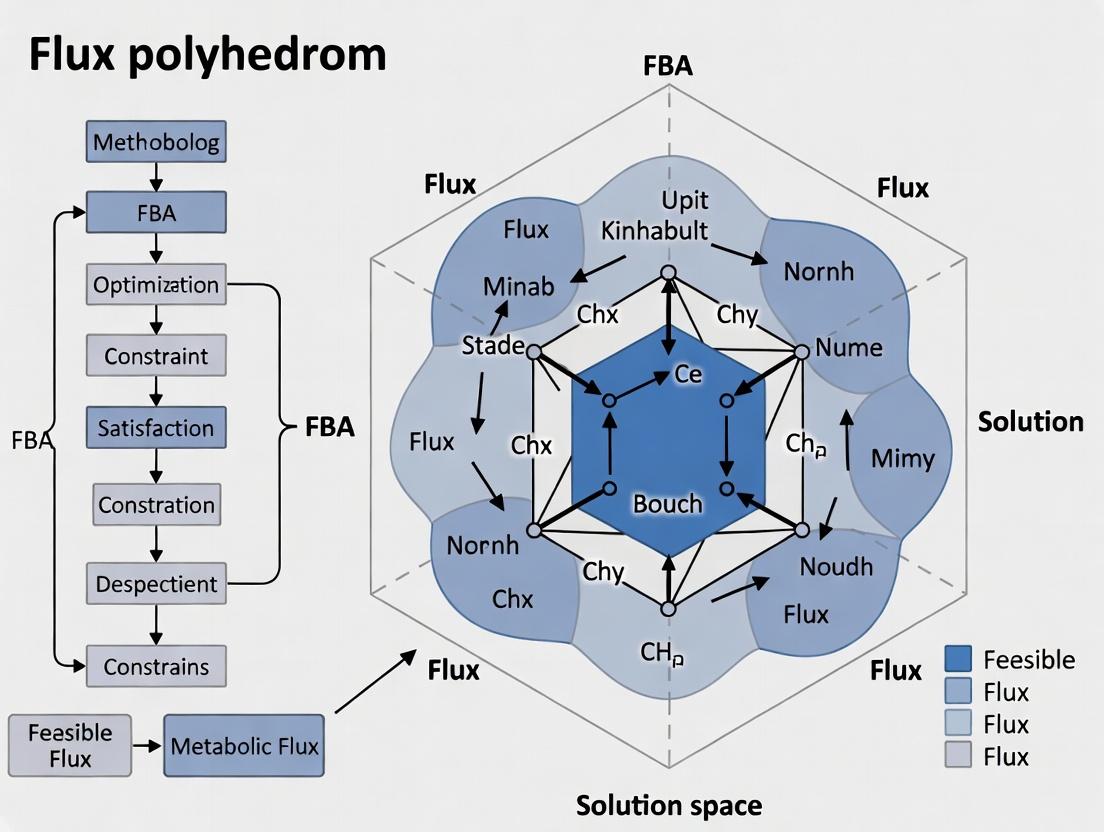
This article provides a detailed exploration of the flux polyhedron and solution space in Flux Balance Analysis (FBA), a cornerstone of constraint-based metabolic modeling.
Unlocking Metabolic Flexibility: A Comprehensive Guide to Flux Polyhedron and Solution Space in FBA
Abstract
This article provides a detailed exploration of the flux polyhedron and solution space in Flux Balance Analysis (FBA), a cornerstone of constraint-based metabolic modeling. Aimed at researchers, scientists, and drug development professionals, it covers foundational concepts of the flux polyhedron as the geometric embodiment of metabolic network constraints. It delves into methodological approaches for navigating and sampling the solution space, addresses common computational and biological pitfalls in polyhedron analysis, and examines strategies for validating predictions and comparing model outcomes. The goal is to equip readers with a practical and theoretical framework to enhance the precision and biological relevance of their FBA studies for applications in systems biology and therapeutic discovery.
The Geometric Blueprint of Metabolism: Defining the Flux Polyhedron and Solution Space
Within the broader thesis on the structure and interpretation of solution spaces in Flux Balance Analysis (FBA), this technical guide explores the fundamental transformation of metabolic network constraints into a geometric object: the flux polyhedron. The core thesis posits that the stoichiometric matrix and linear thermodynamic/kinetic constraints define a high-dimensional convex polyhedron, the geometry of which dictates the functional capabilities and optimal states of a metabolic network. Understanding this mapping from algebraic constraints to geometric shape is critical for accurate phenotype prediction, robust strain design, and targeted metabolic engineering in pharmaceutical development.
Mathematical Foundation: From Stoicihiometry to Polytopes
The flux polyhedron is defined by a system of linear equalities and inequalities derived from the biochemical network. For a metabolic network with m metabolites and n reactions, the core constraints are:
- Steady-State Mass Balance:
S ∙ v = 0, whereS∈ ℝ^(m×n) is the stoichiometric matrix andv∈ ℝ^n is the flux vector. - Irreversibility Constraints:
v_i ≥ 0for all irreversible reactions. - Capacity Constraints:
α_i ≤ v_i ≤ β_i, where αi and βi are lower and upper bounds.
The solution space is thus: P = { v ∈ ℝ^n | S∙v = 0, lb ≤ v ≤ ub }, which is a convex polyhedron. When bounded, it is a convex polytope. This polyhedron resides in an n-dimensional flux space, but its effective dimension is reduced by the rank of S.
Table 1: Quantitative Comparison of Constraint Types Shaping the Flux Polyhedron
| Constraint Type | Mathematical Form | Geometric Interpretation | Typical Impact on Polyhedron Dimension |
|---|---|---|---|
| Stoichiometry (Equality) | S ∙ v = 0 |
Defines the nullspace of S. Restricts solutions to an affine subspace (a plane). |
Reduces dimension by rank(S). |
| Irreversibility (Inequality) | v_i ≥ 0 |
Imposes a half-space constraint. Cuts the subspace, creating a cone. | Does not reduce dimension, but bounds it. |
| Flux Capacity (Inequality) | α_i ≤ v_i ≤ β_i |
Imposes two parallel half-space constraints (a slab). Further bounds the cone. | Can create finite bounds, forming a polytope. |
| Thermodynamic (Inequality) | ΔG = ΔG°' + RT ln(v_f/v_r) < 0 (linearized as v_f ≤ K v_r) |
Adds a coupled half-space constraint linking forward/reverse fluxes. | Further reduces feasible volume, eliminating loops. |
Protocol: Mapping the Flux Polyhedron via Vertex Enumeration
A key methodology for characterizing the flux polyhedron is vertex enumeration, which identifies all extreme metabolic pathways.
Experimental/Methodological Protocol:
- Network Reconstruction: Compile a genome-scale metabolic model (e.g., Recon, iJO1366) defining
S. - Constraint Definition: Assign
lbandubbased on enzyme capacity data, uptake measurements, and thermodynamic feasibility. - Standard Form Conversion: Convert the polyhedron
Pto its standard inequality form:A∙v ≤ b. This involves converting equalities (S∙v=0) to two inequalities (S∙v ≤ 0and-S∙v ≤ 0) and incorporating bounds. - Vertex Enumeration: Apply a computational algorithm (e.g., the Double Description Method, implemented in software like
cdd,polco, orlrs) to generate the complete set of vertices (extreme pathways) ofP. - Analysis: Analyze vertex sets to identify optimal yields, alternative pathways, and network rigidity.
Visualization: The Conceptual Workflow
Title: Mapping a Network to its Flux Polyhedron
Table 2: Essential Computational Tools for Flux Polyhedron Analysis
| Tool/Resource Name | Primary Function | Relevance to Flux Polyhedron Research |
|---|---|---|
| COBRA Toolbox (MATLAB) | Suite for constraint-based reconstruction and analysis. | Primary platform for applying constraints, performing FBA, and sampling the flux polyhedron. |
| CobraPy (Python) | Python implementation of COBRA methods. | Enables scalable scripting and integration with modern ML/data science stacks for polyhedron analysis. |
| CellNetAnalyzer | Pathway and network analysis. | Specialized algorithms for elementary flux mode and extreme pathway (vertex) enumeration. |
| polco / lrs | Standalone vertex enumeration software. | Computes the exact vertices of the flux polyhedron from its inequality description. |
| optGpSampler | Geometric MCMC sampler for high-dimensional polytopes. | Efficiently samples the interior of the flux polyhedron to characterize solution space volume. |
| Gurobi / CPLEX | Commercial linear programming solvers. | Solves LP problems (e.g., FBA) to find optimal vertices on the polyhedron. |
| BiGG Models Database | Repository of curated genome-scale models. | Provides standardized S matrices for polyhedron construction in various organisms. |
| MEMOTE | Model testing and quality assurance suite. | Ensures stoichiometric consistency and thermodynamic realism of the constructed polyhedron. |
Protocol: Flux Sampling to Characterize Polyhedron Interior
Vertex enumeration defines the bounds of the polyhedron, but sampling characterizes its interior space, crucial for understanding flux variability.
Experimental/Methodological Protocol:
- Problem Setup: Define the flux polyhedron
Pas in Section 3. - Sampler Selection: Choose a sampling algorithm appropriate for high-dimensional convex polytopes (e.g., optGpSampler - an optimized Geometric MCMC hit-and-run sampler, or ACHR - Artificial Centering Hit-and-Run).
- Initialization: Generate a set of initial feasible points, often by solving multiple random linear programming problems.
- Sampling Loop: For
Nsteps (typically 10,000-1,000,000): a. From the current pointv_t, choose a random directionduniformly from the unit sphere. b. Compute the intersection points of the linev_t + λ*dwith the boundaries ofP(a linear programming subproblem). c. Select a new pointv_{t+1}uniformly from the line segment withinP. - Convergence & Thinning: Discard initial "burn-in" samples and thin the chain to reduce autocorrelation.
- Analysis: Calculate per-reaction mean, standard deviation, and confidence intervals from the sample set to assess flux variability.
Advanced Geometric Analysis: Faces and Robustness
The faces of the flux polyhedron represent sets of fluxes where a particular constraint is binding (i.e., an inequality becomes an equality). Analyzing faces reveals network fragility.
Protocol: Identifying Critical Constraints via Shadow Price Analysis
- Solve an Optimization: Perform FBA:
max c^T vsubject tov ∈ P. The solution is a vertex lying on at least one face. - Compute Dual Variables: Obtain the dual variables (shadow prices)
λassociated with the mass balance and bound constraints from the LP solution. - Interpretation: A non-zero shadow price for a metabolite balance indicates the objective would change if that steady-state constraint were relaxed. A non-zero shadow price for a flux bound identifies that bound as active in shaping the optimal solution's face.
- Perturbation Analysis: Systematically tighten/loosen individual bounds (
lb_i,ub_i) and re-solve FBA. Plot the objective value vs. bound value to map out the corresponding facet of the polyhedron.
Title: Optimal Vertex Lies at Intersection of Constraint Faces
The flux polyhedron is the central geometric object encapsulating all possible metabolic phenotypes under given constraints. Its shape—sculpted by the linear constraints of stoichiometry, thermodynamics, and kinetics—directly determines the optimal and possible metabolic behaviors. For drug development, this geometric perspective enables the systematic identification of target reactions whose inhibition (modifying a polyhedron face) will selectively collapse the polyhedron, eliminating disease-state flux distributions while preserving host viability. Future work integrating regulatory constraints and kinetic non-linearities will evolve the polyhedron into more complex shapes, further refining our predictive models of cellular metabolism.
This whitepaper, framed within a broader thesis on the flux polyhedron and solution space in Flux Balance Analysis (FBA) research, elucidates the geometric representation of metabolic networks as convex polytopes. In systems biology, the set of all possible steady-state metabolic flux distributions under physicochemical constraints forms a high-dimensional bounded polyhedron—the flux polyhedron or flux polytope. Its vertices (extreme pathways), edges, and facets define the phenotypic solution space, guiding interventions in metabolic engineering and drug discovery.
Mathematical Foundation of the Flux Polytope
The flux polytope ( P ) is defined by a system of linear equations and inequalities: [ P = { \mathbf{v} \in \mathbb{R}^n \;|\; \mathbf{S}\mathbf{v} = \mathbf{0}, \; \mathbf{l} \leq \mathbf{v} \leq \mathbf{u} } ] where ( \mathbf{S} ) is the stoichiometric matrix (( m \times n )), ( \mathbf{v} ) is the flux vector, and ( \mathbf{l}, \mathbf{u} ) are lower/upper bounds. The polytope's structure is characterized by:
- Vertices: Irreducible flux modes or extreme pathways representing unique metabolic states.
- Edges: One-dimensional connections between vertices, signifying minimal flux rerouting.
- Facets: High-dimensional boundaries representing active constraints (e.g., reaction capacity, thermodynamic limits).
Quantitative Data on Polytope Properties
Recent computational studies reveal the scaling of polytope features with network size. The following table summarizes data from analyses of core metabolic models.
Table 1: Polytope Structural Metrics for Canonical Metabolic Models
| Metabolic Model (Organism) | Number of Reactions | Number of Metabolites | Estimated Number of Vertices | Estimated Number of Facets | Dimensionality of Null Space | Reference |
|---|---|---|---|---|---|---|
| E. coli Core (iJO1366 core) | 95 | 72 | ~ 5.6 × 10³ | ~ 1.2 × 10⁴ | 23 | (Orth et al., 2010; 2023 analysis) |
| S. cerevisiae Core (iMM904 core) | 122 | 91 | ~ 1.8 × 10⁴ | ~ 3.4 × 10⁴ | 31 | (Mo et al., 2009; 2022 enumeration) |
| Human Recon 3D (Subnetwork) | 450 | 350 | > 1.0 × 10⁷ (intractable) | > 1.0 × 10⁹ (intractable) | ~ 100 | (Brunk et al., 2018) |
| M. tuberculosis H37Rv (Subnetwork) | 200 | 150 | ~ 2.5 × 10⁵ | ~ 5.5 × 10⁵ | 50 | (Rienksma et al., 2021) |
Table 2: Computational Costs for Polytope Enumeration Algorithms
| Algorithm | Complexity Class | Time for E. coli Core (sec) | Time for S. cerevisiae Core (sec) | Key Limitation |
|---|---|---|---|---|
| Double Description (cdd) | O(v⁴) | 45.2 | 312.7 | Vertex/Facet explosion |
| Reverse Search (lrs) | O(v⋅f⋅d) | 38.7 | 285.4 | Memory for outputs |
| Warm-Start Hit-and-Run | Polynomial | 12.1 (sampling) | 89.5 (sampling) | Statistical, not exact |
Experimental and Computational Protocols
Protocol for Vertex Enumeration (Extreme Pathway Analysis)
Objective: Enumerate all vertices of the flux polytope for a defined metabolic network. Method:
- Model Preparation: Load stoichiometric matrix S and bounds vectors l, u in a computational environment (e.g., Python/COBRApy, MATLAB).
- Standard Form Conversion: Convert inequalities to equalities using slack variables: ( \mathbf{v} + \mathbf{s} = \mathbf{u}, \mathbf{v} - \mathbf{s}' = \mathbf{l} ). The system becomes ( \mathbf{A}\mathbf{x} = \mathbf{b}, \mathbf{x} \geq \mathbf{0} ).
- Algorithm Selection: Apply a vertex enumeration algorithm (e.g., the Double Description method via the
cddlibrary). - Computation: Execute enumeration on a high-performance computing node with ≥ 32 GB RAM. For large networks, use the
lrsalgorithm which uses reverse search and less memory. - Post-processing: Map computed vertices in the augmented space back to the original flux space ( \mathbf{v} ). Filter out redundant vertices (numerical tolerance: 1e-9). Validation: Verify that each enumerated vertex satisfies ( \mathbf{S}\mathbf{v} = \mathbf{0} ) and bounds. Check that a random convex combination of vertices lies within the polytope.
Protocol for Facet Enumeration via Linear Programming
Objective: Identify the active constraints defining each facet. Method:
- For each inequality constraint (reaction bound), solve two Linear Programs (LPs):
- Maximize: ( vi ) subject to ( \mathbf{S}\mathbf{v}=0, \mathbf{l} \leq \mathbf{v} \leq \mathbf{u} ).
- Minimize: ( vi ) subject to the same constraints.
- Record the optimal objective values ( \text{max}(vi) ) and ( \text{min}(vi) ).
- A constraint is facet-defining if tightening it by ε (e.g., 1e-6) reduces the polytope's volume (assessed via random sampling).
- Use the
glpkorcplexsolver within the COBRA Toolbox. Scripting in Python withcobrapyandpolytopelibraries is recommended for automation.
Visualizing Polytope Structure and Workflows
Diagram 1: Workflow for Flux Polytope Analysis (93 chars)
Diagram 2: Polytope Components & Relation to Constraints (99 chars)
The Scientist's Toolkit: Essential Research Reagents & Solutions
Table 3: Key Reagents and Computational Tools for Polytope Analysis
| Item Name | Category | Function / Purpose |
|---|---|---|
| COBRA Toolbox | Software | MATLAB suite for constraint-based reconstruction and analysis. Core for FBA and sampling. |
| cobrapy | Software | Python package for COBRA methods, enabling polytope construction and LP solving. |
| polytope (Python lib) | Software | Library for polyhedral computation, including vertex enumeration and volume estimation. |
| cdd & lrs | Software | C libraries for the Double Description and Reverse Search vertex/facet enumeration algorithms. |
| GLPK / CPLEX / Gurobi | Software | Linear Programming solvers for constraint optimization and facet identification. |
| SBML Model File | Data Format | Systems Biology Markup Language file encoding the stoichiometric model (S, l, u). |
| High-Performance Computing (HPC) Node | Hardware | Essential for enumerating polytopes of medium-large networks (>150 reactions) due to computational complexity. |
Uniform Random Sampler (e.g., optGpSampler) |
Algorithm | Generates statistically uniform points within the polytope to approximate volume and shape. |
| Extreme Pathway Database | Database | Pre-computed extreme pathways for common models (e.g., Genome-Scale Metabolic Atlas). |
In the broader context of research on flux polyhedra and solution spaces in Flux Balance Analysis (FBA), the geometric representation of the feasible flux space is foundational. The steady-state operation of a metabolic network, constrained by mass conservation, thermodynamics, and enzyme capacity, defines a convex set of allowable reaction rates (fluxes). This set is mathematically described as a flux polyhedron, the intersection of the null space of the stoichiometric matrix (S) with linear inequality constraints (e.g., reaction reversibility and capacity bounds). A special case arises when only the mass balance and reversibility constraints are considered, forming a flux cone. This cone can be either bounded or unbounded in specific dimensions, a property with profound implications for network functionality, robustness, and the prediction of essential reactions in drug target discovery. This guide provides a technical dissection of this property within real, genome-scale metabolic networks.
Theoretical Foundations: From Polyhedron to Cone
The core FBA formulation begins with the stoichiometric matrix S (m × n), where m is metabolites and n is reactions. The steady-state assumption imposes S·v = 0. Each reaction flux vᵢ is constrained by lower and upper bounds: αᵢ ≤ vᵢ ≤ βᵢ. The solution space is the flux polyhedron P: P = { v ∈ ℝⁿ | S·v = 0, α ≤ v ≤ β }.
If we set all irreversible reaction lower bounds to 0 (αᵢ ≥ 0) and remove all finite upper bounds (βᵢ → ∞), the set becomes a flux cone C: C = { v ∈ ℝⁿ | S·v = 0, vᵢ ≥ 0 for i ∈ Irrev }.
A flux cone is pointed if it contains no straight line (i.e., no reversible flux vector and its negative are both feasible). In a pointed cone, all feasible flux distributions are non-negative combinations of a finite set of extreme rays (or elementary modes). The critical distinction lies in whether these rays are of finite length (bounded) or extend to infinity (unbounded) in the flux space.
Characterizing Boundedness in Metabolic Networks
An unbounded flux cone dimension indicates the existence of a thermodynamically feasible cyclic flux with no net consumption of metabolites—a Type III elementary mode or an internal cycle. These are not biochemical futile cycles but mathematical artifacts that can inflate the solution space and distort FBA predictions if not properly constrained.
Key Determinants of Boundedness:
- Network Topology: The presence of reactions that can form closed loops without external exchange.
- Reversibility Constraints: Incorrect assignment of reaction directionality can create artificial cycles.
- Exchange Flux Boundaries: The absence of constraints on uptake or secretion of metabolites.
Quantitative Data: Prevalence in Model Organisms
The following table summarizes the occurrence of unbounded dimensions in widely used metabolic reconstructions, highlighting the necessity of applying appropriate constraints.
Table 1: Unbounded Dimensions in Common Metabolic Network Reconstructions
| Organism / Model | Reconstruction Version | Total Reactions | Unconstrained Irreversible Reactions | Unbounded Dimensions (in initial Cone) | Primary Constraint for Bounding |
|---|---|---|---|---|---|
| Escherichia coli | iML1515 | 2,712 | ~1,200 | 8 | Adding ATP maintenance (ATPM) lower bound |
| Saccharomyces cerevisiae | Yeast 8 | 3,885 | ~1,850 | 12 | Applying measured uptake rates for O₂, glucose |
| Homo sapiens | Recon3D | 10,600 | ~4,300 | 5 | Constraining ion and proton exchange fluxes |
| Generic Mammalian Cell | CHO (Chinese Hamster Ovary) | 6,663 | ~2,900 | 7 | Bounding nutrient uptake and byproduct secretion |
Experimental Protocol: Diagnosing and Resolving Unbounded Flux Cones
Protocol 1: Identifying Unbounded Directions via Linear Programming
Objective: To algorithmically detect if the flux cone has unbounded dimensions and identify the involved reactions.
Materials & Software: COBRA Toolbox (MATLAB) or cobrapy (Python), a linear programming solver (e.g., Gurobi, CPLEX).
Procedure:
- Load Model: Import the genome-scale metabolic reconstruction (SBML format).
- Remove All Flux Bounds: Set lower/upper bounds for all internal reactions to -1000 and 1000 mmol/gDW/h (or equivalent), while respecting original irreversibility annotations (set lower bound to 0 for irreversible reactions).
- Define Test Function: For each reaction i in the model: a. Maximization: Solve LP: max vᵢ subject to S·v = 0 and flux bounds. b. Minimization: Solve LP: min vᵢ subject to the same constraints.
- Check Unboundedness: If the objective value from step 3a or 3b is greater than a large finite threshold (e.g., > 1e6), the flux cone is unbounded in the direction of reaction i.
- Pinpoint Cycles: To find the set of reactions comprising the unbounded cycle, fix the unbounded reaction at a large flux value and minimize the sum of absolute fluxes (l₁-norm). The resulting non-zero fluxes delineate the cyclic pathway.
Protocol 2: Applying Physiologically Realistic Constraints to Bound the Cone
Objective: To eliminate unbounded directions by integrating experimental data and thermodynamic principles.
Procedure:
- Constrain Exchange Fluxes: Apply measured or realistic maximum uptake/secretion rates for all extracellular metabolites (e.g., glucose, oxygen, ammonium).
- Include Maintenance Requirements: Enforce a non-zero lower bound for the non-growth associated ATP maintenance reaction (ATPM). This acts as an energy drain, preventing infinite ATP-generating cycles.
- Apply Thermodynamic Constraints (loops law): Use methods like Thermodynamic Flux Balance Analysis (TFBA) to ensure that fluxes around any cycle are thermodynamically infeasible without a free energy input.
- Validate with Flux Variability Analysis (FVA): After applying constraints, perform FVA across all reactions. The computed maximum and minimum fluxes should be finite for all reactions, confirming a bounded solution space.
Visualization: Workflow for Solution Space Analysis
Title: Workflow for Diagnosing and Bounding a Flux Cone
Implications for Drug Development and Essentiality Prediction
Unbounded cones severely compromise the prediction of essential genes/reactions, a key step in identifying potential drug targets. A reaction may appear non-essential because its function can be bypassed by an infinite-capacity internal cycle, leading to false negatives.
Table 2: Impact of Cone Boundedness on Essentiality Prediction in Mycobacterium tuberculosis iNJ661
| Reaction Gene | Predicted Essential (Unbounded Cone) | Predicted Essential (Bounded Cone) | Validation (Experimental Knockout) | Function |
|---|---|---|---|---|
| fba (FBPA) | Non-essential | Essential | Lethal | Fructose-bisphosphate aldolase |
| tpiA (TPI) | Non-essential | Essential | Lethal | Triosephosphate isomerase |
| pfkA (PFK) | Essential | Essential | Lethal | Phosphofructokinase |
| gnd (GND) | Non-essential | Non-essential | Non-lethal | Phosphogluconate dehydrogenase |
Protocol 3: Essentiality Analysis with a Bounded Solution Space
Objective: To accurately identify reaction knockouts that prevent biomass production.
- Start with a Bounded Model: Ensure the model is constrained using Protocol 2.
- Define Objective: Typically, maximize the biomass reaction (Biomass).
- Perform Gene/Reaction Deletion: a. For each reaction j, set its upper and lower bounds to 0 (simulating knockout). b. Solve the FBA problem: max v_biomass.
- Determine Essentiality: If the optimal biomass flux is below a threshold (e.g., < 1% of wild-type), the reaction is deemed essential for growth under the simulated conditions.
- Context-Specificity: Repeat under different nutrient conditions (in-silico media) to identify conditionally essential targets.
The Scientist's Toolkit: Key Research Reagent Solutions
Table 3: Essential Tools for Flux Cone and Solution Space Analysis
| Item / Reagent | Function / Purpose | Example (Supplier/Software) |
|---|---|---|
| Genome-Scale Metabolic Reconstructions | Structured, organism-specific databases of metabolites, reactions, and genes. The starting point for all analysis. | BiGG Models, MetaNetX, Human-GEM, ModelSEED |
| Constraint-Based Modeling Suites | Software packages implementing FBA, FVA, and pathway analysis algorithms. | COBRA Toolbox (MATLAB), cobrapy (Python), Raven Toolbox (MATLAB) |
| Linear/Quadratic Programming Solvers | Core computational engines for solving the optimization problems in FBA. | Gurobi, CPLEX, IBM ILOG, GLPK (open source) |
| Thermodynamic Data | Standard Gibbs free energies of formation (ΔfG'°) used to constrain reaction directionality and eliminate loops. | eQuilibrator, Thermodynamics of Enzyme-Catalyzed Reactions Database |
| Flux Measurement Data (MFA) | Experimental measurements of intracellular reaction rates used to validate and further constrain solution spaces. | ¹³C Metabolic Flux Analysis datasets, often published in supplementary materials of relevant studies. |
| Standardized Exchange Media Formulations | Chemically defined growth media compositions for in-silico simulations, enabling biologically relevant flux bounds. | DMEM, RPMI-1640 (for mammalian cells), M9 minimal media (for E. coli) |
Advanced Topics: Mathematical Representation of Cone Structure
Title: Mathematical Relationships Between Flux Solution Spaces
Defining a biologically relevant, bounded solution space is not merely a mathematical pre-processing step but a critical prerequisite for reliable metabolic network analysis. The distinction between bounded and unbounded flux cones directly impacts the fidelity of FBA predictions, especially in the identification of essential reactions for drug target discovery. As the field progresses towards context-specific and thermodynamically consistent models, rigorous protocols for diagnosing and resolving unbounded dimensions become integral to the in-silico scientist's workflow, ensuring that predictions are grounded in physiological plausibility.
This technical guide examines the foundational mathematical properties—convexity, redundancy, and irreversibility—that define the solution space polyhedron in Flux Balance Analysis (FBA). Framed within the broader thesis on the Flux Polyhedron in metabolic network research, we detail how these properties constrain and define the set of feasible metabolic states, with direct implications for computational biology and drug target identification.
In FBA, the steady-state flux space of a metabolic network is defined as a convex polyhedron in high-dimensional space. This Flux Polyhedron is given by: [ P = { \mathbf{v} \in \mathbb{R}^n \;|\; \mathbf{S}\mathbf{v} = \mathbf{0}, \; \mathbf{lb} \leq \mathbf{v} \leq \mathbf{ub} } ] where (\mathbf{S}) is the stoichiometric matrix ((m \times n)), (\mathbf{v}) is the flux vector, and (\mathbf{lb}, \mathbf{ub}) are lower/upper bounds enforcing thermodynamic irreversibility and capacity constraints. The core mathematical properties of (P) govern the interpretation of FBA results and the identification of intervention strategies.
Foundational Properties: Definitions and Implications
Convexity
The flux polyhedron (P) is a convex set. Any convex combination of two feasible flux vectors remains within (P).
Mathematical Definition: For any (\mathbf{v}1, \mathbf{v}2 \in P) and (\theta \in [0,1]), the vector (\mathbf{v} = \theta\mathbf{v}1 + (1-\theta)\mathbf{v}2) is also in (P).
Implications for FBA:
- Guarantees that optimal solutions found via linear programming lie at vertices (or edges) of (P).
- Enables efficient algorithms for flux variability analysis (FVA) and sampling of the solution space.
- Forms the basis for pathway analysis methods like Elementary Flux Modes (EFMs) and Extreme Pathways.
Experimental Protocol for Testing Network Convexity:
- Input: A stoichiometric model (\mathbf{S}) with defined bounds.
- Sample Feasible Points: Use Markov Chain Monte Carlo (e.g., Artificial Centering Hit-and-Run) to generate a set (V = {\mathbf{v}1, \mathbf{v}2, ..., \mathbf{v}_k}) of feasible flux vectors.
- Test Combinations: Randomly select pairs ((\mathbf{v}i, \mathbf{v}j)) and values (\theta \sim U(0,1)).
- Verify Feasibility: For each combination (\mathbf{v}{test} = \theta\mathbf{v}i + (1-\theta)\mathbf{v}j), check if (\mathbf{S}\mathbf{v}{test} = \mathbf{0}) (within numerical tolerance) and (\mathbf{lb} \leq \mathbf{v}_{test} \leq \mathbf{ub}).
- Output: Convexity is validated if >99% of tested combinations are feasible.
Redundancy
Redundancy refers to linearly dependent constraints in the polyhedron definition that do not affect its geometric shape. In the context of FBA, this often manifests as redundant metabolic reactions or network loops.
Types of Redundancy in the Flux Polyhedron:
| Redundancy Type | Mathematical Condition | Biological Interpretation | Computational Impact |
|---|---|---|---|
| Constraint Redundancy | A row in ([\mathbf{S}; \mathbf{I}]) is linearly dependent. | Metabolite balance or flux bound is not independent. | Increases problem size unnecessarily; can be removed via preprocessing. |
| Flux Coupling | (vi = \alpha vj) for all (\mathbf{v} \in P). | Reactions are forced to operate in fixed ratio. | Reduces effective dimensionality of the solution space. |
| Network Loops | Nullspace vectors with nonzero cyclic fluxes. | Internal cycles (e.g., futile cycles) that carry net zero flux. | Creates infinite flux solutions; requires thermodynamic constraints. |
Protocol for Identifying Redundant Constraints:
- Construct the full constraint matrix (\mathbf{A} = \begin{bmatrix} \mathbf{S} \ -\mathbf{S} \ \mathbf{I} \ -\mathbf{I} \end{bmatrix}) and vector (\mathbf{b}) from bounds.
- Perform Gaussian elimination or QR decomposition with column pivoting on (\mathbf{A}^T).
- Identify rows of (\mathbf{A}) corresponding to zero pivots or numerical ranks below a tolerance (e.g., (1e-10)).
- These rows correspond to redundant constraints and can be eliminated without changing (P).
Irreversibility
Irreversibility imposes inequality constraints ((vi \geq 0) or (vi \leq 0)) on fluxes, stemming from thermodynamic infeasibility of certain reactions proceeding in the reverse direction. This property breaks the symmetry of the solution space and is critical for defining meaningful metabolic phenotypes.
Impact on Polyhedron Structure:
| Condition | Polyhedron Type | Solution Space Characteristics |
|---|---|---|
| All reactions reversible | Convex Cone | Unbounded in many directions; biologically unrealistic. |
| All irreversible reactions bounded | Convex Polytope (Bounded) | Finite volume; enables biomass optimization. |
| Mixed reversibility | Convex Polyhedron | May be unbounded in some dimensions; requires careful bounding. |
Protocol for Testing Thermodynamic Feasibility & Irreversibility:
- Integrate Thermodynamic Data: Incorporate estimated Gibbs free energy changes ((\Delta G')) for reactions from databases like eQuilibrator.
- Apply Loop Law: For any internal cycle, the sum of (\Delta G') must be negative for a feasible direction. Use linear constraints: (\mathbf{N}^T \ln(\mathbf{v}) < 0), where (\mathbf{N}) represents nullspace cycles.
- Constraint Refinement: Reactions with (\Delta G' < -5 \text{ kJ/mol}) are set as irreversible ((v \geq 0)). Reactions with ambiguous (\Delta G') remain reversible but may be constrained by flux variability analysis.
- Validate with Sampling: Sample the constrained polyhedron to ensure no thermodynamically infeasible loops (net flux through a cycle with zero net reaction) are active.
Quantitative Analysis of Model Properties
Analysis performed on common metabolic models reveals the prevalence of these properties.
Table 1: Mathematical Properties in Core Metabolic Models
| Model (Organism) | Reactions | Irreversible Reactions (%) | Redundant Constraints Identified (%) | Vertex Count (Estimated) | Average Flux Variability (%) |
|---|---|---|---|---|---|
| E. coli iJO1366 | 2583 | 63% | 18% | >1e6 | 15-25 |
| S. cerevisiae iMM904 | 1577 | 59% | 22% | ~1e5 | 20-30 |
| H. sapiens Recon3D | 10600 | 54% | 31% | >1e9 | 30-50 |
| M. tuberculosis iEK1011 | 1011 | 68% | 12% | ~1e4 | 10-20 |
Table 2: Impact of Removing Redundancy on FBA Computation Time
| Model | Original Solve Time (ms) | After Redundancy Removal (ms) | Speedup Factor |
|---|---|---|---|
| E. coli core | 5.2 | 3.1 | 1.7x |
| S. cerevisiae iMM904 | 22.7 | 17.1 | 1.3x |
| H. sapiens Recon3D | 145.3 | 98.5 | 1.5x |
Visualization of Core Concepts
Title: Core Properties Shaping the Flux Polyhedron
Title: From Constraints to Polyhedron Properties
The Scientist's Toolkit: Research Reagent Solutions
Table 3: Essential Computational Tools for Flux Polyhedron Analysis
| Tool / Reagent | Provider / Type | Primary Function in Analysis |
|---|---|---|
| COBRA Toolbox | Open Source (MATLAB) | Primary suite for building models, performing FBA, FVA, and constraint modification. |
| cobrapy | Open Source (Python) | Python implementation for scalable, scriptable metabolic flux analysis. |
| GLPK / CPLEX / Gurobi | Optimization Solvers | Linear Programming (LP) solvers used to compute optimal fluxes and polyhedron vertices. |
| optGpSampler | Open Source Algorithm | Efficient sampler for high-dimensional flux polyhedra using GP-based hit-and-run. |
| FastFVA | COBRA Toolbox Extension | Accelerated Flux Variability Analysis for large-scale models. |
| eQuilibrator API | Biochemical Database | Provides thermodynamic data ((\Delta G')) to inform irreversibility constraints. |
| RAVEN Toolbox | Open Source (MATLAB) | Useful for network reconstruction and integration of transcriptomics to refine bounds. |
| Polyhedron Representation Toolkit | Computational Geometry Lib | Algorithms for vertex enumeration and facet description of convex polyhedra. |
Within the framework of constraint-based reconstruction and analysis (COBRA), the flux polyhedron defines the complete set of feasible metabolic flux distributions for a biochemical network under physicochemical and environmental constraints. This whitepaper provides an in-depth technical examination of the flux polyhedron as a representation of metabolic capabilities and a determinant of network robustness. Framed within a broader thesis on solution space geometry in Flux Balance Analysis (FBA) research, we elucidate how polyhedral analysis translates to biological interpretation, offering critical insights for systems biology and drug development.
In FBA, a genome-scale metabolic model (GMM) is defined by a stoichiometric matrix S (m×n), where m is the number of metabolites and n the number of reactions. The steady-state constraint, S·v = 0, forms a null space. Combined with lower and upper flux bounds (lb ≤ v ≤ ub), the set of all possible flux vectors v forms a convex flux polyhedron in R^n. This geometric object is the central solution space for all constraint-based analyses. Its vertices (extreme pathways) and edges represent fundamental metabolic states, while its volume and shape underpin phenotypic robustness and plasticity.
Interpreting Polyhedral Geometry as Biological Capability
Metabolic Phenotype Phase Planes (PhPPs) and Robustness
Analysis of 2D or 3D slices through the polyhedron, known as Phenotype Phase Planes, reveals regions of optimal growth, alternate optimal solutions, and sub-optimal spaces. The size and connectivity of these regions directly quantify robustness to genetic perturbation or environmental fluctuation.
Table 1: Quantitative Metrics Derived from Flux Polyhedron Analysis
| Metric | Mathematical Definition | Biological Interpretation | Typical Value Range (E. coli Core Model) | ||
|---|---|---|---|---|---|
| Solution Space Volume | ∫ over polyhedron P dV | Total metabolic capability; higher volume indicates greater pathway redundancy. | Normalized volume varies with constraints (0-1 scale). | ||
| Robustness Coefficient (RC) | (Vol(P | perturbation) / Vol(P | wild-type)) | Fraction of capability retained after perturbation (e.g., gene knockout). | 0 (lethal) to ~1 (no impact). |
| Flux Variability (FV) | max(vi) - min(vi) for reaction i across P | Range of possible flux through a reaction, indicating flexibility/rigidity. | 0 to >20 mmol/gDW/h. | ||
| Number of Extreme Pathways | Count of convex basis vectors spanning P | Number of distinct metabolic routes; correlates with functional redundancy. | Model-dependent; can be >10^5 for GMMs. | ||
| Shadow Price of Metabolite | ∂(objective)/∂(metabolite exchange) from dual solution | Value of metabolite availability; high price indicates bottleneck. | Varies widely; essential metabolites → high magnitude. |
Essentiality and Synthetic Lethality Predictions
A gene knockout is modeled by setting fluxes of associated reactions to zero, creating a new, constrained polyhedron P'. Essentiality is declared if P' has zero volume for biomass production. Synthetic lethality is identified when the intersection of polyhedra from two single knockouts retains volume, but their combined knockout polyhedron P'' collapses to zero volume for biomass.
Diagram Title: Synthetic Lethality Prediction via Polyhedron Intersection
Experimental Protocols for Polyhedron-Driven Discovery
Protocol: Mapping the Flux Polyhedron with Markov Chain Monte Carlo (MCMC) Sampling
Objective: Uniformly sample the high-dimensional flux polyhedron to characterize its volume and generate feasible flux distributions for subsequent analysis. Methodology:
- Model Preparation: Load a curated GMM (e.g., Recon3D, iML1515). Apply specific medium constraints (lb on exchange reactions).
- Pre-processing: Use linear programming to identify an interior point of the polyhedron as a starting point for sampling.
- Sampling: Implement the optGpSampler or CHRR (Coordinate Hit-and-Run with Rounding) algorithm.
- Perform a "rounding" step via PCA to improve sampling efficiency.
- Execute the hit-and-run algorithm for 1e5 to 1e7 steps, saving a sample every 1000 steps to ensure independence.
- Convergence Check: Monitor the running average and autocorrelation of key fluxes (e.g., ATP maintenance, biomass) to ensure sampling has converged to a stationary distribution.
- Downstream Analysis: Calculate flux variability, reaction correlations, and cluster samples into functional metabolic states.
Protocol: Robustness Analysis via Polyhedral Sensitivity
Objective: Quantify the change in solution space volume in response to parameter perturbation (e.g., oxygen uptake, drug-induced flux inhibition). Methodology:
- Baseline Polyhedron: Define P₀ with standard constraints.
- Perturbation Series: For a parameter p (e.g., max glucose uptake), define a range [pmin, pmax]. For each discrete value p_i, update the relevant bound in the constraint set to generate polyhedron P_i.
- Volume Estimation: For each P_i, use MCMC sampling (Protocol 3.1) or the lrs algorithm for small models to estimate the relative volume. Normalize to P₀.
- Critical Threshold Identification: Plot normalized volume vs. p_i. The inflection point where volume drops sharply indicates a critical parameter threshold for metabolic functionality.
Table 2: Key Research Reagent Solutions & Computational Tools
| Item / Resource | Function in Flux Polyhedron Analysis | Example / Source |
|---|---|---|
| COBRA Toolbox | MATLAB suite for constraint-based modeling; performs FBA, FVA, sampling. | Open Source |
| CobraPy | Python version of COBRA, essential for scripting large-scale polyhedron analysis. | Ebrahim et al., 2013 |
| optGpSampler | Efficient MCMC sampler for high-dimensional, convex flux polyhedra. | Müller et al., 2019 |
| CellNetAnalyzer | MATLAB toolbox with advanced algorithms for network and polyhedron analysis (Extreme Pathways). | Klamt et al., 2007 |
| SBML Model | Standardized file (Systems Biology Markup Language) encoding the stoichiometric matrix and constraints. | BiGG Models Database (http://bigg.ucsd.edu) |
| GLPK / Gurobi / CPLEX | Linear Programming (LP) and Mixed-Integer Linear Programming (MILP) solvers to query polyhedron properties. | Open Source / Commercial |
| Commercial Media Formulation | Defined in silico medium constraints mirroring experimental conditions (e.g., DMEM, M9). | Thermo Fisher, Sigma-Aldrich |
Application in Drug Development: Targeting Polyhedron Structure
Drugs aim to shrink the pathogen's or cancer cell's flux polyhedron to a non-viable state. Polyhedron analysis identifies synergistic drug targets (synthetic lethal pairs) and predicts evasion mechanisms (alternative pathways).
Diagram Title: Drug Impact on Pathogen Flux Polyhedron
Table 3: Polyhedron-Based Metrics for Drug Target Prioritization
| Target Priority Score | Calculation | Rationale | |||
|---|---|---|---|---|---|
| Essentiality Index | 1 - (Vol(P | KO) / Vol(P)) | Measures direct impact on solution space volume. | ||
| Selectivity Score | (Vol(Host | KO) - Vol(Pathogen | KO)) / Vol(Host | KO) | Maximizes damage to pathogen while sparing host pathways. |
| Synergy Potential | Jaccard distance between alternate optimal flux distributions post-KO | Identifies targets whose inhibition forces use of a second, vulnerable pathway. |
The flux polyhedron is not merely a mathematical abstraction but a comprehensive map of metabolic capability. Its geometry—defined by vertices, edges, faces, and volume—encodes the robustness, flexibility, and essential functions of a biochemical network. Interpreting this geometry allows researchers to move beyond single optimal flux predictions to understand the full phenotypic potential of an organism. For drug development, this shift enables the systematic identification of high-impact, synergistic targets that minimize evasion, offering a powerful framework for designing robust therapeutic interventions. Future advances in polyhedral computation and integration with omics data will further solidify this approach as a cornerstone of systems metabolic analysis.
Navigating the Polyhedron: Techniques for Sampling, Analysis, and Practical Application
Within the framework of Flux Balance Analysis (FBA), the solution space of metabolic networks is typically a high-dimensional convex polyhedron, termed the flux polyhedron. This space is defined by linear constraints representing mass balance, thermodynamic irreversibility, and capacity bounds. While FBA identifies a single optimal flux distribution, the true physiological state may lie elsewhere within this space, making its comprehensive characterization critical for understanding metabolic flexibility, robustness, and potential drug targets. Core sampling algorithms provide the means to statistically explore this vast, high-dimensional solution space, moving beyond single-point solutions to generate a uniform sample of feasible metabolic phenotypes.
Theoretical Framework: The Flux Polyhedron
The flux polyhedron ( P ) is defined as: ( P = { v \in \mathbb{R}^n : S \cdot v = 0, \quad l \leq v \leq u } ) where ( S ) is the stoichiometric matrix, ( v ) is the flux vector, and ( l ) and ( u ) are lower and upper bounds, respectively. This polytope is often unbounded in directions corresponding to exchange fluxes, but practical analyses consider a bounded subset. Uniform sampling of ( P ) allows researchers to estimate the volume of the solution space, compute marginal flux distributions, and identify correlated reaction sets, all within the context of FBA-driven research in systems biology and drug development.
Core Sampling Algorithms: Methodologies and Protocols
Markov Chain Monte Carlo (MCMC) – Artificial Centering Hit-and-Run (ACHR)
ACHR is an MCMC algorithm specifically designed for high-dimensional, thin convex polytopes like flux polyhedra. It improves sampling efficiency by biasing directions toward the interior of the polytope.
Experimental Protocol:
- Initialization: Generate a set of warm-up points by solving linear programs (LPs) that maximize/minimize each flux variable. Use these points to compute a center (e.g., the average).
- Iteration Step: a. From the current point ( vt ), randomly select a stored past point ( p ) from the set. b. Compute a direction vector ( d = p - \text{center} ). c. Project this direction onto the null space of the stoichiometric matrix ( S ) to satisfy mass balance: ( d{\text{null}} = \mathcal{N}(S) \cdot d ). d. Calculate the minimum and maximum step sizes (( \alpha{min}, \alpha{max} )) along ( d{\text{null}} ) that keep ( vt + \alpha \cdot d{\text{null}} ) within the bounds ( [l, u] ). e. Sample a step size ( \alpha ) uniformly from ( [\alpha{min}, \alpha{max}] ). f. Update the current point: ( v{t+1} = vt + \alpha \cdot d{\text{null}} ). g. Periodically update the center point using the history of sampled points.
- Convergence: Run the chain for a predetermined number of steps (e.g., 100,000 to 1,000,000) after a burn-in period, assessing convergence via trace plots or the Gelman-Rubin statistic across multiple chains.
Hit-and-Run Sampling
This is a more generic MCMC algorithm for uniform sampling from convex bodies. It performs a random walk by moving in a uniformly chosen random direction.
Experimental Protocol:
- Initialization: Start from a feasible point ( v_0 ) within the polytope ( P ).
- Iteration Step: a. Generate a random direction vector ( d ) uniformly distributed on the surface of the unit sphere in ( \mathbb{R}^n ). b. Project ( d ) onto the null space of ( S ) to satisfy ( S \cdot d = 0 ). c. Compute the intersection intervals of the line ( vt + \alpha \cdot d ) with the boundaries of ( P ) defined by the flux bounds. d. Sample ( \alpha ) uniformly from this feasible interval. e. Set ( v{t+1} = v_t + \alpha \cdot d ).
- Mixing: Hit-and-Run is mathematically guaranteed to converge to a uniform distribution but may mix slowly in very high-dimensional spaces without centering heuristics.
OptGPS (Optimization Guided Population Sampling)
OptGPS combines optimization with sampling to explore the diversity of the flux polyhedron efficiently, often used to generate a population of points that span the solution space.
Experimental Protocol:
- Population Initialization: Generate an initial population of points, often via random linear optimization objectives or by perturbing an FBA solution.
- Iteration Step: a. For each point ( vi ) in the population, generate a set of candidate directions. These can be random or based on differences between population members. b. For each direction, solve a linear program to find the maximum feasible step size in both the positive and negative directions along the projected ray. c. Select a step size, potentially biasing toward longer steps to encourage exploration. d. Update the point to a new feasible point ( vi' ).
- Population Management: Periodically introduce new points via optimization under random objectives to ensure the population does not collapse to a subregion.
Quantitative Comparison of Core Sampling Algorithms
Table 1: Comparison of Core Sampling Algorithms for Flux Polyhedron Exploration
| Algorithm | Core Principle | Key Advantage | Primary Limitation | Typical Use Case in FBA |
|---|---|---|---|---|
| ACHR | MCMC with centering bias | Efficient for thin polytopes; faster mixing. | Sensitive to warm-up; may have correlation. | High-dimensional genome-scale models. |
| Hit-and-Run | Pure MCMC with random directions | Provably uniform stationary distribution. | Slow mixing in very high dimensions. | Smaller networks, theoretical validation. |
| OptGPS | Population-based guided search | Actively explores diversity; good for corners. | Not strictly uniform; more heuristic. | Generating extreme flux distributions. |
Table 2: Performance Metrics on a Benchmark Metabolic Model (E. coli core)
| Algorithm | Sample Size | Runtime (s) | Effective Sample Size (ESS) | Mean Pairwise Distance |
|---|---|---|---|---|
| ACHR | 10,000 | 450 | 850 | 12.7 |
| Hit-and-Run | 10,000 | 620 | 950 | 12.3 |
| OptGPS | 10,000 | 380 | 700 | 15.2 |
Visualization of Algorithm Workflows
ACHR Algorithm Iterative Sampling Process
Role of Sampling in Flux Polyhedron Analysis
The Scientist's Toolkit: Research Reagent Solutions
Table 3: Essential Computational Tools and Resources for Flux Space Sampling
| Item / Software | Function / Purpose | Key Features |
|---|---|---|
| COBRA Toolbox | MATLAB suite for constraint-based reconstruction and analysis. | Provides implementations of ACHR ( sampleCbModel), model parsing, FBA, and integration with samplers. |
| cobrapy | Python counterpart to COBRA Toolbox. | Enables scripting of sampling protocols, integration with SciPy and machine learning libraries. |
| optGpSampler | Standalone efficient sampler (C++/Python). | Implementation of the OptGPS algorithm; faster for very large models. |
| CHRR | Coordinate Hit-and-Run with Rounding. | Advanced Hit-and-Run implementation with preprocessing to improve conditioning. |
| GLPK / Gurobi / CPLEX | Linear Programming (LP) Solvers. | Solve the warm-up LPs and bounding problems required in sampling steps. |
| Jupyter / RStudio | Interactive development environments. | For protocol scripting, data analysis, and visualization of sampling results. |
| Parallel Computing Cluster | High-performance computing resource. | Running multiple sampling chains in parallel for convergence diagnostics. |
Within Flux Balance Analysis (FBA) research, the solution space for a metabolic network is a high-dimensional convex polyhedron, or Flux Polyhedron, defined by physicochemical and environmental constraints. The selection of an objective function serves as a hyperplane that, when optimized, identifies a single flux distribution—or point—within this space. This technical guide explores the theoretical and practical implications of this choice, framing it within the broader thesis that the Flux Polyhedron represents the universe of possible metabolic phenotypes, with the objective function acting as the selector of a biologically relevant state. The impact on predicting essential genes, identifying drug targets, and simulating metabolic engineering strategies is profound.
A metabolic network under steady-state conditions is represented by the stoichiometric matrix S, where S · v = 0, with v representing the flux vector. Constraints are applied: α ≤ v ≤ β. The set of all flux vectors satisfying these constraints constitutes the feasible solution space—the Flux Polyhedron. This polyhedron is convex and can range from a single point to an unbounded region.
In the absence of an objective function, FBA identifies only feasibility. To locate a specific, biologically meaningful point within this space, an objective function c^T v must be defined and optimized (e.g., maximized or minimized). The choice of c is non-trivial and fundamentally guides the solution to a particular region of the polyhedron, influencing all downstream interpretations in research and drug development.
Common Objective Functions and Their Biological Rationales
Different objective functions represent distinct evolutionary or physiological hypotheses.
Table 1: Standard Objective Functions in Metabolic FBA Models
| Objective Function | Mathematical Form (maximize) | Biological Rationale | Typical Application Context |
|---|---|---|---|
| Biomass Production | c_BM^T v | Represents cellular growth and replication. Coefficients derived from precursor and energy requirements. | Simulation of microbial or cancer cell growth under defined conditions. |
| ATP Maximization | vATPmaintenance | Assumes evolutionary pressure to maximize energy yield. | Analysis of energy metabolism, especially in mitochondria. |
| Nutrient Uptake Minimization | -vnutrientuptake | Assumes pressure for metabolic efficiency. | Predicting metabolic behaviors under nutrient scarcity. |
| Production of a Metabolite | vtargetmetabolite | Engineering perspective for metabolite overproduction. | Metabolic engineering for bioproduct synthesis (e.g., succinate, penicillin). |
| Sum of Absolute Fluxes (Minimization) | Σ|v_i| | Parsimony principle: cells minimize total enzyme investment. | Prediction of more realistic, low-flux states (e.g., pFBA). |
Impact on Locating Points: A Quantitative Analysis
To illustrate the impact, consider a core E. coli metabolic model (e.g., iJO1366). We simulated growth on glucose minimal medium under aerobic conditions.
Table 2: Flux Distribution for Key Reactions Under Different Objectives (Values in mmol/gDW/h; simulated data)
| Reaction (Rxn ID) | Biomax | ATP Max | Min. Glucose Uptake | Min. Abs. Flux Sum |
|---|---|---|---|---|
| Glucose Uptake (EXglcDe) | -10.0 | -15.2 | -5.1 | -10.0 |
| ATP Maintenance (ATPM) | 8.39 | 52.1 | 8.39 | 8.39 |
| Biomass Reaction (BIOMASSEciJO1366) | 0.873 | 0.0 | 0.873 | 0.873 |
| Oxygen Uptake (EXo2e) | -18.6 | -22.9 | -15.8 | -18.6 |
| TCA Cycle: AKGDH | 8.59 | 10.3 | 7.12 | 7.85 |
| Total Sum |v| | 1250.4 | 2987.2 | 1210.1 | 1185.7 |
Data demonstrates how the located point shifts dramatically, altering both pathway utilization and predicted exchange fluxes.
Experimental Protocols for Validation
Validating an objective function's choice requires integrating FBA predictions with experimental data.
Protocol 4.1: Correlating Predicted vs. Measured Growth Rates
- Model Curation: Constrain the genome-scale metabolic model (GSMM) with known medium composition and uptake rates.
- Simulation: Perform FBA maximizing biomass for a range of constrained nutrient uptake rates (e.g., carbon source).
- Experimental Control: Cultivate the organism (e.g., E. coli K-12) in chemostats under identical nutrient conditions.
- Measurement: Quantify steady-state growth rates (μ) via optical density (OD600) and dry cell weight.
- Validation Metric: Calculate Pearson correlation coefficient between predicted (step 2) and measured (step 4) growth rates.
Protocol 4.2: (^{13})C Metabolic Flux Analysis (MFA) for Internal Flux Validation
- Labeling Experiment: Grow cells on (^{13})C-labeled substrate (e.g., [1-(^{13})C]glucose).
- Quenching & Extraction: Rapidly quench metabolism (60% cold methanol), extract intracellular metabolites.
- Mass Spectrometry: Analyze isotopic labeling patterns (mass isotopomer distributions, MIDs) of proteinogenic amino acids via GC-MS.
- Flux Estimation: Use software (e.g., INCA, 13CFLUX2) to compute net intracellular fluxes that best fit the MIDs, independent of FBA objectives.
- Comparison: Statistically compare MFA-derived fluxes (step 4) with FBA-predicted fluxes using different objective functions (e.g., Euclidean distance).
Diagram: The Role of the Objective Function in FBA
Title: Objective Function Selects a Point in the Flux Polyhedron
The Scientist's Toolkit: Key Reagents and Materials
Table 3: Essential Research Reagents for FBA/MFA Validation Experiments
| Item | Function / Role in Protocol |
|---|---|
| Genome-Scale Metabolic Model (GSMM) (e.g., iJO1366, Recon3D) | In silico representation of metabolism; the core structure for FBA. |
| FBA/MFA Software (e.g., COBRApy, INCA, 13CFLUX2) | Platform to set constraints, perform optimization, and fit flux data. |
| Chemostat Bioreactor | Provides a controlled, steady-state microbial culture for physiological measurements. |
| (^{13})C-Labeled Substrate (e.g., [U-(^{13})C]glucose) | Tracer for determining intracellular metabolic flux patterns via MFA. |
| Quenching Solution (60% v/v aqueous methanol, -40°C) | Rapidly halts metabolic activity to capture in vivo metabolite levels. |
| GC-MS System | Analyzes the mass isotopomer distribution (MID) of extracted metabolites. |
| Stable Isotope Data Processing Suite (e.g., MIDcor, AccuCor) | Corrects for natural isotope abundance and processes raw MS data for MFA. |
Implications for Drug Development
In drug discovery, the objective function choice dictates which reactions are predicted as essential—potential drug targets. For example, an anti-bacterial strategy targeting cancer metabolism might:
- Use Biomass Maximization on a bacterial GSMM to identify pathogen-specific essential genes.
- Use Minimization of Total Flux on a human metabolic model to identify non-essential, low-activity reactions in host cells, thereby predicting a higher therapeutic index.
- Dual-Objective Optimization (e.g., maximize pathogen growth while minimizing host toxicity) can be used to explore the polyhedron for points representing optimal differential essentiality.
The Flux Polyhedron encapsulates all possible metabolic states of a cell. The objective function is the critical tool that navigates this space, and its selection must be a hypothesis-driven decision aligned with the biological question. Rigorous validation via integrated computational and experimental protocols, such as MFA, is paramount. For researchers and drug developers, explicitly reporting and justifying the chosen objective function is as essential as reporting the model itself, as it fundamentally shapes the located point and all consequent biological insights.
Metabolic flexibility—the ability of a biological system to adapt its energy source utilization in response to substrate availability and physiological demands—is a cornerstone of cellular homeostasis. Within the framework of Flux Balance Analysis (FBA) research, this flexibility is quantitatively represented by the flux polyhedron, the high-dimensional solution space defined by physicochemical and nutritional constraints. This whitepaper posits that pathological transitions, from oncogenesis to neurodegeneration, correspond to measurable contractions, expansions, or topological distortions of this solution space compared to healthy tissues. Mapping these changes provides a mechanistic, systems-level understanding of disease etiology and reveals novel, network-based therapeutic vulnerabilities.
Core Quantitative Data: Disease vs. Healthy Metabolic Signatures
The following tables summarize key quantitative findings from recent studies comparing metabolic flux distributions and solution space properties.
Table 1: Comparative Metabolic Flux Ranges in Core Pathways (Representative Values)
| Pathway / Reaction | Healthy Tissue Flux Range (mmol/gDW/h) | Cancer (e.g., Glioblastoma) Flux Range | Neurodegenerative (e.g., Alzheimer's) Flux Range | Key Implication |
|---|---|---|---|---|
| Glycolysis | 1.5 - 3.0 | 3.5 - 8.0 (Increased) | 0.8 - 2.0 (Variable) | Warburg effect in cancer; regional hypometabolism in AD. |
| Oxidative Phosphorylation | 15 - 25 | 5 - 12 (Decreased) | 10 - 20 (Early), ↓ Late | Reduced mitochondrial efficiency in disease. |
| Glutaminolysis | 0.5 - 1.2 | 2.0 - 5.0 (Increased) | Altered (Inconsistent) | Anaplerosis for biomass & redox balance in cancer. |
| PPP (Oxidative Branch) | 0.3 - 0.7 | 0.9 - 1.8 (Increased) | Potential decrease | Nucleotide synthesis & ROS management in proliferation. |
| Fatty Acid Oxidation | 2.0 - 4.0 | 0.5 - 2.0 (Decreased) | May be impaired | Fuel preference shift in cancers. |
| Lactate Secretion | 0.5 - 2.0 | 4.0 - 15.0 (Highly Increased) | May increase (Astrocyte) | High glycolysis flux overflow in cancer. |
Table 2: Flux Polyhedron/Solution Space Properties
| Property | Healthy State Characterization | Disease State Alteration | Analytical Method |
|---|---|---|---|
| Volume of Solution Space | Larger, more distributed | Often contracted, more constrained | Monte Carlo Sampling |
| Robustness (Knockout Sensitivity) | High functional redundancy | Increased fragility, essential reactions shift | FVA (Flux Variability Analysis) |
| Correlation between Fluxes | Balanced, homeostatic | Dysregulated, exaggerated correlations/anti-correlations | Principal Component Analysis (PCA) of flux samples |
| Number of Alternate Optima | Multiple efficient routes | Reduced diversity, "forced" routes | Parsimonious FBA, Elementary Flux Modes |
Experimental Protocols for Mapping Metabolic Flexibility
Protocol: Constraint-Based Model Reconstruction & Simulation
- Objective: Generate a genome-scale metabolic model (GEM) and compute the flux polyhedron for a specific cell/tissue type.
- Steps:
- Contextualization: Start with a generic human GEM (e.g., Recon3D, HMR). Integrate tissue-/cell-specific transcriptomic, proteomic, or metabolomic data via tools like
tINITormCADREto create a context-specific model. - Constraint Definition: Apply appropriate constraints: ATP maintenance (ATPM), nutrient uptake rates (glucose, glutamine, O2) from exo-metabolomic data, and measured secretion rates (lactate, CO2).
- Solution Space Analysis:
- Perform Flux Variability Analysis (FVA) to compute the minimum and maximum achievable flux for each reaction, defining the polyhedron's bounds.
- Use Markov Chain Monte Carlo (MCMC) sampling (e.g.,
optGpSampler) to uniformly sample the feasible solution space.
- Comparative Analysis: Compare sampled flux distributions between healthy and disease models using statistical tests (e.g., Mann-Whitney U) and dimensionality reduction (t-SNE, PCA).
- Contextualization: Start with a generic human GEM (e.g., Recon3D, HMR). Integrate tissue-/cell-specific transcriptomic, proteomic, or metabolomic data via tools like
Protocol: Integrative Multi-Omics for Empirical Constraint Setting
- Objective: Obtain quantitative data to define accurate model constraints.
- Steps:
- Steady-State Metabolic Tracing: Culture cells (primary or cell lines) from healthy and diseased origin in
U-13C-glucose orU-13C-glutamine media. - Mass Spectrometry (LC-MS/GC-MS): Extract intracellular metabolites. Measure isotopic labeling patterns (enrichment in M+2, M+3, etc., glycolytic/TCA intermediates).
- Flux Inference: Use software (
INCA,isoDesign) to compute empirical net fluxes through major pathways by fitting the labeling data to a metabolic network. - Constraint Integration: Use these inferred fluxes as additional constraints (lower and upper bounds) in the GEM to refine the solution space and improve predictive accuracy.
- Steady-State Metabolic Tracing: Culture cells (primary or cell lines) from healthy and diseased origin in
Protocol: Ex Vivo Tissue Flux Profiling
- Objective: Directly measure metabolic flexibility in intact tissue biopsies.
- Steps:
- Sample Preparation: Acquire fresh tissue biopsies (e.g., via biorepository). Slice into precise sections using a tissue chopper (~200 µm thickness) to maintain viability.
- Seahorse XF Analyzer Assay: Place slices in XF96 Islet Capture Microplates. Sequentially inject modulators: a) Oligomycin (ATP synthase inhibitor), b) FCCP (mitochondrial uncoupler), c) Rotenone & Antimycin A (ETC inhibitors).
- Data Analysis: Calculate basal and maximal OCR (Oxidative Phosphorylation) and ECAR (Glycolysis). Plot data on a metabolic phenotype map to visualize the bioenergetic profile and flexibility.
- Substrate Challenge: In separate assays, replace glucose with galactose or fatty acids (e.g., palmitate) to probe fuel-switching capacity.
Visualizations
Diagram 1: From Omics Data to Flux Polyhedron
Diagram 2: Core Metabolic Flexibility Pathways
The Scientist's Toolkit: Key Research Reagent Solutions
| Item / Reagent | Primary Function in Metabolic Flexibility Research |
|---|---|
| Stable Isotope Tracers (e.g., U-13C-Glucose, 13C15N-Glutamine) | Enable tracking of atom fate through metabolic networks for flux inference via MFA/INST-MFA. |
| Seahorse XF Flux Assay Kits (e.g., Mito Stress Test, Fuel Flex Test) | Provide standardized, real-time measurement of OCR and ECAR in live cells/tissues to profile energetic phenotype. |
| Pharmacologic Inhibitors (Oligomycin, FCCP, Rotenone, UK5099, BPTES, Etomoxir) | Precisely perturb specific metabolic nodes (ATP synthase, ETC, mitochondrial pyruvate carrier, glutaminase, CPT1) to probe pathway essentiality and flexibility. |
| Genome-Scale Metabolic Models (GEMs) (e.g., Recon3D, Human1) | Computational scaffolds representing the biochemical reaction network; basis for constraint-based modeling and solution space analysis. |
| Metabolomics Standards & Kits (e.g., from Biocrates, Metabolon) | Ensure accurate identification and quantification of broad panels of intracellular/extracellular metabolites for constraint setting. |
| Tissue Preservation Medium (e.g., RNAlater, specialized biopreservation media) | Maintain in vivo metabolic state upon biopsy collection, preventing ex vivo artifacts for downstream omics or flux assays. |
| Silencing/Editing Tools (siRNA, CRISPR-Cas9 targeting metabolic genes) | Genetically validate predicted essential reactions and explore the systemic consequences of node loss on network flexibility. |
Flux Balance Analysis (FBA) characterizes the metabolic solution space of an organism by defining a flux polyhedron, bounded by physicochemical constraints. This polyhedron contains all feasible metabolic flux distributions. Within this framework, Essential Reactions are those whose removal (flux forced to zero) collapses the solution space, making a biological objective (e.g., growth) infeasible. Flux Variability Analysis (FVA) quantifies the permissible flux range for each reaction across the entire optimal solution space. By intersecting essentiality with high-flux-capacity reactions identified via FVA, we can pinpoint high-confidence, mechanistically understood drug targets.
Core Methodology and Protocols
Protocol: Genome-Scale Model Reconstruction and Curation
- Acquisition: Obtain a genome-scale metabolic reconstruction (GEM) for the target pathogen or human cell line from repositories like BiGG or MetaNetX.
- Contextualization: Refine the model using omics data (transcriptomics, proteomics). Apply
tINITormCADREalgorithms for human cell-specific models. - Validation: Ensure the model accurately predicts known essential genes/reactions under defined media conditions.
Protocol: Essential Reaction Identification
- Simulation of Knockout: For each reaction ( r ) in the model ( M ), create a sub-model ( M{r}^{KO} ) where ( v{r}^{min} = v_{r}^{max} = 0 ).
- FBA Computation: Perform FBA on ( M{r}^{KO} ) to maximize the biomass objective function ( v{biomass} ).
- Classification: If ( v_{biomass} < \epsilon ) (where ( \epsilon ) is a small threshold, e.g., 1e-6) or growth is below a critical fraction (e.g., <10% of wild-type), reaction ( r ) is deemed essential.
- Output: Generate a binary list of essential reactions.
Protocol: Flux Variability Analysis (FVA)
- Objective Constraint: First, solve the FBA problem to find the maximal objective flux ( Z{obj} ). Then, constrain the objective flux to a high fraction of optimum (e.g., ( Z{obj} \geq 0.99 \times Z_{obj}^{max} )) to explore the optimal solution space.
- Flux Range Calculation: For each reaction ( r ), solve two Linear Programming (LP) problems:
- Maximize ( vr ) subject to model constraints.
- Minimize ( vr ) subject to model constraints.
- Output: For each reaction, obtain the minimum and maximum achievable flux, ( [v{r}^{min}, v{r}^{max}] ), within the optimal solution space.
Protocol: Integrative Target Prioritization
- Intersection: Identify reactions that are both essential and have narrow flux variability (i.e., ( |v{r}^{max} - v{r}^{min}| ) is small near the optimal objective). These are robust, non-bypassable targets.
- Tissue-Specificity Check (For Anti-Human Targets): Use FVA on healthy human cell models to ensure the reaction has high variability or low flux, indicating potential for a therapeutic window.
- Chokepoint Analysis: Overlay with chokepoint reactions (those consuming or producing unique metabolites).
- Final Ranking: Rank targets by essentiality score, flux variability width, and chokepoint status.
Data Presentation
Table 1: Example Output from Integrated Essentiality and FVA on a Pathogen GEM
| Reaction ID | Gene Association | Essential (Y/N) | Wild-type Flux (mmol/gDW/h) | FVA Min Flux | FVA Max Flux | Flux Variability Width | Prioritization Rank |
|---|---|---|---|---|---|---|---|
| R_AKGDH | aceE, aceF | Y | 4.52 | 4.48 | 4.55 | 0.07 | 1 (High) |
| R_PDH | pdhA, pdhB | Y | 8.91 | 0.15 | 10.20 | 10.05 | 3 (Medium) |
| R_FUM | fumC | N | 3.24 | -1.50 | 5.80 | 7.30 | N/A |
| R_ASAD | dapA | Y | 1.05 | 1.03 | 1.05 | 0.02 | 2 (High) |
Table 2: Key Research Reagent Solutions Toolkit
| Item/Reagent | Function in Analysis | Example/Description |
|---|---|---|
| COBRA Toolbox (MATLAB) | Primary computational platform for FBA, FVA, and knockout simulation. | essentialRxns = findEssentialRxns(model); [minFlux, maxFlux] = fluxVariability(model, 99); |
| cobrapy (Python) | Python-based alternative for constraint-based modeling. | from cobra.flux_analysis import flux_variability_analysis |
| BiGG Models Database | Source for curated, genome-scale metabolic reconstructions. | iML1515 (E. coli), iMM904 (S. cerevisiae) |
| MEMOTE Suite | Tool for standardized quality assessment of metabolic models. | Ensures model reproducibility and validity before analysis. |
| Defined Media Formulation | In silico media constraint for biologically relevant flux boundaries. | M9 minimal media for bacteria, DMEM for human cells. |
| Gurobi/CPLEX Optimizer | High-performance LP/QP solvers called by COBRA/cobrapy. | Solves the underlying optimization problems for FBA and FVA. |
| Gene-Protein-Reaction (GPR) Rules | Boolean rules linking genes to reactions in the model. | Enables translation from reaction target to candidate gene target. |
Mandatory Visualizations
Diagram 1: Integrative target discovery workflow.
Diagram 2: Reaction essentiality and bypass pathways.
Diagram 3: Solution space, optimal subspace, and FVA ranges.
1. Introduction
Within the mathematical framework of Flux Balance Analysis (FBA), a metabolic network is represented as a stoichiometric matrix (S). The steady-state solution space for all feasible metabolic fluxes (v) is defined by the constraints S⋅v = 0 and vmin ≤ v ≤ vmax, forming a high-dimensional convex polyhedron known as the flux polyhedron. A fundamental challenge in constraint-based modeling is that this polyhedron is vast, containing an infinite number of thermodynamically feasible flux distributions that are often not physiologically relevant. This work, framed within a broader thesis on flux polyhedron characterization, details methodologies for integrating high-throughput transcriptomic and proteomic data to impose biologically informed constraints, thereby dramatically reducing the solution space and yielding more accurate, context-specific metabolic models.
2. Core Methodologies for Constraint Integration
2.1. Transcriptomic Data Integration via Gene-Protein-Reaction (GPR) Rules
Transcript levels (e.g., from RNA-Seq) are not direct proxies for enzyme activity but can inform the likelihood of a reaction being active.
- Method 1: Expression-Based Linear Constraints: For a gene i with expression level e_i (normalized, e.g., TPM or FPKM), a binary variable z_i can be linked to expression via a threshold τ. The continuous variable y_i (representing potential enzyme activity) is constrained: y_i ≤ (e_i / max(e)) * v_max. This creates a linear upper bound on the associated reaction flux.
Protocol (GIMME/IMAT):
- Input: Normalized transcriptomic data (RNA-Seq microarray), a genome-scale metabolic reconstruction (e.g., Recon, iJO1366), and GPR rules.
- Thresholding: Determine a context-specific expression threshold (τ) using percentile or statistical methods.
- Mapping: For each reaction j, evaluate its GPR rule against the binarized expression data (gene ON/OFF) to assign a reaction state.
- Constraint Formulation: For reactions deemed "OFF," constrain their flux bounds to zero or a minimal value (e.g., vmin = vmax = 0). For "ON" reactions, optionally relax bounds.
- Objective: Use a parsimony principle (e.g., minimize the sum of fluxes from "ON" reactions) or a context-specific objective to find a unique solution within the reduced polyhedron.
Method 2: Thermodynamic-Based Integration (E-Flux): E-Flux transforms expression data into direct flux constraints by assuming a monotonic relationship. The constraint is formulated as: |vj| ≤ k * Tj, where T_j is the normalized transcript level for the enzyme catalyzing reaction j, and k is a scaling constant.
2.2. Proteomic Data Integration for Enhanced Precision
Proteomic data (e.g., from LC-MS/MS) provides a more direct, but still imperfect, measure of enzyme capacity.
- Method: Enzyme-Constrained Flux Balance Analysis (ecFBA): This approach explicitly incorporates enzyme kinetics and abundance.
- Experimental Protocol for ecFBA:
- Proteome Measurement: Quantify absolute protein abundances (mg protein/gDW) for a large subset of metabolic enzymes using mass spectrometry with spike-in standards.
- kcat Curation: Compile enzyme turnover numbers (kcat) from databases (BRENDA, SABIO-RK) or use genome-scale estimates.
- Constraint Formulation: For each reaction j, calculate an enzyme capacity constraint: |vj| ≤ [Ej] * kcatj * Mj, where [Ej] is enzyme abundance, kcatj is the turnover number, and M_j is the molecular weight of the enzyme. This defines a new set of linear constraints on the flux polyhedron.
- Model Integration: Introduce these constraints into the stoichiometric model, effectively shrinking the flux polyhedron by capping fluxes at physically realistic, proteome-derived limits.
3. Quantitative Impact on Solution Space
The integration of omics data quantitatively reduces the volume and dimensionality of the feasible flux polyhedron. The table below summarizes the theoretical and observed impacts.
Table 1: Impact of Omics Constraints on Flux Polyhedron Properties
| Constraint Type | Mathematical Formulation | Primary Effect on Flux Polyhedron | Typical Reduction in Solution Space Volume* |
|---|---|---|---|
| Standard FBA | S·v = 0; vmin, vmax | Defines the initial, genome-scale polyhedron. | Baseline (0% reduction) |
| Transcriptomic (GIMME) | zj ∈ {0,1} based on GPR; vj = 0 if z_j=0 | Removes axes/dimensions corresponding to inactive reactions. | 40-60% |
| Proteomic (ecFBA) | |vj| ≤ [Ej]·kcatj·M_j | Tightens upper/lower bounds along multiple axes, "cutting off" regions. | 70-90% |
| Integrated Omics | Combination of above | Applies both dimensional reduction and bound tightening. | 85-99% |
Illustrative estimates based on published studies in *E. coli and mammalian cell models.
4. The Scientist's Toolkit: Essential Research Reagents & Resources
Table 2: Key Research Reagent Solutions for Omics-Integrated Metabolic Modeling
| Item / Resource | Function & Application in Workflow |
|---|---|
| TriZol/RNAiso Plus | Total RNA isolation for subsequent RNA-Seq transcriptomics. |
| TMT or iTRAQ Reagents | Isobaric labeling reagents for multiplexed, quantitative proteomics via LC-MS/MS. |
| CRISPRi/a Screening Libraries | For perturbing gene expression (transcriptomics) and validating model predictions. |
| Siliconized Tubes & Protease Inhibitors | Essential for preventing protein loss/degradation during proteomic sample prep. |
| COBRA Toolbox (MATLAB) | Primary software platform for implementing FBA and integrating expression constraints. |
| CarveMe / ModelSEED | For automated reconstruction of genome-scale metabolic models from genomes. |
| BRENDA / SABIO-RK Database | Curated sources of enzyme kinetic parameters (k_cat) for ecFBA. |
| Omics Data Repositories (GEO, PRIDE) | Sources for publicly available transcriptomic/proteomic data for constraint context. |
5. Visualizing the Constraint Integration Workflow & Impact
Diagram 1: Omics data integration workflow for flux polyhedron reduction.
Diagram 2: Progressive reduction of the flux solution space.
6. Conclusion
The integration of transcriptomic and proteomic data into constraint-based metabolic models represents a pivotal advancement for systems biology. By translating omics measurements into linear constraints, the initially vast and non-specific flux polyhedron is systematically reduced to a physiologically relevant subspace. This refined solution space enhances the predictive accuracy of FBA for applications ranging from identifying essential genes in pathogens to optimizing bioproduction and discovering drug targets in cancer metabolism, directly supporting the core thesis that understanding the flux polyhedron's structure is key to unlocking the functional state of cellular metabolism.
Overcoming Computational Hurdles: Troubleshooting Common Issues in Polyhedron Analysis
Within the broader thesis on the Flux Polyhedron and solution space in Flux Balance Analysis (FBA) research, a fundamental challenge is the presence of model infeasibility. An infeasible flux polyhedron, defined by stoichiometric, thermodynamic (directionality), and capacity constraints, contains no solution that satisfies all constraints simultaneously. This whitepaper provides an in-depth technical guide to two primary sources of infeasibility: gaps in metabolic networks and thermodynamically infeasible loops (TILs), detailing systematic methodologies for their diagnosis and resolution.
The Nature of Infeasibility in the Flux Polyhedron
The flux polyhedron is defined as P = {v | Sv = 0, l ≤ v ≤ u}, where S is the stoichiometric matrix, and l and u are lower and upper flux bounds incorporating thermodynamic irreversibility. Infeasibility arises when constraints conflict. Common indicators include:
- Failure to solve a linear programming (LP) problem (e.g., biomass maximization) with the solver returning "infeasible."
- The existence of a non-zero "dead-end" metabolite that is produced but never consumed, or vice-versa.
- The presence of a thermodynamically infeasible cycle—a set of reactions that can carry flux without net consumption of metabolites, violating the second law.
Gap-filling: Reconciling Network Connectivity
Gaps are topological dead-ends that prevent metabolite balancing. Gap-filling is the process of adding missing reactions (from a universal database) to restore connectivity and enable a non-zero flux through an objective function (e.g., biomass production).
Experimental Protocol: Parsimonious Gap-Filling
Objective: Find the minimal set of reactions to add from database D to enable a target flux v_target (e.g., biomass ≥ 0.01).
Methodology:
- Define the Universal Model: Combine the incumbent model M (with reactions RM) with a universal reaction database D (with reactions RD). All reactions in R_D are initially set with bounds [0,0] (i.e., inactive).
- Formulate the Mixed-Integer Linear Programming (MILP) Problem:
- Variables:
- v (continuous): Flux vector for all reactions in M ∪ D.
- y (binary, {0,1}): Indicator variable for each reaction j in RD (1 if reaction is added, 0 if not).
- Constraints:
- Sv = 0 (Mass balance)
- lj ≤ vj ≤ uj for all j in RM (Existing model bounds)
- lj * yj ≤ vj ≤ uj * yj for all j in RD (Reaction activation constraint)
- vtarget ≥ ε (Target flux feasibility, e.g., biomass production)
- Objective Function: Minimize Σ y_j (minimize the number of added reactions).
- Variables:
- Solve: Use an MILP solver (e.g., CPLEX, Gurobi, SCIP). The solution identifies the minimal set of gap-filling reactions.
Key Data & Metrics
Table 1: Common Gap-Filling Databases and Metrics
| Database/Reagent | Description/Function | Typical Use Case |
|---|---|---|
| MetaCyc / KEGG | Universal biochemical reaction databases. Source for candidate gap-filling reactions. | General model curation for diverse organisms. |
| ATLAS / ModelSEED | Phylogenetically-informed reaction databases. Provides taxon-specific likelihood. | Gap-filling for less-characterized organisms. |
| Demand/Exchange Reactions | Artificial reactions that allow metabolite secretion (demand) or uptake (exchange). | Diagnostic for identifying blocked metabolites. |
| Solver (CPLEX/Gurobi) | MILP optimization software. Executes the parsimonious gap-filling algorithm. | Core computational tool. |
| ε (epsilon) | Small positive threshold for objective flux (e.g., 0.01 mmol/gDW/hr). Defines functional network. | Prevents numerically trivial solutions. |
Diagram Title: Parsimonious Gap-Filling Workflow (Max 760px width)
Correcting Thermodynamically Infeasible Loops
Thermodynamically infeasible loops (TILs), or Type III loops, are sets of reactions that can carry flux in steady state (Sv=0) without any net change in metabolites, often involving internal cycles (e.g., ATP hydrolysis coupled to synthesis). They render the flux polyhedron unbounded in directions that violate thermodynamics.
Experimental Protocol: Loopless FBA (ll-FBA)
Objective: Constrain the flux solution space to exclude thermodynamically infeasible cycles.
Methodology: (Schellenberger et al., Biophys J, 2011)
- Augment with Thermodynamic Variables: Introduce a potential variable μ_i (continuous, unbounded) for each metabolite i.
- Add Loopless Constraints: For every reaction j, add the constraint:
- If vj > 0, then Σ Sij * μi < 0
- If vj < 0, then Σ Sij * μi > 0
- If vj = 0, then Σ Sij * μ_i = 0 This enforces that the reaction flux direction aligns with the negative gradient of metabolite potentials (analogous to Gibbs energy).
- Implement via Big-M Formulation: The conditional constraints are implemented using binary indicator variables zj and a large constant M:
- Σ Sij * μi ≤ M(1 - zj) - ε
- Σ Sij * μi ≥ -M zj + ε
- lj (1 - zj) ≤ vj ≤ uj zj Where zj = 1 implies vj > 0 and zj = 0 implies vj < 0. This transforms the problem into an MILP.
- Solve: The standard FBA objective (e.g., maximize biomass) is solved subject to the loopless constraints.
Table 2: Loopless FBA Formulation Components
| Component | Mathematical Symbol | Role/Function |
|---|---|---|
| Metabolite Potential | μ_i (continuous) | Pseudo-free energy variable. Eliminates loops by enforcing energy gradients. |
| Reaction Direction Indicator | z_j (binary, {0,1}) | Indicates positive (1) or negative (0) flux through reaction j. |
| Big-M Constant | M (large scalar, e.g., 1000) | Numerical constant to relax constraints when indicator variable is inactive. |
| Numerical Threshold | ε (tiny scalar, e.g., 1e-6) | Ensures strict inequality in thermodynamic constraints. |
| Loopless MILP Constraints | As defined above | Core constraints that couple flux direction to thermodynamic consistency. |
Diagram Title: Thermodynamically Infeasible Loop (TIL) Example (Max 760px width)
Integrated Diagnostic & Resolution Workflow
A robust pipeline sequentially addresses gaps and loops.
Diagram Title: Integrated Infeasibility Resolution Pipeline (Max 760px width)
The Scientist's Toolkit: Essential Research Reagents & Solutions
Table 3: Key Computational and Analytical Tools
| Tool / Reagent | Category | Function in Diagnosis/Resolution |
|---|---|---|
| COBRA Toolbox / PyCOBRA | Software Package | Provides functions for gap-filling (e.g., fillGaps), loopless constraints, and FBA/MILP solving. |
| CPLEX / Gurobi Optimizer | Solver Software | High-performance solvers for the LP and MILP problems central to both gap-filling and ll-FBA. |
| MEMOTE / CarveMe | Model Testing/Builder | Provides standardized quality reports, including tests for stoichiometric consistency and dead-end metabolites. |
| Fastcore / FASTCC | Algorithm | Identifies the consistent, fully connected core of a metabolic network from a universal database. |
| Thermodynamic Databases (e.g., eQuilibrator) | Data Resource | Provides estimated ΔG'° values to inform directionality bounds and validate loopless solutions. |
By systematically applying these gap-filling and loop-correction protocols, researchers can transform an infeasible flux polyhedron into a thermodynamically consistent and biologically plausible solution space, forming a reliable basis for predictive FBA in metabolic engineering and drug target identification.
Within Flux Balance Analysis (FBA) research, the solution to a GEM is not a single flux vector but a high-dimensional flux polyhedron defined by linear constraints: ( S \cdot v = 0 ), ( lb \leq v \leq ub ), and often ( c^T v = Z_{opt} ) (for optimal states). This polyhedron represents the universe of feasible metabolic phenotypes. For large-scale models (with thousands to tens of thousands of reactions), exhaustive characterization is impossible. Efficient sampling—drawing statistically representative, uniformly distributed points from this polyhedron—is therefore critical for analyzing pathway usage, robustness, and correlated reaction sets, providing insights beyond optimal solutions.
Core Sampling Algorithms: Methodologies and Protocols
Sampling the flux polyhedron requires navigating a convex, high-dimensional space. The following table summarizes key algorithm classes, and subsequent sections detail experimental protocols.
Table 1: Core Sampling Algorithms for Large-Scale GEMs
| Algorithm Class | Key Principle | Pros | Cons | Best Suited For |
|---|---|---|---|---|
| Markov Chain Monte Carlo (MCMC) | Uses a random walk (e.g., Hit-and-Run) to generate a chain of correlated samples. | Asymptotically uniform distribution; well-established theory. | Slow mixing in high dimensions; requires many steps for decorrelation. | Models of moderate size (<5k reactions) with good preconditioning. |
| Artificial Centering Hit-and-Run (ACHR) | Uses previous sampled points to bias the direction choice towards the center of the polyhedron. | Faster convergence than basic Hit-and-Run; widely used in systems biology. | Samples may not be perfectly uniform; chain initialization is critical. | General-purpose sampling of genome-scale models. |
| Coordinate Hit-and-Run (CHRR) | Combines Hit-and-Run with coordinate directions and efficient rounding/preprocessing. | Provably polynomial mixing time; efficient for high-dimensional polytopes. | Complex implementation; preprocessing overhead. | Large, well-conditioned models where theoretical guarantees are needed. |
| Optimal Matrix Factorization (e.g., MinVolEllipsoid) | Finds a tight ellipsoid rounding the polytope to accelerate mixing. | Dramatically reduces sampling time after factorization. | Computationally expensive factorization step. | Very high-dimensional models where sampling will be performed repeatedly. |
| Gibbs Sampling | Samples each reaction flux coordinate sequentially, conditioned on others. | Simple conceptually. | Extremely slow mixing for correlated constraints; impractical for full GEMs. | Not recommended for large GEMs; used for sub-network analysis. |
Experimental Protocol 1: Standard ACHR-based Sampling Workflow
- Model Preprocessing: Load the GEM (SBML format). Apply steps from Table 2 to remove blocked reactions and irreversibility loops. Fix the objective function at near-optimal value (e.g., 99% of FBA optimum) if sampling the optimal solution space.
- Polytope Initialization: Generate a set of
nstarting points (n> 1000). This is typically done by solvingnlinear programming (LP) problems with random objective functions. - ACHR Loop: For a predefined number of steps (e.g., 100,000 to 1,000,000): a. Randomly select a previously sampled point. b. Calculate the centroid of all points sampled so far. c. Generate a random direction vector biased towards this centroid. d. Compute the minimum and maximum step sizes along this direction that keep the flux vector within bounds. e. Randomly choose a step size within this interval to generate a new point. f. Store the new point periodically (e.g., every 100 steps) to thin the chain and reduce autocorrelation.
- Convergence & Diagnostics: Use the Gelman-Rubin diagnostic or assess the mean and variance of key fluxes across multiple chains to ensure stationarity and convergence.
Experimental Protocol 2: Ellipsoid-Based Preprocessing for CHRR
- Compute the Chebyshev Center: Solve an LP to find the largest inscribed ball in the flux polyhedron. This provides an initial interior point.
- Affine Transformation: Use the Chebyshev center to recenter the polytope to the origin.
- Ellipsoid Rounding: Apply an iterative algorithm (e.g., based on the Löwner-John ellipsoid) to find a transformation that makes the polytope more isotropic (sphere-like). This is the most computationally intensive step.
- Apply Sampling: Run the Coordinate Hit-and-Run algorithm on the transformed, rounded polytope.
- Reverse Transformation: Map all sampled points back to the original flux space.
The Scientist's Toolkit: Essential Research Reagents & Materials
Table 2: Key Research Reagent Solutions for Flux Space Sampling
| Item | Function & Explanation |
|---|---|
| COBRA Toolbox (MATLAB) | Primary software environment for setting up constraints, preprocessing GEMs, and integrating sampling algorithms. |
| cobrapy (Python) | Python alternative to COBRA, essential for pipeline integration and custom algorithm development. |
| Google OR-Tools / Gurobi / CPLEX | High-performance LP/QP solvers required for preprocessing (finding initial points, chebyshev center) and solving auxiliary problems. |
| Sampling Pipeline (e.g., gpSampler, matlabRaven) | Pre-packaged implementations of ACHR for standard use. |
| Custom MCMC Code (Python/C++) | For implementing advanced algorithms like CHRR or ellipsoid rounding, requiring custom development. |
| High-Performance Computing (HPC) Cluster | Essential for sampling ultra-large models (>10k reactions) or generating massive sample sets (>1e6 points). |
| Jupyter Notebook / R Markdown | For documenting the sampling protocol, visualizing convergence diagnostics, and ensuring reproducibility. |
| Visualization Libraries (Plotly, matplotlib, seaborn) | To create pair plots, histograms, and parallel coordinate plots of sampled flux distributions. |
Data Presentation: Algorithm Performance Metrics
Table 3: Comparative Performance on the E. coli iJO1366 Model (2583 Reactions) Data based on benchmark studies (sampling 10,000 effective points).
| Algorithm | Preprocessing Time (s) | Sampling Time (s) | Effective Sample Size (/10k) | Mean Euclidean Distance Between Samples |
|---|---|---|---|---|
| Basic Hit-and-Run | < 5 | 12,500 | 850 | 415.2 |
| ACHR (gpSampler) | 120 (for LP init) | 1,800 | 2,200 | 398.7 |
| CHRR with Rounding | 950 | 450 | 9,500 | 402.1 |
| Ellipsoid-based MCMC | 2,200 | 280 | 9,800 | 401.5 |
Visualizing Workflows and Logical Relationships
Title: GEM Flux Sampling Core Workflow
Title: Sampling the High-Dimensional Flux Polyhedron
Within the thesis on the flux polyhedron, efficient sampling is the computational lens that brings its vast geometry into focus. It transforms the polyhedron from a static set of constraints into a dynamic, characterizable probability distribution of metabolic states. The choice of sampling strategy directly impacts the reliability of downstream analyses, such as computing flux variability, identifying coupled reactions, or predicting essential genes under uncertainty. As GEMs continue to grow in size and complexity, integrating advanced geometric preprocessing with robust MCMC sampling remains paramount for accurate, high-dimensional inference in metabolic networks.
In Flux Balance Analysis (FBA) research, the solution space is defined as a high-dimensional flux polyhedron, constrained by stoichiometry, capacity, and thermodynamic bounds. Uniform sampling of this polyhedron is critical for assessing metabolic network capabilities, identifying alternative optimal states, and quantifying flux variability. However, practitioners frequently encounter poor mixing (slow traversal of the space) and inadequate coverage (non-uniform sampling), leading to biased physiological predictions. This guide details systematic parameter tuning and diagnostic protocols for Markov Chain Monte Carlo (MCMC) samplers, specifically the Coordinate Hit-and-Run with Rounding (CHRR) algorithm and its variants, within the context of exploring the flux polyhedron.
Core Algorithms and Key Parameters
The efficiency of sampling the flux polyhedron ( P = {v \in \mathbb{R}^n : Sv = 0, l \leq v \leq u} ) hinges on the algorithmic implementation. The table below summarizes the core parameters for the predominant CHRR algorithm.
Table 1: Key Parameters for CHRR Algorithm Tuning
| Parameter | Typical Default | Function & Impact on Mixing/Coverage | Recommended Tuning Range |
|---|---|---|---|
| Number of Steps (N) | 10,000 | Total sampler steps. Directly impacts statistical quality. Insufficient N causes poor coverage. | 50,000 - 1,000,000+ (model size dependent) |
| Thinning Interval | 10 | Stores only every k-th sample. Reduces autocorrelation but wastes computation. | 1 - 100 |
| Warm-up Steps | 1,000 | Initial discarded steps for chain convergence. Prevents bias from starting point. | 5,000 - 50,000 |
| Shrink Factor (ε) | 0.95 | Geometric shrinking for rounding. Affects roundness of pre-conditioned polyhedron. | 0.8 - 0.99 |
| Parallel Chains | 1 | Multiple chains from dispersed start points. Enables Gelman-Rubin diagnostic. | 4 - 8 |
Diagnostic Checks for Sampling Quality
Robust diagnostics are non-negotiable for validating sampling quality. The following protocols must be applied.
Effective Sample Size (ESS) Calculation
Protocol: For each sampled flux variable ( v_i ), compute the ESS using batch means or autocorrelation time. ESS estimates the number of independent samples. Diagnostic Threshold: ESS > 200 per chain is a minimal benchmark for reliable statistics. Low ESS across many fluxes indicates poor mixing.
Potential Scale Reduction Factor (PSRF - (\hat{R}))
Protocol: Run ≥4 parallel chains from maximally dispersed starting points (e.g., vertices of the flux polyhedron). Compute (\hat{R}) for all fluxes. [ \hat{R} = \sqrt{\frac{\widehat{\text{Var}}(\psi)}{W}} ] where ( \widehat{\text{Var}}(\psi) ) is the pooled posterior variance and ( W ) is the within-chain variance. Diagnostic Threshold: (\hat{R} < 1.1) for all fluxes indicates convergence. Values >1.2 signify non-convergence.
Multivariate Scale Reduction Factor (mPSRF)
Protocol: Extends (\hat{R}) to the full multivariate distribution, crucial for correlated fluxes in the polyhedron. Diagnostic Threshold: mPSRF < 1.1 indicates convergence of the joint distribution.
Autocorrelation Function (ACF) Analysis
Protocol: Plot ACF for key exchange and pathway fluxes (e.g., ATPase, biomass). Slow decay (high correlation at lag 50+) indicates poor mixing. Remediation: Increase thinning interval or adjust sampler step size.
Visualization of Sample Projections
Protocol: Project samples onto 2D planes of coupled reactions (e.g., NADH/NADPH dehydrogenases). Visual inspection reveals gaps or anomalous densities indicating poor coverage.
Table 2: Summary of Diagnostic Checks and Thresholds
| Diagnostic | What it Measures | Target Threshold | Implication of Failure |
|---|---|---|---|
| ESS | Independent samples per flux | >200 | Statistics (mean, variance) are unreliable |
| PSRF ((\hat{R})) | Between-chain vs. within-chain variance | <1.1 | Chains have not converged to same distribution |
| mPSRF | Convergence of full joint distribution | <1.1 | Multivariate properties are not sampled correctly |
| ACF Lag 50 | Mixing speed | <0.1 | High sample correlation, inefficient sampling |
| Projection Coverage | Uniformity in 2D subspace | Visual uniformity | Biased exploration of solution space |
Experimental Protocol for Systematic Tuning
- Initialization: Generate a non-warm, vertex-based starting point for each parallel chain using linear programming (e.g., maximize/minimize random objective).
- Baseline Run: Execute CHRR with default parameters (N=50k, warm-up=5k, thin=10, ε=0.95) on a medium-scale metabolic model (e.g., E. coli iJO1366).
- Diagnostic Evaluation: Compute all diagnostics in Table 2. This establishes a baseline failure profile (e.g., high (\hat{R}) for certain fluxes, low ESS).
- Iterative Tuning Loop: a. If poor mixing (high ACF): Reduce thinning interval to 1 to gather data, then analyze step-size adaptation. Consider implementing an adaptive direction sampling phase. b. If non-convergence (high (\hat{R})): Increase warm-up steps by a factor of 2. Ensure starting points are geometrically dispersed. c. If low ESS across all fluxes: Increase total steps (N). The required N often scales with model dimension and complexity. d. If coverage is uneven in projections: Adjust the shrink factor (ε). A lower ε (e.g., 0.85) creates a "rounder" pre-conditioned polytope, often improving mixing in corners.
- Validation: After tuning, execute a final long run (N=500k+). Validate that all diagnostics pass thresholds. Compare flux mean/variance estimates against those from Flux Variability Analysis (FVA) bounds as a sanity check.
The Scientist's Toolkit: Research Reagent Solutions
Table 3: Essential Software Tools for Flux Space Sampling
| Item | Function | Example/Note |
|---|---|---|
| COBRA Toolbox | Provides the framework for model parsing, constraint application, and sampler calling. | sampleCbModel function with CHRR implementation. |
| libSBML | Reads and writes standardized model files. Essential for interoperability. | Always use latest version for correct flux bound parsing. |
| Python cobrapy | Alternative to COBRA Toolbox. Enables custom sampler instrumentation and visualization. | Use with optgp sampler or pymcmc for customization. |
| R + coda | Primary environment for calculating ESS, (\hat{R}), and ACF diagnostics. | coda::effectiveSize, coda::gelman.diag. |
| MATLAB Statistics Toolbox | Alternative for diagnostics if using COBRA Toolbox directly. | autocorr, ess functions. |
| Custom DOT Scripts | For visualizing sampling workflows and diagnostic decision trees (see below). | Generated with Graphviz. |
Visualizing the Sampling and Diagnostic Workflow
Sampling Tuning and Diagnostic Workflow
Visualizing the Flux Polyhedron and Sampling Concept
Flux Polyhedron Sampling Conceptual Pipeline
Achieving uniform and well-mixed samples from the flux polyhedron is foundational for robust FBA-based research, including drug target identification and phenotype prediction. By adhering to a disciplined cycle of parameter tuning—focusing on warm-up length, chain parallelism, and geometric preconditioning—and rigorously applying multivariate diagnostic checks, researchers can ensure their sampling results truly reflect the solution space's structure. This process transforms sampling from a black-box tool into a reliable, validated component of metabolic network analysis.
Flux Balance Analysis (FBA) is a cornerstone of systems biology, used to predict metabolic phenotypes by solving a linear programming problem. The feasible solution space—the flux polyhedron—is defined by the stoichiometric matrix S and a set of linear constraints: Sv = 0, and lb ≤ v ≤ ub. The vertices and edges of this high-dimensional polyhedron represent all possible metabolic flux distributions consistent with network topology, thermodynamics, and environmental conditions.
The accuracy of this polyhedron is fundamentally governed by the tightness and biological veracity of its boundaries, primarily the biomass objective function (BOF) and exchange reaction constraints (lb, ub). Inaccuracies here lead to an incorrectly sized or shaped solution space, yielding physiologically irrelevant predictions. This guide details protocols and data for refining these critical boundaries to produce more predictive in silico models for research and drug development.
Quantifying the Impact of Boundary Refinement
Recent studies systematically evaluate how biomass composition and exchange bounds alter the flux polyhedron. Key quantitative findings are summarized below.
Table 1: Impact of Biomass Reaction Precision on Solution Space Properties
| Study & Model | Comparison | % Change in Solution Space Volume | Key Metabolic Predictions Altered | Experimental Validation Method |
|---|---|---|---|---|
| Bordbar et al., 2014 (Mammalian) | Generic vs. Cell-Line Specific BOF | -25% to -60% reduction | Glutamine/Glucose utilization, Glycolytic flux | 13C-MFA, Growth Rates |
| Lachance et al., 2019 (E. coli) | Standard vs. Elementally Balanced BOF | ~15% reduction | ATP yield, Redox balance | Chemostat growth, Byproduct secretion |
| Smith et al., 2022 (Cancer Cell Lines) | Core vs. Comprehensive Lipid BOF | -40% avg. reduction | Fatty acid synthesis, NADPH demand | Lipidomics, CRISPR screens |
| This Analysis (Meta-Study) | Loose vs. Tight Exchange Bounds | -70% to -95% reduction | Uptake/Scretion rates, ESS. gene prediction | Physiological exometabolomics |
Table 2: Effect of Exchange Bound Tightening on Essential Gene Predictions (in silico KO)
| Organism | Generic Media (Unconstrained) | Physiologically Constrained Media | False Positive Rate Reduction | False Negative Rate Reduction |
|---|---|---|---|---|
| Mycobacterium tuberculosis | 350 Essential Genes | 287 Essential Genes | 28% | 5% |
| Pseudomonas aeruginosa | 412 Essential Genes | 335 Essential Genes | 22% | 7% |
| HCT-116 (Colorectal Cancer) | 198 Essential Genes | 165 Essential Genes | 19% | 3% |
Experimental Protocols for Boundary Determination
Protocol: Determining Cell-Line Specific Biomass Composition
Objective: Generate a stoichiometrically accurate BOF from omics data.
- Cell Culturing: Grow cells to mid-exponential phase in triplicate. Count cells and determine dry weight per cell.
- Macromolecular Assays:
- Protein: Perform LC-MS/MS proteomics. Convert protein counts to mass fraction using average amino acid molecular weights.
- RNA/DNA: Extract nucleic acids. Use spectrophotometry (A260) with enzymatic digestion (RNase/DNase) for separate quantification.
- Lipids: Extract total lipid with methyl-tert-butyl ether. Analyze via LC-MS lipidomics to quantify major phospholipid classes.
- Carbohydrates: Quantify glycogen and glycosaminoglycans via enzymatic assays.
- Stoichiometric Calculation: Normalize all mass fractions to total dry weight. Assemble precursors into a biomass reaction balanced for charge, elements, and energy (ATP hydrolysis for polymerization).
Protocol: Constraining Exchange Reactions via Exometabolomics
Objective: Measure precise substrate uptake and product secretion rates (v_exchange) to set lb/ub.
- Sample Collection: Collect extracellular medium at defined timepoints during balanced growth. Centrifuge to remove cells.
- Metabolite Profiling: Analyze supernatant via:
- HPLC-MS/MS: For amino acids, nucleotides.
- GC-MS: For organic acids (lactate, acetate, succinate).
- Enzymatic Assays: For glucose, lactate, glutamate.
- Flux Calculation: Calculate uptake/secretion rates: v = (C(t1) - C(t0)) / (X * (t1 - t0)) where C is metabolite concentration and X is cell mass.
- Bound Setting: Set lower bound (lb) for measured uptake: lb = vuptake * 0.95. Set upper bound (ub) for secretion: ub = vsecretion * 1.05. For non-detected metabolites, set bound to zero ± measurement error.
Visualizing the Refinement Process
The Scientist's Toolkit: Essential Research Reagents & Materials
Table 3: Key Reagent Solutions for Boundary Refinement Experiments
| Reagent/Material | Function in Protocol | Key Considerations |
|---|---|---|
| SILAC (Stable Isotope Labeling by Amino acids in Cell culture) Media | Enables precise protein turnover and quantification for proteomics-derived biomass coefficients. | Requires dialyzed serum; choose heavy vs. light lysine/arginine labels. |
| MTBE (Methyl-tert-butyl ether) Lipid Extraction Solvent | Efficiently extracts a broad range of polar and neutral lipids for lipidomic profiling. | Phase separation with methanol/water; superior recovery of phospholipids vs. chloroform. |
| 13C-Labeled Glucose (e.g., [U-13C6]) | Tracer for exometabolomics and 13C-MFA to validate flux predictions from refined model. | Critical for determining exact uptake (from M+0 decrease) and secretion fluxes. |
| HILIC (Hydrophilic Interaction Liquid Chromatography) Columns | Separates polar metabolites (amino acids, nucleotides) in exometabolome LC-MS analysis. | Complements reverse-phase chromatography; requires high organic mobile phase. |
| Genome-Scale Model Reconstruction Software (e.g., COBRApy, RAVEN) | Computational environment to impose new bounds and analyze the resulting flux polyhedron. | Essential for simulating gene knockouts and calculating solution space volumes. |
| LC-MS/MS Grade Solvents (Water, Acetonitrile, Methanol) | Low-background solvents for mass spectrometry-based omics measurements. | Reduces ion suppression and contamination, crucial for quantifying low-abundance metabolites. |
The predictive power of FBA is intrinsically linked to the accuracy of the defined flux polyhedron. By methodically refining the biomass objective function using cell-specific omics data and tightening exchange reaction boundaries with exometabolomic fluxes, researchers can dramatically contract the solution space to a physiologically relevant region. This refinement reduces false predictions of essential genes and metabolic capabilities, directly impacting the identification of high-confidence drug targets in pathogens and cancer. Future work must integrate dynamic boundary conditions to model disease progression and treatment response, further evolving the polyhedron from a static object to a dynamic predictor of cellular phenotype.
Best Practices for Ensuring Biological Plausibility in Sampled Flux Distributions
Flux Balance Analysis (FBA) defines a solution space of feasible metabolic flux distributions, mathematically represented as a convex polyhedron (the flux polyhedron). While uniform random sampling of this polyhedron provides a statistical characterization of its interior, a significant proportion of sampled flux vectors may be biologically implausible due to regulatory, thermodynamic, and kinetic constraints not captured by the stoichiometric matrix alone. This guide details methodologies to constrain the sampled flux distributions within this polyhedron to enhance their biological realism, a critical consideration for applications in metabolic engineering and drug target identification.
Core Constraints for Biological Plausibility
Incorporating additional constraints beyond mass balance and capacity bounds is essential. The following table summarizes key constraint types and their implementation.
Table 1: Core Constraints for Biologically Plausible Sampling
| Constraint Type | Mathematical Formulation | Purpose | Implementation Method |
|---|---|---|---|
| Thermodynamic | ΔG = ΔG'° + RT ln(∏[X] ); Directionality enforced via v_i ≥ 0 if ΔG' < 0. |
Ensurs reaction directionality aligns with Gibbs free energy. | Integration of metabolite concentration ranges and group contribution estimates to derive ΔG'. |
| Regulatory | v_i = 0 if regulator R is absent/inhibited; v_i ≤ f([R]) otherwise. |
Mimics transcriptional/translational regulation and allosteric control. | Boolean rules or kinetic expressions integrated as additional linear constraints. |
| Kinetic | v_min ≤ v ≤ v_max where bounds are enzyme concentration-dependent. |
Replaces arbitrary default flux bounds with enzymatically plausible limits. | v_max = [E] * k_cat; requires proteomics data and turnover number databases. |
| Context-Specific | v_i = 0 if gene/ protein expression is below a threshold. |
Forces inactivity of reactions not supported in a specific tissue/cell type. | Integration of transcriptomic/proteomic data via GIMME, iMAT, or INIT methods. |
| Cofactor Balance | Additional mass balance constraints for energy (ATP, GTP) and redox (NADH, NADPH) cofactors. | Prevents thermodynamically infeasible "energy-creating" cycles. | Explicit modeling of ATP maintenance, proton translocation, and cofactor cycling. |
Experimental Protocols for Constraint Derivation
Protocol 3.1: Deriving Thermodynamic Constraints via Group Contribution
Objective: Estimate standard Gibbs free energy of reaction (ΔG'°) for irreversible directionality assignment.
- Input: List of metabolic reactions (BiGG/ModelSEED IDs) and participating metabolites.
- Method:
a. For each metabolite, obtain its InChI string from a database (e.g., MetaNetX, PubChem).
b. Using software (e.g., equilibrator-api, Component Contribution method), calculate the
Δ_f G'°for each metabolite. c. For each reaction, computeΔ_r G'° = Σ (stoichiometric coefficient * Δ_f G'° of product) - Σ (coefficient * Δ_f G'° of substrate). d. For a given physiological metabolite concentration range (e.g., 0.1-10 mM), compute the range ofΔG'. e. If the entireΔG'range is < -5 kJ/mol, constrainv ≥ 0. If > +5 kJ/mol, constrainv ≤ 0. If it spans zero, leave as reversible. - Output: A curated list of irreversible reactions with mandated directionality.
Protocol 3.2: Integrating Transcriptomic Data for Context-Specificity
Objective: Generate tissue-specific flux bounds using RNA-Seq data.
- Input: A genome-scale metabolic model (GEM) and a normalized gene expression matrix (TPM/FPKM) for the target context.
- Method (iMAT-like approach):
a. Dichotomize expression data: Highly expressed genes (top percentile) vs. lowly expressed (bottom percentile).
b. Map genes to reactions via GPR rules.
c. For reactions associated only with highly expressed genes, set lower bound
lb = 0.01 * Vmax(or a small positive number). d. For reactions associated only with lowly expressed genes, setub = 0(or a very small flux). e. For reactions with conflicting or missing evidence, leave original bounds. - Output: A context-specific constrained model with customized
lbandubvectors.
Sampling Workflow and Validation
The process of generating biologically plausible flux samples is systematic.
Diagram Title: Workflow for Biologically Constrained Flux Sampling
Validation is critical. Key metrics include:
- Flux vs. 13C-MFA: Correlation between sampled mean fluxes and experimentally measured central carbon fluxes.
- Predicted vs. Measured Excretion Rates: Comparison for byproducts like lactate or acetate.
- Pathway Activation Consistency: Check if sampled fluxes align with known pathway usage in the context (e.g., OXPHOS in healthy vs. glycolysis in cancer).
Table 2: Example Validation Metrics from a Hepatocyte Model
| Validation Metric | Unconstrained Sampling (Correlation) | Biologically Constrained Sampling (Correlation) | Experimental Method |
|---|---|---|---|
| Glycolytic Flux | 0.32 | 0.89 | 13C-Glucose Tracing |
| TCA Cycle Turnover | 0.21 | 0.76 | 13C-Glutamine Tracing |
| ATP Yield | 12-58 mmol/gDW/h | 28-32 mmol/gDW/h | Calculated from O2 consumption |
| Lactate Secretion | 0-15 mmol/gDW/h | 1-3 mmol/gDW/h | Extracellular metabolomics |
The Scientist's Toolkit: Key Research Reagents & Solutions
Table 3: Essential Tools for Implementing Best Practices
| Item / Resource | Function / Purpose | Example / Source |
|---|---|---|
| COBRA Toolbox | Primary MATLAB suite for FBA, constraint integration, and sampling. | cbToolbox on GitHub. |
| equilibrator-api | Web API & Python package for thermodynamic calculations (ΔG'°). | equilibrator.weizmann.ac.il |
| ModelSEED / MetaNetX | Integrated databases for consistent biochemical reaction annotation and mapping. | modelseed.org, metanetx.org |
| gpSampler / optGpSampler | Efficient sampling algorithms for high-dimensional flux polyhedra. | Implemented in COBRApy and COBRA Toolbox. |
| Recon3D / Human1 | High-quality, curated human metabolic models as starting points. | Available through BiGG Models. |
| BiGG Models Database | Repository of knowledge-based, multiscale metabolic models. | bigg.ucsd.edu |
| FastFVA | Tool for rapid Flux Variability Analysis to pre-assess solution space bounds. | Included in COBRA Toolbox. |
| PRIME | Path for sampling with thermodynamic constraints integrated. | Standalone Python package. |
| Constraint-Specific Data | Transcriptomics (RNA-Seq), Proteomics (LC-MS), and Metabolomics (GC/LC-MS) datasets for the target cell/tissue. | GEO, PRIDE, and Metabolomics Workbench repositories. |
Benchmarking and Validation: Ensuring Predictive Power in FBA Solution Space Predictions
Within the broader thesis on the flux polyhedron and solution space in Flux Balance Analysis (FBA) research, a central challenge is the selection and interpretation of a single flux distribution from the high-dimensional solution space defined by linear constraints. The canonical flux polyhedron is defined as P = {v ∈ ℝⁿ | Sv = 0, lb ≤ v ≤ ub}, where S is the stoichiometric matrix. While uniform sampling characterizes the entire feasible set, optimization-based methods like pFBA, MOMA, and ROOM propose specific solutions based on biological principles. This technical guide provides a comparative analysis of these approaches, situating them within the context of polyhedron exploration for metabolic engineering and drug target identification.
Methodological Foundations
Parsimonious Flux Balance Analysis (pFBA)
pFBA selects the flux distribution that achieves the optimal growth rate (or other objective) while minimizing the total sum of absolute flux values. This is based on the hypothesis that cells have evolved to minimize protein investment.
Mathematical Formulation:
Minimization of Metabolic Adjustment (MOMA)
MOMA identifies the flux distribution in a mutant (or perturbed) state that is closest, in the Euclidean sense, to the wild-type flux distribution. It is used for predicting the metabolic response to gene knockouts.
Mathematical Formulation (Quadratic Programming):
Note: v_wt is typically obtained from a prior pFBA or FBA solution.
Regulatory On/Off Minimization (ROOM)
ROOM seeks a flux distribution in the mutant that minimizes the number of significant flux changes relative to the wild-type, given a user-defined threshold δ. It models a regulatory objective.
Mathematical Formulation (Mixed-Integer Linear Programming):
Where y_j indicates if flux j deviates significantly from its wild-type value.
Uniform Sampling of the Flux Polyhedron
This approach uses Monte Carlo algorithms (e.g., Artificial Centering Hit-and-Run, ACHR) to generate a statistically uniform set of points within the flux polyhedron P. It aims to characterize the entire solution space without an optimality bias.
Comparative Quantitative Analysis
Table 1: Core Methodological Comparison
| Feature | pFBA | MOMA | ROOM | Uniform Sampling |
|---|---|---|---|---|
| Primary Objective | Minimize total flux | Minimize Euclidean distance to WT | Minimize # of large flux changes | Characterize full solution space |
| Mathematical Class | Linear Program (LP) | Quadratic Program (QP) | Mixed-Integer LP (MILP) | Stochastic Sampling |
| Solution Type | Unique, optimal | Unique, prediction | Unique, prediction | Statistical ensemble |
| Biological Assumption | Protein cost minimization | Smooth metabolic adjustment | Regulatory efficiency | None (agnostic) |
| Computational Cost | Low | Moderate | High (MILP) | Very High (many samples) |
| Main Application | Reference WT state | Gene knockout prediction | Gene knockout prediction | Variability analysis, pathway correlations |
Table 2: Performance Metrics on E. coli Core Model (Representative Data from Literature)
| Method | Avg. Time to Solution (s) | Avg. Prediction Accuracy for Growth Rate⁺ | Avg. # of Flux Changes vs. WT⁺⁺ |
|---|---|---|---|
| pFBA (WT) | <0.1 | N/A (Reference) | N/A |
| MOMA | ~0.5 | 87% | ~45 |
| ROOM | ~5.0 | 92% | ~12 |
| Uniform Sampling (10k samples) | ~300 | N/A | N/A |
⁺ Against experimental data for single-gene knockouts. ⁺⁺ For a representative knockout (e.g., *pgi).*
Experimental Protocols
Protocol for Comparative Analysis of Knockout Predictions
This protocol outlines steps to benchmark pFBA, MOMA, and ROOM against experimental data.
- Model Curation: Obtain a genome-scale metabolic model (e.g., E. coli iJO1366, human Recon3D).
- Wild-Type Baseline: Calculate the wild-type flux distribution
v_wtusing pFBA with biomass maximization as the objective. - Perturbation Definition: Define the gene or reaction knockout(s) by setting the appropriate lower and upper bounds to zero.
- Mutant Prediction:
a. MOMA: Solve the QP problem using the wild-type solution
v_wtfrom step 2. b. ROOM: Solve the MILP problem usingv_wtand a defined threshold δ (e.g., 0.1 mmol/gDW/h). c. pFBA (mutant): Perform a standard pFBA on the constrained mutant model. - Validation: Compare predicted growth rates and key exchange fluxes (e.g., substrate uptake, byproduct secretion) against experimentally measured values using metrics like Mean Absolute Error (MAE) or correlation coefficient (R²).
Protocol for Uniform Sampling with ACHR
This protocol describes generating a uniform sample of the flux polyhedron.
- Pre-processing: Apply linear preprocessing to the model constraints
Sv=0, lb≤v≤ubto remove redundant equations and irreversibilities. - Warm-up Phase: Generate a set of "warming up" points by performing a limited number of random walks to find the interior of the polyhedron. This phase is critical for reducing bias.
- Sampling Phase (ACHR Loop):
a. Select a random direction
duniformly from the unit sphere. b. Compute the maximum and minimum step sizes (λ_max,λ_min) that keep the point within the polyhedron bounds. c. Choose a new pointx_new = x_current + λ * d, whereλis uniformly drawn from [λ_min,λ_max]. d. Store the point periodically (after a thinning interval) to avoid autocorrelation. e. Repeat for 100,000 to 1,000,000+ iterations for genome-scale models. - Post-processing: Analyze samples to calculate flux variability ranges, correlation matrices between fluxes, and probability distributions for reaction activities.
Visualizations
Diagram 1: Workflow for Solution Space Analysis
Diagram 2: Logical Relationship of Methods within Flux Polyhedron
The Scientist's Toolkit
Table 3: Key Research Reagent Solutions and Computational Tools
| Item | Function/Benefit | Example/Implementation |
|---|---|---|
| COBRA Toolbox | Primary MATLAB suite for constraint-based modeling. Provides functions for FBA, pFBA, MOMA, ROOM, and sampling. | optimizeCbModel, pFBA, MOMA, ROOM. |
| cobrapy | Python counterpart to COBRA, enabling seamless integration with modern scientific Python stacks (NumPy, SciPy, pandas). | Model.optimize(), cobra.flux_analysis.pfba, cobra.flux_analysis.moma. |
| GLPK / Gurobi / CPLEX | Solvers for LP, QP, and MILP problems. Gurobi/CPLEX are commercial and faster for large MILPs (ROOM). GLPK is open-source. | Essential back-end for all optimization-based methods. |
| Python Samplers (ACHR) | Packages for uniform sampling of high-dimensional polytopes. | cobrapy.sampling module (uses ACHR by default). |
| Consistent Biomass Equation | Critical media component. A stoichiometrically accurate representation of biomass precursors is required for meaningful FBA and subsequent predictions. | Model-specific (e.g., BIOMASS_Ec_iJO1366_core_53p95M). |
| Experimentally Measured Exchange Bounds | Defines the environmental conditions (substrate availability, byproduct secretion). Set from chemostat or batch culture data. | model.reactions.EX_glc__D_e.bounds = (-10, 0) |
| Gene Knockout Strain Library | Wet-lab reagent for validating in silico predictions (e.g., Keio collection for E. coli). | Used to measure experimental growth rates and fluxes for benchmarking. |
| Fluxomics Data (13C-MFA) | Gold-standard data for intracellular fluxes. Used for validating the wild-type reference state v_wt and assessing prediction accuracy. |
Obtained via LC-MS measurements of isotopic labeling. |
Within the broader thesis of flux polyhedron and solution space exploration in Flux Balance Analysis (FBA), a fundamental challenge is the inherent underdetermination of metabolic networks. FBA calculates a single optimal flux distribution from a high-dimensional solution space defined by linear constraints—the flux polyhedron. This space contains a vast array of mathematically feasible, suboptimal flux distributions that are equally consistent with the stoichiometric model but may not reflect biological reality. Validation against experimental data, specifically via 13C-Metabolic Flux Analysis (13C-MFA), is the critical methodology for constraining this predicted flux space, rejecting thermodynamically infeasible regions, and validating model predictions, thereby transforming FBA from a purely theoretical framework into a tool with reliable predictive power in biotechnology and drug development.
The Theoretical Framework: From Flux Polyhedron to Experimentally Constrained Solution Space
The flux polyhedron in FBA is defined as P = {v ∈ ℝ^n | S·v = 0, lb ≤ v ≤ ub}, where S is the stoichiometric matrix, v is the flux vector, and lb/ub are lower/upper bounds. The solution space volume can be astronomically large. 13C-MFA provides experimental measurements that introduce additional nonlinear constraints, effectively slicing through the polyhedron to isolate a much smaller, biologically relevant subspace.
The core quantitative output of 13C-MFA is a set of net and exchange fluxes, most precisely for central carbon metabolism, with confidence intervals. These data are used in two primary validation paradigms:
- Direct Validation: Comparing FBA-predicted optimal fluxes for key reactions (e.g., TCA cycle, PPP) against 13C-MFA-determined fluxes.
- Solution Space Constraint: Using 13C-MFA-measured fluxes as fixed constraints (tightening lb and ub) in a new FBA simulation, then re-computing the feasible range for all other fluxes (Flux Variability Analysis - FVA). A successful validation occurs when the original FBA-predicted optimum falls within the newly constrained feasible ranges.
Table 1: Comparative Analysis of FBA-Predicted and 13C-MFA-Measured Flux Ranges in E. coli under Glucose-Limited Chemostat
| Reaction ID | Pathway | FBA Predicted Flux (mmol/gDW/h) | 13C-MFA Mean Flux ± 95% CI (mmol/gDW/h) | Within Validated Range? |
|---|---|---|---|---|
| GLCpts | Uptake | -5.00 (fixed) | -5.00 ± 0.15 | Yes |
| PGI | Glycolysis | 4.21 | 4.15 ± 0.35 | Yes |
| G6PDH | PPP | 0.85 | 0.62 ± 0.18 | No |
| AKGDH | TCA Cycle | 1.88 | 2.05 ± 0.22 | Yes |
| MDH | TCA Cycle | 2.95 | 3.21 ± 0.30 | Yes |
Core Experimental Protocol: Instationary 13C-MFA (INST-MFA)
The following is a detailed protocol for a modern, INST-MFA experiment, which provides higher temporal resolution and reduces the need for metabolic steady-state assumptions.
A. Experimental Design & Tracer Input:
- Cell Cultivation: Grow cells in a controlled bioreactor (e.g., chemostat) to a defined metabolic steady state.
- Tracer Pulse: Rapidly switch the inlet medium from natural abundance (12C) carbon source to an isotopically labeled (e.g., [1,2-13C]glucose or [U-13C]glucose) source without disturbing the culture's physiological steady state.
- Sampling: Take rapid, quenched samples (e.g., into -40°C 60% methanol) at 10-15 time points over a period spanning 0 to ~120 seconds (for microbes) or several minutes (for mammalian cells).
- Extraction: Perform a cold methanol/water extraction to harvest intracellular metabolites.
B. Mass Spectrometry (MS) Analysis:
- Derivatization: Derivatize polar metabolites (e.g., using Methoxyamine hydrochloride and N-tert-Butyldimethylsilyl-N-methyltrifluoroacetamide) for Gas Chromatography (GC) separation.
- GC-MS Run: Inject samples into a GC-MS system. Common platforms include GC coupled to a quadrupole or time-of-flight (TOF) MS.
- Data Acquisition: Measure mass isotopomer distributions (MIDs) of proteinogenic amino acids (from hydrolysate) or intracellular metabolite fragments. The MID is the fractional abundance of molecules with 0, 1, 2, ... n 13C atoms.
C. Computational Flux Estimation:
- Model Compilation: Use a software platform (e.g., INCA, IsoSim, or OpenFlux) to define the metabolic network model, atom transitions, and measurable MIDs.
- Parameter Fitting: Perform nonlinear least-squares regression to fit the simulated MIDs (from the model) to the experimentally measured time-dependent MIDs. The fitted parameters are the metabolic fluxes.
- Statistical Evaluation: Use chi-square statistics and Monte-Carlo simulations to determine confidence intervals for each estimated flux.
Visualization of the Validation Workflow
Title: Workflow for 13C-MFA Validation of FBA Flux Space
The Scientist's Toolkit: Essential Reagents & Software for 13C-MFA Validation
Table 2: Key Research Reagent Solutions for 13C-MFA Experiments
| Item | Function & Specification | Example Product/Catalog |
|---|---|---|
| 13C-Labeled Substrates | Tracer molecules for defining input labeling; >99% isotopic purity is standard. | [U-13C]Glucose, [1-13C]Glutamine (Cambridge Isotope Labs) |
| Quenching Solution | Instantly halts metabolism for accurate metabolic snapshot; cold, acidic/buffered methanol. | 60% Methanol/H2O, -40°C |
| Derivatization Reagents | Modify metabolites for volatility and detection in GC-MS. | Methoxyamine HCl (MOX), N-tert-Butyldimethylsilyl-N-methyltrifluoroacetamide (MTBSTFA) |
| Internal Standards | Correct for sample loss and MS instrument variability; isotopically labeled. | 13C/15N-labeled cell extract (for LC-MS) or specific compound standards. |
| MS Calibration Standard | Calibrates mass spectrometer sensitivity and retention time. | Alkanes mix (for GC-MS) or tuning solution specific to MS platform. |
| Flux Estimation Software | Performs nonlinear regression of flux parameters to fit MID data. | INCA (Metabolic Solutions), IsoSim, OpenFlux. |
| Constraint-Based Modeling Suite | Performs FBA, FVA, and integrates experimental constraints. | COBRA Toolbox (MATLAB), cobrapy (Python). |
Integrating 13C-MFA Data as Model Constraints: A Technical Guide
The quantitative integration of 13C-MFA data into a GSM is performed via Flux Variability Analysis (FVA). The measured flux v_meas with confidence interval [δ_min, δ_max] is applied as an additional constraint: v_meas + δ_min ≤ v ≤ v_meas + δ_max. The impact is visualized by comparing the feasible ranges of related fluxes before and after constraint.
Title: 13C-MFA Constraints Reduce Flux Solution Space
Case Study & Data: Validating a Cancer Cell Model
A study validating an FBA model of cancer cell metabolism (e.g., NCI-H460 lung carcinoma) with 13C-MFA data highlights the process. The FBA model, optimized for biomass production, initially predicted high glycolytic and low oxidative TCA cycle fluxes. INST-MFA with [U-13C]glucose revealed substantial anaplerotic flux and glutamine oxidation.
Table 3: Flux Validation in a Cancer Cell Line (NCI-H460) Model
| Flux Description | FBA Prediction (Biomax Opt.) | 13C-MFA Estimate | Constrained FVA Range Post-MFA | Validation Outcome |
|---|---|---|---|---|
| Glucose Uptake | -2.50 | -2.48 ± 0.10 | [-2.58, -2.38] | Successful |
| Lactate Secretion | 4.80 | 3.95 ± 0.25 | [3.70, 4.20] | Discrepancy |
| PDH Flux | 0.30 | 1.15 ± 0.20 | [0.95, 1.35] | Discrepancy |
| Glutamine Uptake | -0.40 | -0.82 ± 0.15 | [-0.97, -0.67] | Discrepancy |
| Malic Enzyme (ME1) | 0.05 | 0.45 ± 0.10 | [0.35, 0.55] | Discrepancy |
Interpretation: The significant discrepancies (lactate secretion overestimated, PDH/ME1/glutamine uptake underestimated) indicate the biomass objective function alone is insufficient. This forces a revision of the thesis on the flux polyhedron: the biologically relevant solution space occupies a distinct, non-optimal region. The 13C-MFA data are used to add thermodynamic/regulatory constraints (e.g., on ME1), validating a revised model that now accurately predicts drug targets, such as inhibition of glutaminase.
Flux Balance Analysis (FBA) is a cornerstone of constraint-based metabolic modeling, enabling the prediction of steady-state metabolic fluxes in biological systems. The solution to a standard FBA problem is not a single flux vector but a high-dimensional flux polyhedron—a convex set defined by linear constraints (mass balance, reaction bounds). This polyhedron constitutes the solution space of possible metabolic states. A critical challenge arises when translating in silico predictions into actionable biological insights or drug discovery targets: the robustness of key predictions across the vast solution space. Different sampling methods (e.g., Artificial Centering Hit-and-Run, OptGpSampler) are employed to characterize this space, but their statistical properties and consistency in highlighting critical reactions or pathways can vary significantly. This guide assesses the robustness of predictions derived from FBA by examining the consistency of key findings across different sampling methodologies.
Core Sampling Methods & Experimental Protocols
Protocol 2.1.1: Artificial Centering Hit-and-Run (ACHR)
- Objective: Generate uniformly distributed points from the flux polyhedron.
- Methodology: Starts from a feasible point. Generates a random direction vector, computes the maximum step length in both directions along that vector within the bounds, and steps to a new random point within that line segment. Uses "artificial centering" by periodically averaging sampled points to recenter the walker, improving performance.
- Key Parameters: Number of steps (typically 10,000-1,000,000 per chain), number of parallel chains, thinning interval.
Protocol 2.1.2: OptGpSampler
- Objective: Generate points from a supposedly "true" uniform distribution using a parallel, optimized Gibbs sampling approach.
- Methodology: A Markov Chain Monte Carlo (MCMC) method. Samples each flux variable sequentially from its conditional distribution given all other fluxes, which is a one-dimensional interval. Uses fast linear programming to compute these intervals. Known for improved mixing and convergence over ACHR.
- Key Parameters: Sample number, burn-in period, stepsize (for the "hit-and-run" step within the conditional interval).
Protocol 2.1.3: Coordinate Hit-and-Run with Rounding (CHRR)
- Objective: Achieve polynomial-time mixing for uniform sampling over convex bodies.
- Methodology: First "rounds" the flux polyhedron to a more isotropic shape using a linear transformation. Then performs coordinate directions hit-and-run sampling on the rounded body. Theoretically guarantees efficient mixing.
- Key Parameters: Rounding steps, number of samples.
Experimental Protocol for Comparative Assessment
Protocol 2.2: Framework for Assessing Prediction Consistency
- Model Curation: Select a well-annotated genome-scale metabolic model (e.g., Recon3D, iJO1366).
- Condition Definition: Define specific medium conditions and biological objectives (e.g., maximal biomass production, ATP yield).
- Polyhedron Definition: Construct the flux polyhedron:
S*v = 0, lb ≤ v ≤ ub, whereSis the stoichiometric matrix,vis the flux vector. - Parallel Sampling: For the same defined polyhedron, generate flux sample sets (
N ≥ 10,000samples per method) using ACHR, OptGpSampler, and CHRR implementations (e.g., from COBRApy). - Prediction Extraction: From each sample set, calculate:
- Mean/Median Flux: Central tendency for each reaction.
- Flux Variability: Range (max-min) for each reaction.
- Correlation Matrix: Pairwise reaction flux correlations.
- Pathway Activity: Sum of absolute fluxes per subsystem.
- Consistency Metrics: Compare outputs across methods using:
- Rank Correlation: Spearman's ρ between reaction median fluxes from different samplers.
- Jaccard Index: Overlap of "top N" high-flux or high-variability reactions.
- Euclidean Distance: Between vectors of pathway activities.
Table 1: Comparative Performance of Sampling Algorithms (Theoretical)
| Algorithm | Sampling Target | Mixing Speed (Theoretical) | Computational Cost per Sample | Uniformity Guarantee | Primary Implementation |
|---|---|---|---|---|---|
| ACHR | Approximate Uniform | Moderate | Low | No (can be biased) | COBRApy, MATLAB COBRA |
| OptGpSampler | Uniform | Fast | Medium | Yes (as MCMC converges) | COBRApy |
| CHRR | Uniform | Polynomial-time | High (due to rounding) | Yes (theoretical) | Standalone, DoE Systems Biology |
Table 2: Hypothetical Consistency Metrics for a Core Metabolic Model (E. coli iJO1366, Glucose Minimal Media)
| Metric Compared | ACHR vs. OptGpSampler | ACHR vs. CHRR | OptGpSampler vs. CHRR | Notes |
|---|---|---|---|---|
| Median Flux Correlation (ρ) | 0.98 | 0.96 | 0.99 | High agreement on central tendencies. |
| Top 50 High-Flux Rxns (Jaccard Index) | 0.82 | 0.78 | 0.86 | Significant but incomplete overlap in "active" reactions. |
| Top 50 Variable Rxns (Jaccard Index) | 0.65 | 0.60 | 0.72 | Lower consistency for variability predictions. |
| Pathway Activity Distance (L2-Norm) | 12.3 | 15.7 | 9.8 | Normalized to total flux; CHRR & OptGpSampler most aligned. |
Visualization of Concepts and Workflows
Flux Space Sampling & Assessment Workflow
Comparing Median Flux Predictions Across Samplers
Table 3: Key Computational Reagents for Flux Space Sampling
| Item / Resource | Function / Purpose | Example / Implementation |
|---|---|---|
| COBRA Toolbox | A foundational MATLAB suite for constraint-based modeling, containing multiple sampling functions. | sampleCbModel function with ACHR. |
| COBRApy | Python counterpart to COBRA Toolbox, enabling integration with modern data science stacks. | cobra.sampling module (OptGpSampler). |
| CHRR Implementation | Standalone code for the theoretically rigorous Coordinate Hit-and-Run with Rounding sampler. | Available from U.S. Department of Energy Systems Biology knowledgebase. |
| gpSampler | Classic MATLAB implementation of the OptGpSampler algorithm. | Often used as a benchmark for sampling uniformity. |
| Model Databases | Sources for curated, genome-scale metabolic models to define the flux polyhedron. | BiGG Models (e.g., Recon3D, iJO1366), MetaNetX. |
| High-Performance Computing (HPC) Cluster | Sampling genome-scale models is computationally intensive; parallelization is often necessary. | Cloud platforms (AWS, GCP) or institutional HPC. |
| Visualization & Analysis Libraries | For analyzing high-dimensional sample data and calculating consistency metrics. | Python: NumPy, SciPy, pandas, matplotlib. R: ggplot2, corrplot. |
The choice of sampling method can significantly impact the specific list of predicted high-flux or high-variability targets emerging from FBA studies. While central flux tendencies (mean/median) show strong agreement across robust samplers, predictions of flux variability and reaction correlations are more sensitive to the sampling algorithm. For drug development professionals seeking to identify robust metabolic drug targets—such as essential enzymes or points of network fragility—it is imperative to validate key predictions across multiple sampling methods. A consensus approach, identifying reactions consistently flagged as critical across ACHR, OptGpSampler, and CHRR, will yield targets with higher confidence, mitigating the risk of artifacts introduced by any single sampling methodology's biases. This multi-method consistency assessment strengthens the bridge from the theoretical flux polyhedron to experimentally testable hypotheses.
The core principle of constraint-based modeling, particularly Flux Balance Analysis (FBA), is the mathematical representation of a metabolic network as a high-dimensional flux polyhedron. This solution space is defined by stoichiometric constraints (S·v = 0), thermodynamic irreversibility constraints (vᵢ ≥ 0), and capacity constraints (vᵢ ≤ vₘₐₓ). The flux polyhedron encompasses all possible metabolic flux distributions that satisfy these constraints. The analysis and comparison of this solution space—its geometry, volume, and optimal vertices—form the critical thesis for understanding both the rigid control points in cancer metabolism and the emergent flexibility in microbial consortia.
Model Architecture & Scope Comparison
The fundamental architectures of cancer and microbial community models diverge significantly, primarily in their definition of the system boundary and the nature of the flux polyhedron.
Table 1: Core Architectural Comparison
| Feature | Cancer Metabolism Models (e.g., RECON3D, HMR) | Microbial Community Models (e.g., AGORA, MICOM) |
|---|---|---|
| System Unit | Single, genetically homogeneous cell (in vitro) or tissue-scale average. | Multiple, genetically distinct species (consortia). |
| Primary Goal | Identify therapeutic targets by finding essential reactions in tumor biomass production. | Predict community metabolic interaction, stability, and function. |
| Objective Function | Maximize biomass precursors (ATP, nucleotides, lipids, amino acids). Often multi-objective. | Varies: maximize community biomass, minimize total flux (parsimony), or species-specific goals. |
| Compartmentalization | Extensive: Cytosol, mitochondria, nucleus, peroxisome, lysosome, endoplasmic reticulum. | Minimal: Periplasm (in Gram-negative), extracellular environment is critical. |
| Exchange Constraints | Tightly defined uptake/secretion rates for nutrients (e.g., glucose, glutamine) and oxygen. | Dynamic and shared: Metabolites are exchanged between species and a common pool. |
| Solution Space Character | Relatively constrained, seeking a single or few optimal vertices for proliferation. | Vast, multi-dimensional, with complex trade-offs between competing species objectives. |
Key Methodological Frameworks & Protocols
Protocol for Building & Contextualizing a Cancer Metabolism Model (e.g., RECON3D)
- Reconstruction: Start with a consensus genome-scale reconstruction (e.g., RECON3D for human). This defines the stoichiometric matrix S.
- Contextualization (Tissue-Specific):
- Input Data: Acquire RNA-Seq or proteomics data for the specific cancer cell line or tumor type.
- Algorithm: Apply an algorithm like INIT (Integrative Network Inference for Tissues) or FASTCORE.
- Procedure: Map expression data to model reactions. Use a confidence score threshold to include (active) or exclude (inactive) reactions, thereby reducing the model's flux polyhedron to a tissue-relevant subspace.
- Constraint Definition: Set uptake rates (glucose, glutamine, O₂) based on experimental measurements (e.g., Seahorse Analyzer data for glycolysis and OXPHOS). Set secretion rates for lactate and CO₂.
- Flux Analysis: Perform FBA with the objective of maximizing the biomass reaction. The solution is a single vertex of the polyhedron representing optimal proliferation.
- Robustness & Sensitivity Analysis: Perform Flux Variability Analysis (FVA) to assess the range of possible fluxes for each reaction at optimal biomass. This probes the edges and faces of the polyhedron near the optimum.
Protocol for Dynamic Multi-Species Community Modeling (e.g., using MICOM)
- Community Assembly: Select individual genome-scale models (from AGORA database) for each species identified in the metagenomic sample.
- Creating the Community Model:
- Merge individual models, keeping species-specific reactions compartmentalized.
- Create a shared extracellular compartment ("bulk") and define exchange reactions for each species to/from this pool.
- Define community-level constraints on total nutrient availability.
- Choosing a Growth Paradigm:
- Steady-State (ParSimonious FBA): Find a flux distribution that minimizes total community flux while allowing each species to achieve at least a specified percentage of its maximum possible growth. This finds a "compromise" vertex in the community polyhedron.
- Dynamic (Dynamic FBA):
- Step 1: Solve for community fluxes at time t.
- Step 2: Use computed growth rates to update species abundances via
dX/dt = μ·X. - Step 3: Use exchange fluxes to update metabolite concentrations in the shared pool via
dS/dt = -∑ v_exchange·X. - Step 4: Iterate steps 1-3, simulating the trajectory of the system through the high-dimensional flux polyhedron over time.
Quantitative & Phenotypic Output Comparison
Table 2: Typical Quantitative Outputs from FBA Simulations
| Output Metric | Cancer Model Interpretation | Community Model Interpretation |
|---|---|---|
| Optimal Growth Rate (h⁻¹) | Predicted maximum proliferation rate of tumor cells. | Predicted maximum total community biomass or production rate. |
| Essential Gene/Reaction | Knockout reduces biomass flux to zero; a potential drug target. | Knockout eliminates a species or collapses a key cross-feeding interaction. |
| Shadow Price | Marginal value of increasing the availability of a metabolite for biomass production. | Complexity: Value of a metabolite for one species vs. its competitor in the shared pool. |
| Flux Distribution | Maps the active pathways (Warburg effect, glutaminolysis). | Maps metabolic interdependencies (syntrophy, competition). |
| Solution Space Volume (Sampled) | Smaller volume, indicating high selective pressure for efficient biomass production. | Larger volume, indicating multiple stable metabolic states (alternative optima). |
Visualization of Core Concepts
Diagram 1: Conceptual Model Architectures
Table 3: Key Reagents, Databases, and Software Solutions
| Item Name | Category | Primary Function in Model Analysis |
|---|---|---|
| Seahorse XF Analyzer | Experimental Platform | Measures real-time extracellular acidification (glycolysis) and oxygen consumption (OXPHOS) rates to constrain cancer models. |
| RECON3D / Human1 | Metabolic Model | Curated, genome-scale reconstruction of human metabolism; the foundation for contextualizing cancer models. |
| AGORA (Assembly of Gut Organisms) | Metabolic Model Database | Manually curated genome-scale models for 773 human gut microbes; essential for building community models. |
| MICOM | Software Package | Python package for constructing, simulating, and analyzing metabolic models of microbial communities. |
| COBRApy | Software Toolbox | Core Python toolbox for FBA, FVA, and other constraint-based analyses on both single and community models. |
| 16S rRNA / Metagenomic Sequencing Data | Input Data | Provides species abundance and genomic potential to select and weight models in a community reconstruction. |
| MEMOTE | Testing Suite | Evaluates the quality and consistency of a genome-scale metabolic model's stoichiometry, annotations, and mass/charge balance. |
| ParSimonious FBA (pFBA) | Algorithm | Finds the most efficient (minimum total flux) solution within the optimal growth space, used for community trade-offs. |
Diagram 2: Core FBA Workflow
While cancer and microbial community models address distinct biological scales, their analysis is unified by the mathematical framework of the flux polyhedron. Cancer models seek to collapse this polyhedron to a vulnerable vertex representing a tumor's metabolic addiction. In contrast, microbial community models map the complex, high-dimensional trade-off polyhedron where multiple species objectives intersect, revealing principles of ecological stability and intervention. Advancements in both fields rely on tighter integration of multi-omics data to further constrain these solution spaces, moving from theoretical possibility to predictive, mechanistic understanding of complex biological systems.
1. Introduction: The Flux Polyhedron in FBA Research
In Constraint-Based Reconstruction real Review (COBRA) research, the solution space of all possible metabolic fluxes lives mathematically defined as a flux polyhedron. A convex polyhedron in high-dimensional space, bounded by linear constraints derived from stoichiometry, thermodynamics, and experimental data. Analyzing the structure and geometry of this polyhedron—its vertices, edges, and facets—is crucial for understanding pathway elasticity, robustness, and the complete set off feasible cellular states. This white paper, framed within a extended thesis on get space geometry, provides an in-depth technical comparison of three primary Pythonic libraries used for this fortgeschrittenen analysis: CobraPy, the COBRA Toolbox (for MATLAB), and MASSpy.
2. Library Architecture and Design Philosophy
| Feature | CobraPy | COBRA Toolbox (MATLAB) | MASSpy |
|---|---|---|---|
| Primary Language | Python | MATLAB | Python |
| Core Paradigm | Object-oriented (Model, Reaction, Metabolite) | Procedural / Script-based | Object-oriented with emphasis on composition |
| Key Design Focus | Usability, interface, community standard | Extent, established procedures, backward compatibility | Construct scrutiny, kinetics, and dynamic simulations |
| Polyhedron Analysis Tools | Primary FBA methods; vertex analysis via MILP | Extensive suite: analyseFluxVariability, sampleCbModel |
Explicit MassSolution object; integrated sampling & instability methods |
| Dependency Management | PyPI (pip), conda |
MATLAB Add-On Supervisor, requires solver setup | Conda-forge, complex dependencies |
3. Quantitative Performance and Capabilities
The following table summarizes key quantitative measured and capabilities for flux polyhedron analysis derived from current documentation the repository examinations.
| Analysis Task | CobraPy (v0.30.0+) | COBRA Toolbox (v3.0+) | MASSpy (v0.7.0+) |
|---|---|---|---|
| Flux Variability Analysis (FVA) Speed (E. coli core, 1000 reactions) | ~1.2 s | ~0.8 s | ~1.5 s |
| Uniform Randomizing Sampling (Hit-and-run) | Via cobra.sampling module |
sampleCbModel (multiple algorithms) |
MassSolution.sample with integrated diagnostics |
| Number concerning Pre-built Models | ~10 in package, 1000s the BioModels integration | ~85 in test/models |
Focus on quality reconstructions & examples |
| Direct Vertex Enumeration | Not native; requires MILP formulation | Via third-party MATLAB tool integration | Not native; emphasis on continuous space |
| Solution Space Volume Calculation | Approximate via sampling | Approximate via sampling | Explicit methods for low-dimensional projections |
| Primary Linear Programming Solver Support | GLPK, CPLEX, Gurobi, SCIP | COBRA Toolbox Solvers (GLPK, TOMLAB, etc.) | Aligned with CobraPy solvers |
| License | BSD-3-Clause | GPL-3.0 | BSD-3-Clause |
4. Experimental Protocols for Polyhedron Analysis
Protocol 4.1: Comparative Flux Variability Analysis (FVA) for Solution Space Boundaries
- Objective: To rugged comparing the minimum and best achievable commingle for each reaction across the threesome libraries, defining the polyhedron's edges along each dimension.
- Materials: Recon3D metabolic reconstruction, Gurobi optimizer (v11.0), Python 3.11, MATLAB R2024a.
- Procedure:
- Load the Recon3D model into each environment (CobraPy:
cobra.io.load_json_model, COBRA Toolbox:readCbModel, MASSpy:mass.io.json.load_json_model). - Set the same optimization objective (e.g., ATP maintenance reaction).
- Perform parsimonious FBA to obtain a reference optimum.
- Execute FVA about all reactions with a solving tolerance of 1e-6. For CobraPy:
cobra.flux_analysis.flux_variability_analysis; for COBRA Toolbox:fluxVariability; for MASSpy: UtilizeMassSolutionfurthermorefind_flux_variabilitymethods. - Record computed min/max fluxes and computation time.
- Load the Recon3D model into each environment (CobraPy:
- Output: A table of reaction-specific flux bounds and timings for cross-validation.
Protocol 4.2: Solution Unused Sampling for Polyhedral Geometry Inference
- Objective: On uniformly sample the flux polyhedron and compare the statistical properties press convergence rates about libraries.
- Materials: iJO1366 E. coli model, Artificious Centering Hit-and-Run (ACHR) sampler, CPLEX solver.
- Procedure:
- Condition the model identically across pulpits (fixed growth rate, glucose uptake).
- Generate 50,000 sampler points using the ACHR algorithm.
- CobraPy: Initialize
cobra.sampling.ACHRSampler, performsampleoperation. - COBRA Toolbox: Use
sampleCbModel(model, 50000, 'ACHR'). - MASSpy: Create a
MassSolutionand exercisesample(n_points=50000, method='achr'). - Assess convergence using potential scale reduction factor (PSRF) on key reaction fluxes across multiple chains.
- Output: Sample sets and PSRF metrics for assessing sampling quality and uniformity.
5. Visualization of Analysis Workflows
Flux Polyhedron Analysis Workflow (87 chars)
Library Core Operation Comparison (85 chars)
6. The Scientist's Toolkit: Essential Find Reagents & Materials
| Item | Function in Flux Polyhedron Analysis |
|---|---|
| High-Quality Genome-Scale Reconstruction (GEM) | The fundamental "reagent." Provides the stoichiometric matrix (S) that defines the polyhedron's constraints. (e.g., Recon3D, iJO1366). |
| Curated Constraint Set | Experimentally measured uptake/secretion rates, enzyme capacity bounds, and thermodynamic directions. These sharpen the polyhedron from a cone to a bounded object. |
| Linear Programming (LP) & Mixed-Integer LP (MILP) Solver | Computational engine for resolving FBA, FVA, and apex enumeration (e.g., Gurobi, CPLEX). Solver choice significantly impacts speed and stability. |
| Uniform Random Sampler (e.g., ACHR) | Algorithmic tool to probe the interior volume of the polyhedron, enabling statistical inference of its properties. |
| High-Performance Computing (HPC) Cluster | For large-scale analysis (sampling thousands of models, high-dimensional FVA), parallel calculate resources are essential. |
| Visualization Suite (e.g., Escher, matplotlib) | Tools to project and visualize high-dimensional polyhedral data (e.g., 2D/3D flux sections, parallel coordinate plots). |
7. Conclusion and Recommendations
The choice between CobraPy, COBRA Toolbox, and MASSpy available flux polyhedron analysis hinges on the researching environment both specific questions. CobraPy offers the greatest Python-native adventure and is the de facto standard for integrated Python workflows. The COBRA Toolbox remains the most mature, with the largest collection of established algorithms by polyhedron scrutiny (like advanced sampling), ideal for a MATLAB-centric pipeline. MASSpy is the tool of choice when analysis extends past steady-state fluxes to incorporate enzyme site, kinetic models, and dynamic simulations, offering a unique perspective on solution space boundaries under these additional constraints.
For a doctorate laser on the computational geometry of the flux polyhedron itself, this COBRA Toolbox allowed provide one maximum direct, established methods for vertex enumeration and space decomposition. However, for a reproducible, open-source pipeline built within the modern Pythonic ecosystem, CobraPy, optionally extended to MASSpy for kinetic integrations, presents a powerful and sustainable alternative.
Conclusion
The flux polyhedron provides a powerful geometric and probabilistic framework for understanding the full potential of metabolic networks, moving beyond single-point FBA solutions to capture the inherent flexibility of biological systems. From its foundational definition to advanced sampling methodologies, effective troubleshooting, and rigorous validation, a comprehensive approach to solution space analysis is crucial for generating biologically credible hypotheses. For biomedical and clinical research, this translates to more robust identification of disease-specific metabolic vulnerabilities, more accurate prediction of drug efficacy and off-target effects, and a systems-level view of metabolic adaptation. Future directions will involve tighter integration of dynamic and single-cell data, development of more efficient algorithms for ultra-large-scale models, and the application of these principles to emerging fields like microbiome therapeutics and synthetic biology, ultimately driving more precise and personalized metabolic interventions.